High Speed Egg Printing Machine Top Factory
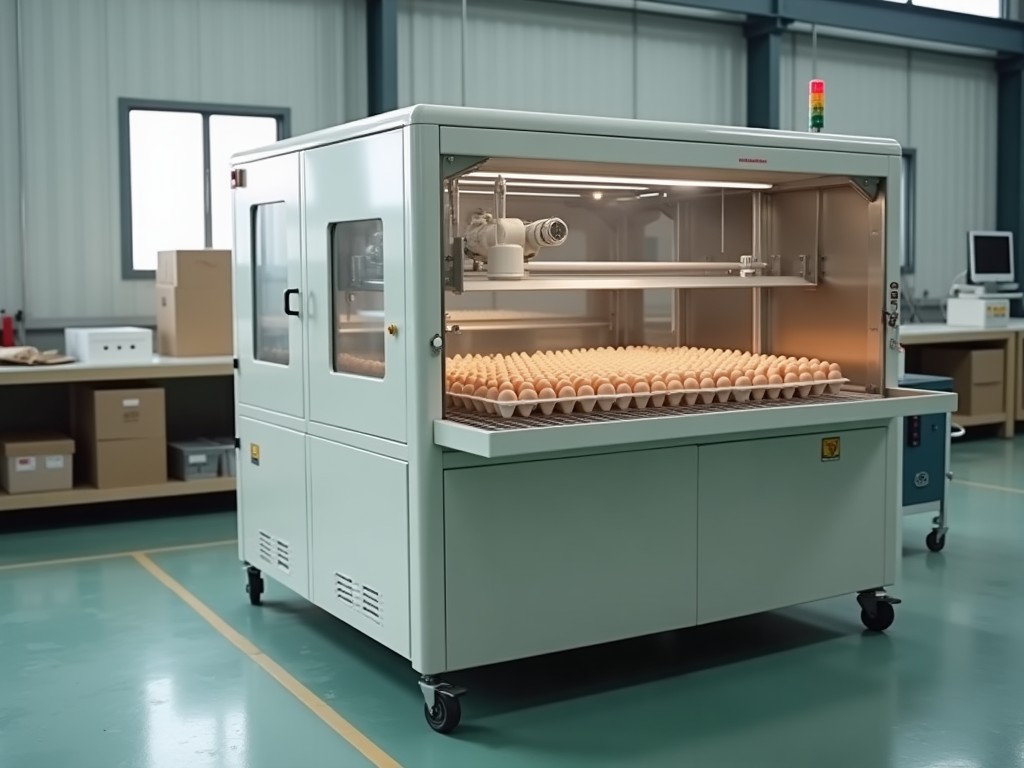
High Speed Egg Printing Machine
Egg printing machines apply food‑grade markings directly onto shells for branding, lot tracking, and regulatory compliance. The system must handle fragile products at high throughput while maintaining precise droplet placement and avoiding shell damage.
Technical Specifications
| Parameter | Typical Value |
|---|---|
| Print head technology | Piezoelectric inkjet, 600 dpi nozzle plate |
| Throughput | Up to 300 eggs /min (single lane), configurable to 600 eggs /min with dual lane |
| Ink type | Food‑grade, UV‑curable, ISO 22000 certified |
| Conveyor speed range | 0.1–0.6 m /s, servo‑driven with closed‑loop tension control |
| Vision system | 2‑camera line‑scan for orientation detection, ±0.2 mm positioning accuracy |
| Power supply | 380 V 3‑phase, 5 kW average consumption |
| Footprint (L×W×H) | 2200 mm × 900 mm × 1500 mm (including safety guards) |
Key Features
- Gentle egg handling via soft‑touch grippers and low‑vibration transfer reduces breakage to <0.1 % at rated speed.
- Modular ink cartridge system allows quick change between colors or UV‑curable formulations without downtime.
- Integrated cleaning station performs automated flush and wipe cycles between batches, meeting FDA 21 CFR 178.3570.
- Real‑time print quality monitoring uses reflectance sensors to detect missed or misaligned marks, triggering reject divert.
- Open‑protocol Ethernet/IP interface enables seamless connection to MES or traceability software.
Applications in Food Processing
Poultry processors use egg printing to embed farm‑specific codes, best‑before dates, or logos directly onto shells, eliminating the need for secondary labeling steps that can introduce contaminants. The non‑contact inkjet method preserves shell integrity, which is critical for hatchery operations where even micro‑cracks affect viability. Additionally, UV‑curable inks cure instantly under low‑intensity lamps, allowing immediate packing without drying delays.
Quality Control Philosophy
Each machine undergoes a three‑stage validation: (1) mechanical run‑in to verify conveyor alignment and gripper force distribution, (2) inkjet droplet analysis using high‑speed imaging to confirm volume consistency within ±2 %, and (3) end‑of‑line print inspection on a sample batch of 5 000 eggs to assess legibility under various lighting conditions. These steps are documented in a factory test report that accompanies every shipment.
Customization Options
- Number of lanes (single, dual, or quad) to match line speed requirements.
- Ink color selection from a palette of FDA‑approved pigments, including black, red, blue, and edible metallic shades.
- Integration of barcode or DataMatrix encoding modules for automated traceability.
- Alternative conveyor materials (stainless steel 316L or food‑grade polymer) for specific sanitation regimes.
- Extended safety guarding and wash‑down enclosures for environments requiring IP65 rating.
Frequently Asked Questions
- Can the printing speed be adjusted for different egg sizes? Yes, the servo‑driven conveyor and vision system automatically adapt grip timing based on real‑time size detection, allowing seamless switching between small (quail) and large (goose) eggs without mechanical changeover.
- What information is required before a quotation? Required details include target eggs per minute, desired print content (text, logo, code), ink color preference, and any integration needs with existing MES or packaging lines.
- How is print quality verified during operation? Inline reflectance sensors continuously monitor mark contrast; if a threshold is crossed, the system triggers a reject pulse and logs the event for traceability.
- What maintenance intervals are recommended? Daily wipe‑down of the print head, weekly deep clean of the ink pathways, and monthly inspection of gripper wear parts are standard; exact intervals depend on operating shift length and ink type.
- Are spare parts available internationally? Critical components such as piezo print heads, servo drives, and vision cameras are stocked at regional service centers; lead times are typically 2–4 weeks for express shipment.
Next Steps
To discuss how this egg printing solution can be adapted to your production line, please contact our technical team with your line layout and throughput goals. We will provide a feasibility study, layout drawing, and detailed quotation within five business days.



