Factory Direct Egg Traceability Coding System
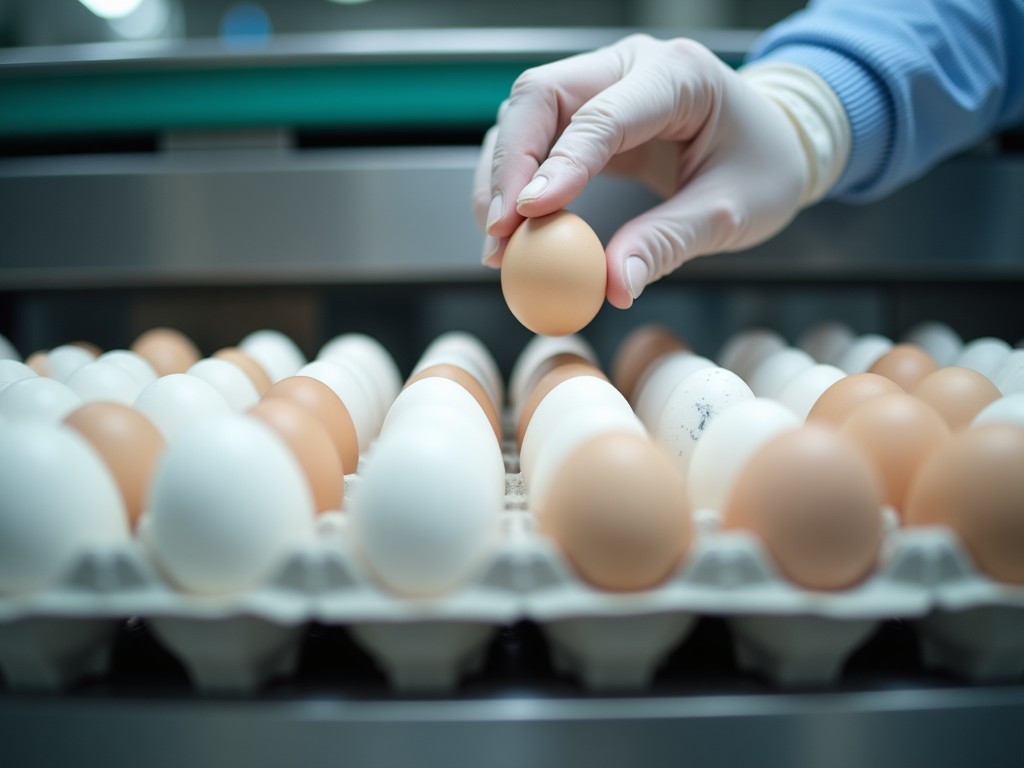
Factory Direct Egg Traceability Coding System
Overview
The system applies machine‑readable codes directly onto eggshells at the point of production, enabling end‑to‑end traceability without secondary labels or packaging modifications. By integrating coding into the existing processing line, manufacturers eliminate extra handling steps that can damage fragile shells and reduce the risk of misreads during downstream scanning.
Coding Technology
A continuous‑flow piezo inkjet head deposits food‑grade, UV‑curable ink droplets of 30 picoliter volume, producing a 0.5 mm‑high alphanumeric matrix that remains legible after washing, grading, and refrigeration. The ink formulation complies with FDA 21 CFR 175.300 and EU 10/2011 for direct food contact, ensuring no migration of contaminants onto the edible interior.
System Architecture
The core hardware consists of a synchronized belt conveyor, a high‑speed vision sensor for egg orientation, the inkjet coding module, and a programmable logic controller that coordinates print timing based on real‑time speed feedback. A lightweight industrial PC runs the traceability software, which assigns unique identifiers, stores production metadata, and forwards data to plant MES or ERP systems via OPC UA or REST APIs.
Key Technical Specifications
| Parameter | Typical Value |
|---|---|
| Print height | 0.5 mm |
| Maximum line speed | 180 eggs/min (up to 30 m/min belt) |
| Ink type | UV‑curable, food‑grade pigment |
| Power consumption | 120 W (standby 15 W) |
| Operating temperature | 5 °C – 40 °C |
| Maintenance interval | 200 h (printhead cleaning) |
Integration and Compatibility
The controller accepts discrete I/O signals for start/stop, speed encoder pulses, and fault indications, allowing seamless retrofit into existing grading or packing lines. Data output follows GS1‑128 or ISO/IEC 15434 formats, compatible with most traceability platforms; optional middleware can translate to proprietary ERP schemas without altering line hardware.
Applications in Egg Production
Traceability is critical in the egg industry because shells are porous, susceptible to micro‑cracks, and subject to strict recall regulations in markets such as the EU, USA, and Japan. By coding each egg, producers can rapidly isolate affected batches, reduce waste during recalls, and provide consumers with verifiable information about farm origin, lay date, and feed program.
- High‑volume inline grading lines (up to 30 000 eggs/h)
- Free‑range and organic certification tracking
- Retail‑ready carton labeling elimination
Customization Options
Print head configuration can be scaled from single‑line to triple‑line arrays to accommodate varying code lengths or multi‑language requirements. Conveyor modules are available in 0.5 m increments, with adjustable side guides to handle egg sizes ranging from 40 mm to 55 mm diameter. Software licenses include optional modules for blockchain‑based audit trails or real‑time dashboard analytics.
Quality Assurance and Validation
Before shipment, each system undergoes a 48‑hour endurance test at line speed, verifying code readability after simulated washing, drying, and cold‑storage cycles. Adhesion strength is measured per ASTM D3359, targeting a minimum of 4B (no ink removal) under 90 % relative humidity. All food‑contact components carry ISO 22000 certification, and the manufacturing facility follows ISO 9001:2015 quality‑management protocols.
FAQ
Can the system handle different egg sizes without retooling?
Yes. Adjustable guide rails and interchangeable throat plates accommodate diameters from 40 mm to 55 mm; changeover takes under five minutes.
What information is required before quotation?
Line speed, egg size range, desired code format (numeric, alphanumeric, GS1), and any integration points (MES, PLC) help us size the conveyor and select the appropriate inkjet head.
How is quality inspected during production?
An integrated vision station validates code contrast and position on each egg, rejecting any item that falls below a 0.3 mm print height threshold or shows smudging.
What is the typical production lead time?
Standard configurations ship within 6‑8 weeks after receipt of purchase order; customized conveyor lengths or software extensions may extend this to 10‑12 weeks.
Can we arrange a sample trial?
Yes. We can provide a portable demo unit for up to two weeks of on‑site evaluation, including installation support and operator training.
Get a Quote
To discuss how a factory‑direct egg traceability coding system can be tailored to your processing line, please use the contact form below or email our technical sales team. We will respond with a detailed proposal, including layout drawings, performance guarantees, and implementation timeline.
Request a Quote


