Factory Direct Automatic Egg Tray Cleaner
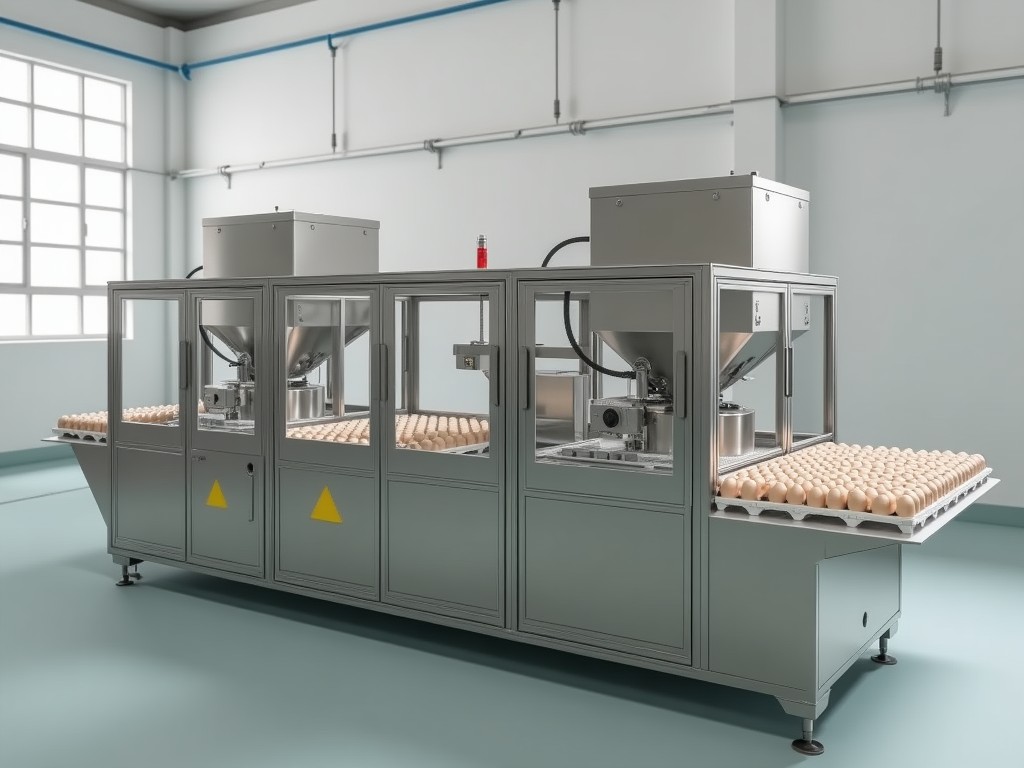
Factory Direct Automatic Egg Tray Cleaner
The equipment automates the removal of organic residues, feathers, and microbial contaminants from plastic or pulp egg trays before they are returned to the laying house or packing line. A closed‑loop spray system delivers heated water and approved sanitizing agents through precision nozzles, while rotating brushes agitate the tray surface to dislodge adhered particles. After washing, a high‑velocity air knife removes excess moisture, achieving a dry tray ready for reuse within a single cycle.
Technical Specifications
| Parameter | Typical Value |
|---|---|
| Tray throughput | Up to 1,200 trays per hour (adjustable) |
| Cycle time | 18‑22 seconds per tray (including wash, rinse, and air‑dry) |
| Installed power | 3.5 kW (motor) + 1.2 kW (heater) |
| Water consumption | 4‑6 L per tray (recirculation rate 85 %) |
| Control system | PLC with touch‑screen HMI, IP65 rated |
| Overall dimensions (L×W×H) | 2,200 mm × 950 mm × 1,600 mm |
| Net weight | 380 kg |
Cleaning Mechanism and Materials
Spray nozzles are arranged in a staggered pattern to ensure overlapping coverage, delivering water at 2.0‑2.5 bar and temperature up to 65 °C. The brush module uses food‑grade polypropylene bristles mounted on a stainless‑steel shaft that rotates at 150 rpm, providing mechanical agitation without damaging tray geometry. All wetted parts are constructed from AISI 304 stainless steel, which resists corrosion from chlorinated sanitizers and facilitates cleaning-in-place (CIP) procedures.
An integrated air‑knife system supplies filtered, oil‑free air at 0.8 MPa to blow off surface water, achieving a residual moisture level below 0.2 % w/w. Sensors monitor spray pressure, water temperature, and airflow; deviations trigger automatic shutdown and alert the operator via the HMI.
Typical Installations and Value Proposition
In high‑volume egg processing plants, the cleaner replaces manual soaking and scrubbing, reducing labor requirements by up to 70 % and eliminating variability in cleaning efficacy. By returning trays to a hygienic state, the system lowers the risk of cross‑contamination between flocks, supporting compliance with ISO 22000 and local biosecurity regulations. The closed‑loop water circuit minimizes fresh‑water intake, cutting utility costs in regions with water‑usage restrictions.
Facilities that operate multiple laying houses benefit from the modular design: additional wash stations can be added in-line without redesigning the conveyor layout, allowing capacity scaling as flock size expands.
Optional Configurations
- Adjustable tray width guides (100 mm‑300 mm) to accommodate different tray formats
- Chemical dosing pump for precise injection of peracetic acid or chlorine dioxide
- UV‑C module for post‑dry surface disinfection (optional)
- Data logging package with Ethernet/IP connectivity for MES integration
- Stainless‑steel AISI 316 upgrade for highly corrosive environments
Quality Assurance and Testing
Each unit undergoes a factory acceptance test that verifies spray coverage uniformity using fluorescent tracer particles, measures residual ATP on cleaned trays, and confirms cycle time consistency across a 100‑tray run. Material certificates for stainless steel and food‑grade polymers are provided with the shipment. Prior to dispatch, the cleaner is subjected to a 48‑hour continuous operation test to validate thermal stability of the heating element and wear resistance of the brush bearings.
Spare parts are stocked with standardized dimensions (e.g., M8 mounting bolts, 6 mm‑diameter nozzle orifices) to simplify maintenance and reduce downtime.
Frequently Asked Questions
Can the cleaner handle both plastic and pulp trays?
Yes. The adjustable guide system and non‑abrasive brushes accommodate the dimensional tolerances of both material types without causing deformation or excessive wear.
What information is needed for a quotation?
Required details include tray dimensions (length, width, height), desired throughput (trays per hour), water supply pressure and temperature, and any specific sanitizing agents mandated by your quality program.
Is integration with an existing conveyor line possible?
The cleaner is supplied with adjustable inlet and outlet rollers that can be set to match line speeds ranging from 0.2 m/s to 0.6 m/s. Mounting brackets are provided for side‑load or overhead installation.
What is the typical lead time for a standard unit?
Standard configurations are built within 4‑6 weeks after receipt of the technical data sheet and purchase order. Custom options may extend the schedule by 1‑2 weeks depending on component availability.
Next Steps
To obtain a detailed quotation or discuss site‑specific requirements, please contact our engineering team using the form below. Providing the tray specifications and expected production volume will enable us to propose the optimal configuration and provide a firm delivery schedule.
Request Quote


