Egg Tray Washing Machine For Egg Packing Lines
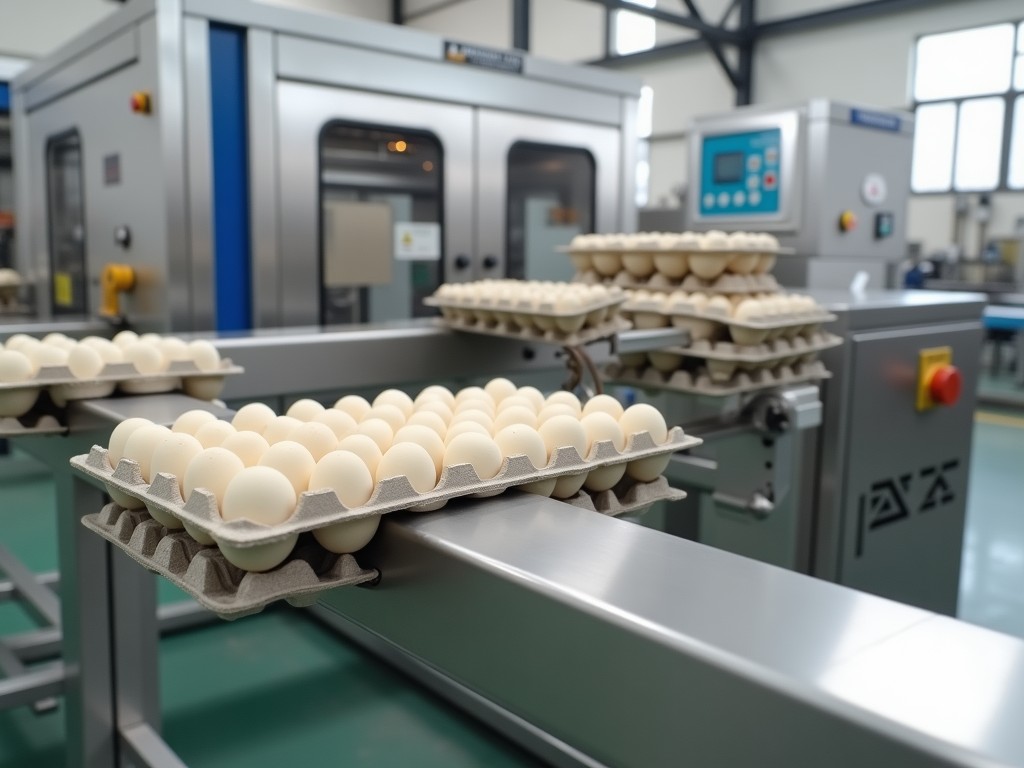
Egg Tray Washing Machine for Egg Packing Lines
This equipment cleans reusable polymer or pulp egg trays before they enter the packing line, removing debris, albumin residues, and microorganisms that could affect hatchery hygiene.
It integrates directly after the tray accumulator and before the loading robot, providing a continuous flow of sanitized trays at line speed.
Working Principle
Trays are conveyed on a stainless‑steel belt through a series of spray zones where heated water and approved detergent are applied at controlled pressure.
After washing, a rinse stage removes detergent traces, followed by an optional air‑knife or hot‑air dryer that reduces surface moisture to <5 % w/w before the trays reach the packing station.
Key Technical Characteristics
- Wash tunnel length: 1.2 m to 2.5 m, adjustable to match tray throughput.
- Spray pressure range: 0.15 MPa to 0.6 MPa, regulated by a proportional valve.
- Water temperature control: 45 °C to 65 °C with ±1 °C stability.
- Conveyor speed: 0.1 m/s to 0.4 m/s, synchronized with line rate via encoder feedback.
- Motor drive: 1.5 kW IE3 rated, sealed to IP66.
- Materials: frame and contact surfaces AISI 304 stainless steel; nozzles PEEK or PTFE for chemical resistance.
Typical Specification Table
| Parameter | Typical Value | Note |
|---|---|---|
| Maximum tray width | 320 mm | Customizable to 350 mm on request |
| Maximum tray length | 540 mm | Accommodates most poultry‑egg tray formats |
| Installed power | 2.2 kW (including pump and dryer) | Three‑phase 380 V, 50 Hz |
| Water consumption | 9 L per tray (average) | Depends on spray time and pressure settings |
| Noise level | ≤78 dB(A) at 1 m | Measured with enclosure doors closed |
Applications in Egg Packing Lines
In a typical packing line, trays are reused up to 30 cycles before replacement. Residual egg white can promote bacterial growth and cause uneven sealing of cartons.
By installing a washing machine directly upstream of the carton loader, the line achieves a consistent microbial load reduction of >3 log CFU per tray, which helps meet hatchery biosecurity standards without adding manual labor.
The compact footprint allows retrofit into existing lines where space between the tray stacker and the loading robot is limited to 800 mm.
Customization Options
- Adjustable nozzle layout for different tray geometries (round, oval, square).
- Optional UV‑C disinfection module (254 nm, 1 mJ/cm² dose) for additional pathogen control.
- Choice of drying method: heated air (up to 70 °C) or centrifugal air‑knife.
- Control interface: PLC with touchscreen HMI or hard‑wired relay panel.
- Enclosure rating: IP54 standard, upgradeable to IP65 for wash‑down environments.
Quality Control Philosophy
Each unit undergoes a factory acceptance test that verifies spray uniformity using a calibrated dye‑trace method, confirming coefficient of variation <8 % across the belt width.
Material traceability is maintained for all stainless‑steel components, and welds are inspected per ASME Section IX standards.
Before shipment, a functional run‑test at line speed validates that moisture content of trays after drying remains below the threshold that could cause carton adhesion issues.
Frequently Asked Questions
Q: Can the machine be integrated with an existing PLC?
A: Yes, the unit provides discrete I/O (start, stop, fault) and optional Modbus TCP interface for seamless connection to line controllers.
Q: What information is required for a quotation?
A: Tray dimensions (width, length, height), material (polymer or pulp), desired throughput (trays per hour), and any special requirements such as UV‑C or specific drying method.
Q: Are spare parts readily available?
A: Critical wear items (nozzles, belts, seals) are stocked as standard kits; lead time for replacement is typically 5–7 business days.



