China Egg Farm Automation Equipment
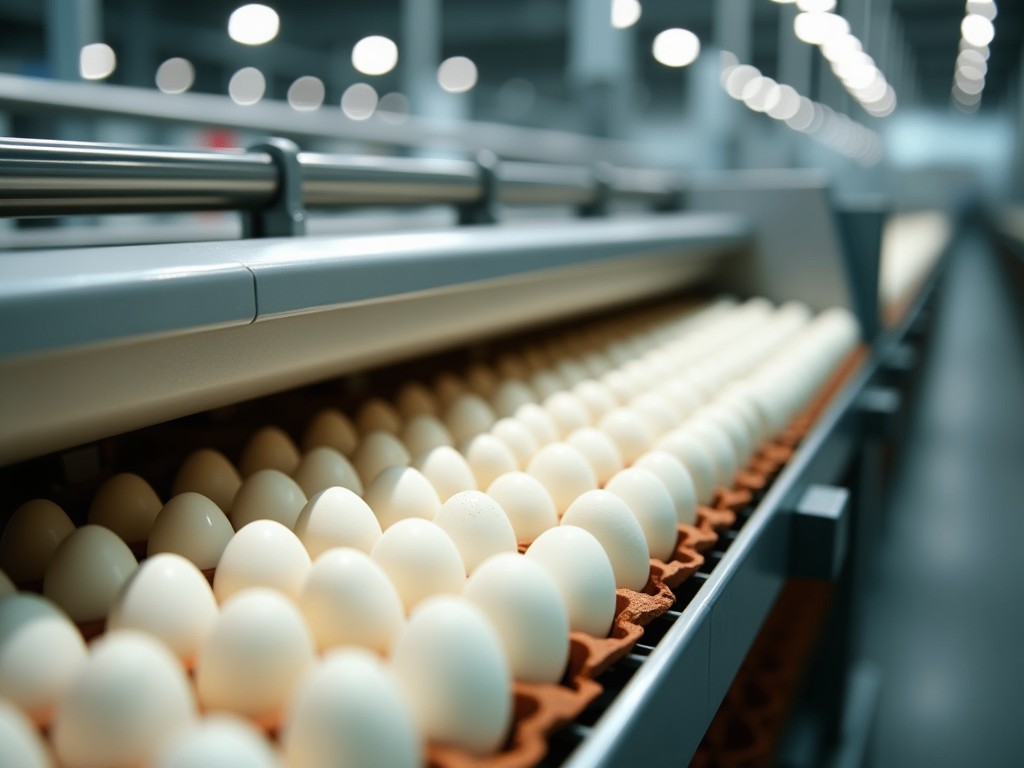
China Egg Farm Automation Equipment
Automation systems for egg farms integrate conveying, sorting, grading, and packaging functions into a continuous line that reduces manual handling and improves traceability from lay‑to‑pack.
Key Functional Modules
- Automatic egg collection conveyors with soft‑touch belts to minimize shell damage.
- Vision‑based grading units that classify eggs by weight, shape, and shell integrity at rates up to 30,000 pieces per hour.
- Sanitary washing and drying stations employing recirculating water filtration and HEPA‑filtered air flow.
- Robotic packing cells capable of placing eggs into cartons, trays, or bulk containers with programmable layer patterns.
- Data acquisition software that logs production metrics, enables remote monitoring, and supports predictive maintenance alerts.
Technical Specifications
| Parameter | Typical Range | Notes |
|---|---|---|
| Conveyor speed | 0.2–1.5 m/s | Adjustable via VFD; soft start/stop to reduce impact. | Grading accuracy | ±2 g weight tolerance | Based on load‑cell calibration; repeatability <0.5 g. |
| Washing temperature | 45–55 °C | Controlled by PID loop; water reuse >80 %. |
| Power consumption | 15–30 kW (depending on line length) | Measured at full load; includes motors, drives, and controls. |
| Footprint | 12–25 m² per 10 k‑egg/h module | Modular design allows linear or L‑shaped layout. |
Operating Principles
Eggs are first transferred from nesting belts to a sanitized inlet conveyor where a low‑vibration belt prevents micro‑cracks. Subsequent stations use servo‑driven diverters to route each egg to the appropriate grading lane based on real‑time sensor feedback.
After grading, eggs enter a spray‑wash chamber where nozzles deliver a controlled flow of alkaline solution; excess liquid is removed by air knives before the drying tunnel, which maintains a dew point below 5 °C to avoid condensation on shells.
The final packing stage employs a six‑axis robot equipped with a vacuum gripper; placement patterns are programmed via a PLC and can be changed without mechanical retooling, supporting multiple carton sizes on the same line.
Applications in Egg Production
Layer farms benefit from reduced labor dependency because the automation line handles the repetitive tasks of collection, washing, and packing, allowing workers to focus on flock health and feed management.
Integrated data capture provides traceability records required by export markets, linking each carton to flock ID, lay date, and processing timestamps, which supports compliance with ISO 22000 and BRCGS standards.
By minimizing manual contact, the system lowers the risk of microbial cross‑contamination, a critical factor for farms targeting premium or organic egg segments where shelf life and safety certifications are decisive purchasing criteria.
Customization Options
- Adjustable lane width for specialty eggs (e.g., quail, duck) ranging from 30 mm to 55 mm.
- Optional UV‑C disinfection module post‑wash for additional pathogen reduction.
- Choice of stainless steel grades (304 for standard corrosion resistance, 316L for high‑salinity environments).
- Software modules for predictive maintenance, OEE calculation, and ERP integration via OPC UA.
- Packaging adaptations for eco‑friendly cartons, including variable depth and insert slots for labeling.
Quality Assurance
Each module undergoes factory acceptance testing that includes cycle‑run validation at 110 % of rated capacity, leak testing of wash chambers, and verification of vision system calibration against NIST‑traceable standards.
Material traceability is maintained from raw steel receipt to final assembly, with mill certificates retained for structural components and food‑grade certifications for all contact surfaces.
Warranty terms typically cover 24 months for mechanical parts and 12 months for control electronics, with optional extensions available based on service agreement.



