Poultry Egg Packing Machine In Kenya
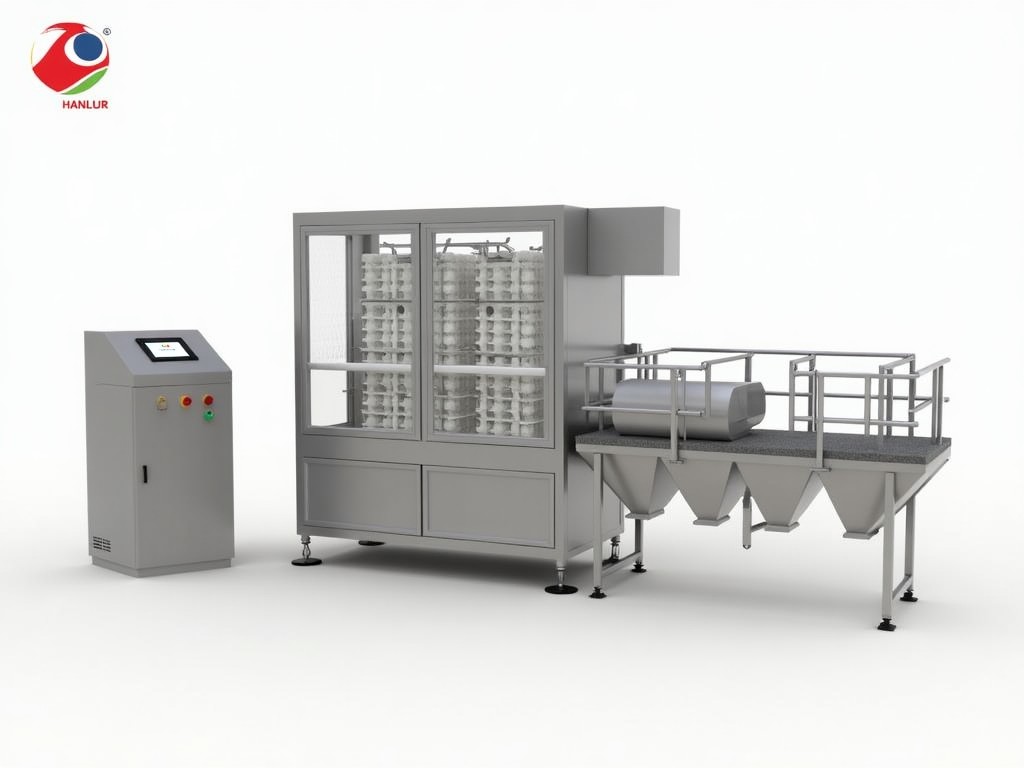
Poultry Egg Packing Machine for Kenya
A poultry egg packing machine automates the transfer of eggs from collection belts to standardized trays or cartons, performing gentle handling, orientation, and counting to minimize breakage.
In Kenyan poultry operations, where farm sizes range from smallholder units to medium‑scale integrators, manual packing introduces variability in product quality and increases labor cost, especially during peak lay periods.
Typical throughput capacities span 5,000 to 30,000 eggs per hour, with lane configurations adjustable from two to six to match farm output and packaging requirements.
Key Technical Specifications
| Parameter | Typical Value | Notes / Customization |
|---|---|---|
| Egg size range (mm) | 40 – 63 | Adaptable to local breeds and exotic lines |
| Lane count | 2 – 6 | Configurable per production line |
| Packing speed (eggs/hour) | 5,000 – 30,000 | Variable via servo drive settings |
| Power consumption (kW) | 1.5 – 4.5 | Depends on lane count and auxiliary modules |
| Overall dimensions (L×W×H, mm) | 2,200 × 1,200 × 1,500 | Footprint adjustable for limited spaces |
| Contact material | Stainless steel 304 | Food‑grade, corrosion resistant |
| Control system | PLC with HMI touchscreen | Recipe storage, fault diagnostics |
Operational Principles
Eggs enter the machine on a low‑speed, cushioned belt that reduces impact and maintains orientation.
An integrated candling station uses LED back‑lighting and sensors to detect cracks, blood spots, or misshapen shells; defective items are diverted to a reject chute.
Remaining eggs pass through a weighing/grading module that assigns each egg to a size class, triggering lane‑diverting gates driven by precision servos.
At the packing station, pneumatic or mechanical pushers place eggs into pre‑formed trays or cartons at a rate synchronized with the lane flow, ensuring uniform layering.
All contact surfaces are designed for quick disassembly and CIP (clean‑in‑place) compliance, supporting biosecurity protocols common in Kenyan poultry farms.
Applications in the Kenyan Poultry Industry
Export‑oriented farms must meet strict quality thresholds; automated packing reduces human‑induced variability, helping achieve consistent grade A standards required by regional markets.
Labor scarcity during peak laying cycles drives demand for equipment that can operate continuously with minimal supervision, lowering dependence on seasonal workers.
The machine’s adjustable infeed height allows integration with existing barn conveyor systems, avoiding costly layout modifications.
Stainless‑steel construction and sealed drives tolerate high ambient temperatures and dusty environments typical of open‑side poultry houses.
Easy‑clean design supports routine sanitation schedules, reducing risk of cross‑contamination between flocks.
Customization Options
- Lane configuration: 2, 4, or 6 lanes; adjustable spacing for different tray sizes.
- Packing format: standard 30‑egg trays, 12‑egg cartons, or bulk case loaders.
- Infeed height: modular risers to match collection belt elevation from 800 mm to 1,200 mm.
- Integrated cleaning system: spray nozzles and drainage for automated CIP cycles.
- Data logging: Ethernet‑enabled PLC output for production traceability and OEE monitoring.
- Remote monitoring: optional IoT gateway for real‑time alerts and performance dashboards.
- Enclosure rating: IP54 for general use; IP65 available for wash‑down zones.
Quality Assurance & Testing
Each unit undergoes a factory run‑test using food‑grade egg simulators; breakage rate is measured and must stay below 0.1 % under nominal load.
Hygiene verification includes swab analysis of contact surfaces after a CIP cycle, confirming absence of residual organic matter.
Electrical safety is validated against IEC 60204‑1 standards, with insulation resistance and earth continuity checks documented.
Where applicable, machines carry CE marking; documentation packs include Declaration of Conformity and user manuals in English.
Frequently Asked Questions
Q: Can the machine be adapted to handle both brown and white eggs?
A: Yes, the grading module uses weight and size, not shell colour, so both varieties are processed on the same line.
Q: What information is needed to prepare a quotation?
A: Required details include target eggs per hour, preferred tray or carton size, infeed belt height, and any optional modules such as cleaning or data logging.
Q: How is the machine protected during overseas shipment to Mombasa?
A: Units are packed in corrosion‑inhibiting film, placed on sturdy pallets, and secured with strapping; optional wooden crates are available on request.
Q: What is the typical lead time for a standard configuration?
A: Standard two‑lane models usually ship within 6‑8 weeks after receipt of purchase order and technical confirmation.
Next Steps
To discuss how this packing solution can integrate with your specific egg handling line, please provide your production details.



