Oem Automatic Egg Packing Machine Manufacturer
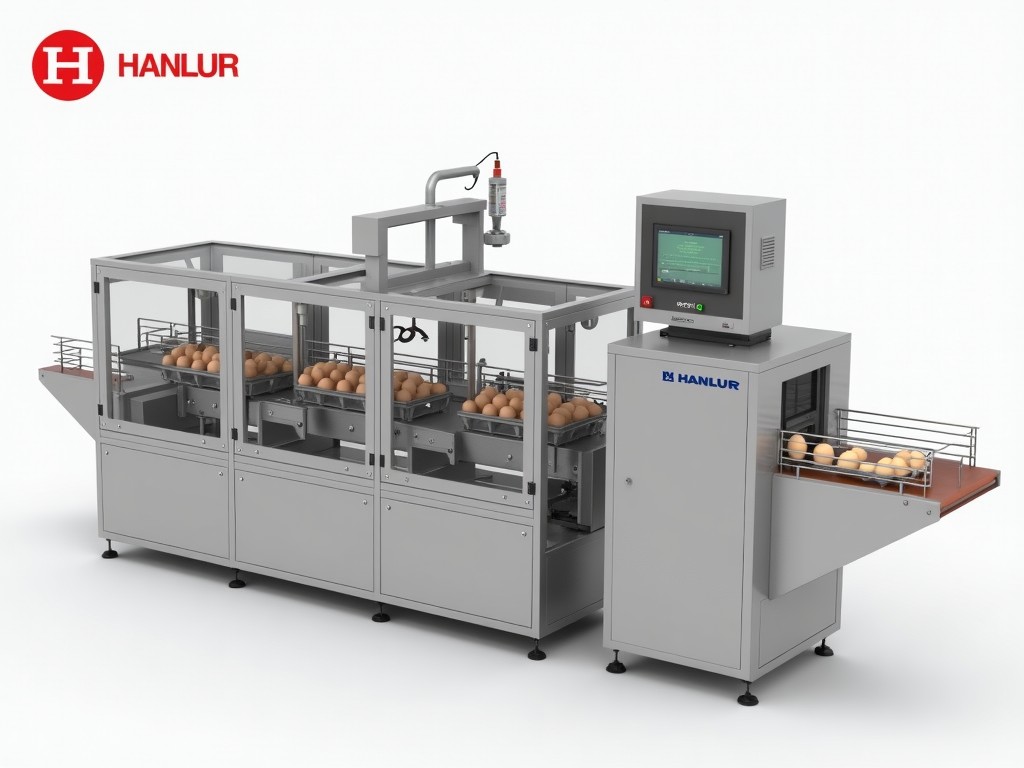
OEM Automatic Egg Packing Machine Manufacturer
An automatic egg packing machine integrates feeding, orientation, counting, and carton sealing into a single continuous line. It is designed to handle fragile shells while maintaining high throughput, typically ranging from 180 to 300 eggs per minute depending on model and configuration.
Core subsystems include a vibratory bowl feeder that aligns eggs point‑down, a vision‑guided rotary orientator that corrects any mis‑orientation, a servo‑driven counting mechanism that batches eggs into preset quantities, and a hot‑melt glue or tape sealing unit that closes the cartons. Each module is synchronized via a PLC with adjustable speed ramps to prevent shell damage during acceleration or deceleration.
Frames are constructed from AISI 304 stainless steel for corrosion resistance, with critical contact surfaces polished to Ra 0.8 µm to facilitate cleaning. Drive motors are IE3 efficiency class, rated for continuous operation at 400 V three‑phase, and gearboxes are sized for a 1.5 service factor to accommodate shock loads from sudden stops.
Core Technical Specifications
| Parameter | Typical Value | Customizable Range |
|---|---|---|
| Capacity (eggs/min) | 240 | 180‑300 |
| Motor Power (kW) | 4.5 | 3‑6 |
| Footprint (L×W×H, m) | 2.2×1.0×1.8 | Adjustable per layout |
| Net Weight (kg) | 850 | ±10 % |
Operational Principles
The feeder uses a tuned amplitude vibration to move eggs upward along a helical track, ensuring single‑file presentation. A downstream rotary station equipped with high‑speed cameras detects egg orientation; actuators rotate mis‑aligned eggs within 40 ms to achieve point‑down alignment before counting.
Counting is performed by a servo‑driven paddle that indexes a precise number of eggs into a pocket conveyor. The pocket conveyor transports the batch to a carton former where pre‑formed blanks are erected, filled, and sealed using a thermostatic hot‑melt applicator set at 180 ± 5 °C.
All motions are governed by a modular PLC program that allows recipe changes for different egg sizes (small, medium, large) and carton formats (6‑egg, 12‑egg, 18‑egg) without mechanical adjustments.
Customization Options
- Variable speed drive with programmable acceleration curves.
- Alternative sealing methods: ultrasonic, adhesive tape, or heat‑seal foil.
- Integration with upstream washing and drying lines via standardized communication interfaces (Profibus, Ethernet/IP).
- Optional UV‑C sterilization module positioned after counting.
- Custom cartoning formats: trays, clamshells, or eco‑friendly pulp containers.
Applications in Poultry Processing
In commercial egg processing plants, the machine replaces manual cartoning, reducing labor dependency and improving traceability. By maintaining consistent orientation and gentle handling, it minimizes micro‑cracks that can lead to spoilage during storage.
The equipment is also suited for farm‑based packing operations where space is limited; its compact footprint and modular design allow installation within existing grading lines without major civil works.
For specialty markets such as organic or free‑range eggs, the optional UV‑C stage provides an additional microbial barrier without chemical additives, supporting certification requirements.
Quality Control and Testing
Each unit undergoes a factory acceptance test that includes a 24‑hour run‑at‑rated‑capacity, vibration analysis of critical bearings, and leak testing of pneumatic shells. Dimensional inspection of food‑contact surfaces is performed using a coordinate measuring machine with a tolerance of ±0.02 mm.
After assembly, a sample of packed cartons is subjected to drop testing from a height of 0.5 m to verify seal integrity, followed by a compression test to ensure carton strength meets ISPM‑15 standards for export packaging.
Frequently Asked Questions
Can dimensions be customized to fit an existing line?
Yes, the frame and conveyor lengths can be adjusted in 50 mm increments based on site layout drawings provided during the quotation phase.
What information is required before a quotation?
Required inputs include target eggs per minute, egg size distribution, carton type and size, available power supply voltage, and any upstream/downstream equipment interfaces.
Which materials are available for food‑contact parts?
Standard food‑contact components are made from AISI 304 stainless steel; optional upgrades to AISI 316L or FDA‑approved polymers are available upon request.
How is quality inspected during production?
In‑process checks include vision‑based orientation verification, weight sampling of packed cartons, and seal temperature monitoring. Final inspection is documented in a test report shipped with each unit.
Inquiry and Support
To discuss your specific packing requirements, request a detailed technical proposal, or arrange a virtual factory tour, please use the contact form below. Our engineering team will respond with a preliminary layout and performance estimate within two business days.



