Factory Direct Automatic Egg Tray Packing Machine
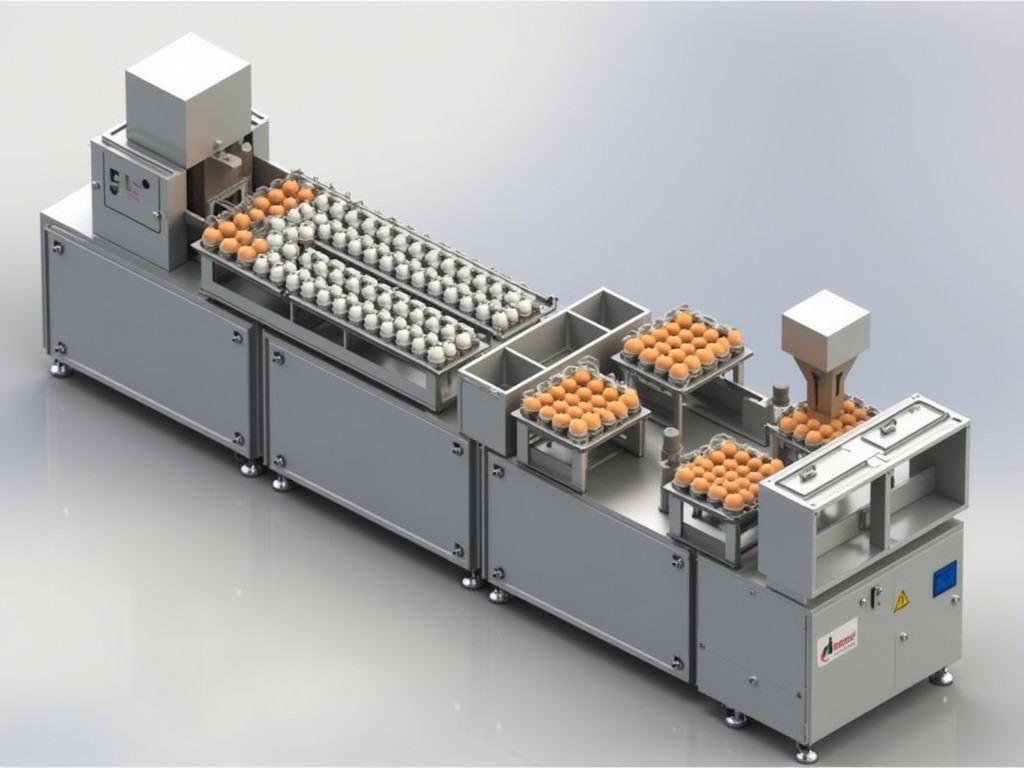
Factory Direct Automatic Egg Tray Packing Machine
Overview
The machine automates the transfer of formed egg trays from the molding line into secondary packaging such as cartons or pallets. It receives trays at a controlled rate, aligns them, and places them into pre‑formed containers with minimal handling. This reduces manual labor, lowers breakage risk, and increases line throughput.
Working Principle
Trays exit the molding conveyor onto a synchronized belt that carries them to a rotary indexing station. At the station, a pneumatic gripper picks each tray, rotates it to the correct orientation, and deposits it into a moving carton feeder. The feeder advances the carton one position after each placement, ensuring consistent fill levels.
All motions are driven by servo motors with programmable acceleration profiles, allowing adjustment for tray size, weight, and carton dimensions without mechanical changeovers.
Technical Specifications
| Parameter | Typical Value | Notes |
|---|---|---|
| Packing speed | 20‑30 trays per minute | Depends on tray weight and carton size |
| Power consumption | 2.5 kW (average) | Three‑phase 380 V, 50/60 Hz |
| Air pressure requirement | 0.6 MPa | Filtered, dry air |
| Machine footprint | 2200 mm × 1200 mm × 1800 mm (L × W × H) | Includes control cabinet |
| Tray size range | Length 180‑300 mm, Width 120‑200 mm, Height 20‑35 mm | Adjustable guides |
| Carton size range | Length 250‑400 mm, Width 180‑300 mm, Height 100‑250 mm | Customizable feeder |
| Construction material | Food‑grade stainless steel 304, 1.5 mm thickness | Corrosion resistant, easy to clean |
Key Features
- Servo‑driven indexing with programmable acceleration for gentle tray handling
- Quick‑change guide rails allow size changeover in under 15 minutes
- Integrated vision system verifies tray presence and orientation before placement
Applications
Egg producers that run high‑volume inline molding lines benefit from automatic packing because it eliminates the bottleneck of manual tray loading into cartons. The machine maintains the line’s takt time, ensuring that the packaging stage does not limit overall output. By reducing direct human contact with trays, it also lowers the chance of contamination, which is critical for food‑grade packaging facilities.
Facilities that pack trays into retail‑ready cartons, bulk pallets, or specialized export containers can adjust the feeder and gripper to match the target package geometry without stopping production.
Customization Options
- Alternative gripper types (vacuum, mechanical) for different tray materials
- Extended conveyor lengths to accommodate upstream buffer zones
- Integration with existing line PLC via Profibus, Ethernet/IP, or Modbus TCP
- Optional sterilization module (UV or hot air) placed before packing
- Custom paint colors or food‑grade coating for specific plant standards
Quality Control and Testing
Each unit undergoes a factory acceptance test that verifies packing speed, positional accuracy (±2 mm), and emergency stop response time (<150 ms). The test includes a 2‑hour continuous run with a representative tray mix to evaluate wear on guides and grippers. Documentation of test results, material certificates, and electrical schematics is provided with the shipment.
Preventive maintenance intervals are based on operating hours; the design includes quick‑release pins for guide rails and tool‑less access to the servo drive compartment, facilitating routine checks without prolonged downtime.
Frequently Asked Questions
Can the machine handle both paper pulp and plastic trays?
Yes. The gripper force and suction levels are adjustable via the HMI, allowing the same unit to process pulp trays (typically 0.15‑0.25 kg each) and thicker plastic trays (up to 0.4 kg) without mechanical changes.
What information is required for a quotation?
To prepare a quote we need the target tray dimensions (length, width, height), material type, desired packing speed, carton or pallet specifications, and any required interfacing signals (e.g., line start/stop, fault relay). Providing a layout of the upstream molding line helps us size the conveyor and positioning units accurately.
How are export shipments protected?
The machine is disassembled into transport‑friendly modules, each wrapped in corrosion‑inhibiting film and placed in a wooden crate with foam edge protection. Crates are marked with handling instructions and undergo a final inspection before loading.
Ready to discuss your line?
Contact our technical team to arrange a virtual review of your current packing station. Provide your line layout and tray specifications, and we will return a concept drawing with cycle time estimates and installation requirements.
Request a Quote


