Egg Tray Packing Machine For 10000 Eggs Per Hour
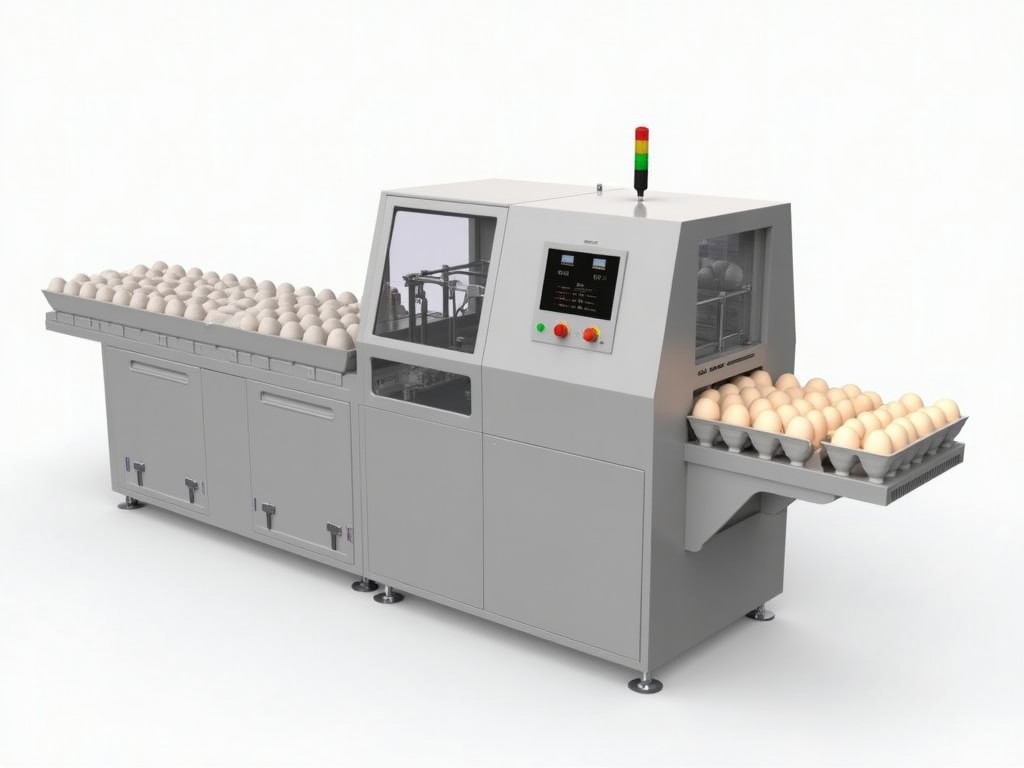
Egg Tray Packing Machine for 10,000 Eggs per Hour
This machine is designed to continuously form, load, and seal egg trays at a rate suited for high‑volume hatcheries and grading lines. The 10,000‑egg‑per‑hour specification assumes standard medium‑size eggs (≈50‑58 g) and a tray pitch of 30 mm, which determines the required cycle time and conveyor speed.
Technical Overview
The core consists of a servo‑driven indexing rotary table that positions pre‑formed tray blanks, a vacuum‑assisted pick‑and‑place head that deposits eggs into each cavity, and a heat‑seal station that applies a thermoplastic film. All motions are synchronized via a PLC with EtherCAT bus, allowing repeatable placement within ±0.5 mm.
Drive power is distributed across three independent axes: tray rotation (0.75 kW), egg placement (1.2 kW vertical), and film sealing (0.9 kW pneumatic). The machine frame uses 304 stainless steel tubing with a 2 mm wall thickness, providing corrosion resistance for wash‑down environments.
Key Specifications
| Parameter | Typical Value | Notes / Customization |
|---|---|---|
| Throughput | 10,000 eggs/hr | Based on 30 mm tray pitch; adjustable via gear ratio |
| Egg Size Range | 45‑63 g (small to jumbo) | Adjustable vacuum suction and gripper fingers |
| Tray Blank Size | 300 × 200 mm (standard) | Custom widths up to 350 mm available |
| Sealing Temperature | 140‑160 °C (film dependent) | PID‑controlled heated roller |
| Installed Power | 3.5 kW (peak) | Three‑phase 380 V, 50/60 Hz |
| Machine Footprint | 2.2 m × 0.9 m × 1.8 m (L×W×H) | Modular extensions for upstream/downstream conveyors |
Operating Principle
Eggs are supplied from a vibrating feeder that aligns them singly onto a pocketed conveyor. As the rotary table advances, a blank tray is positioned beneath the placement head; vacuum cups grasp each egg and release it into the corresponding cavity with a dwell time of 120 ms to ensure gentle handling. After filling, the tray moves to the sealing station where a pre‑heated film is pressed and cooled, forming a hermetic seal. The sealed tray then exits onto a out‑feed belt for accumulation or case packing.
Cycle time is governed by the slowest of the three axes; at nominal settings the placement axis completes a full pick‑place sequence in 0.36 s, yielding the target 10,000 egg/hr rate (≈10 eggs per second). Safety interlocks halt motion if tray misalignment or egg jam is detected, reducing product waste and mechanical shock.
Applications and Industry Fit
Poultry processing plants that integrate egg grading, washing, and packing benefit from a continuous tray‑forming system that eliminates manual loading bottlenecks. The machine’s stainless‑steel construction and IP65‑rated drives meet the hygiene standards required for wet‑processing zones, while the adjustable tray size accommodates both retail‑ready 30‑egg trays and bulk 360‑egg pallet trays used in distribution centers.
Hatcheries that require rapid transfer of fertile eggs to incubators use the same platform with a gentler, lower‑vacuum setting to minimize mechanical stress on the embryo. By swapping the sealing module for a simple lid‑apply station, the line can switch between packed and unpacked modes without mechanical re‑tooling.
Customization Options
- Tray material: food‑grade PET, PP, or molded pulp with thickness options from 0.25 mm to 0.40 mm
- Control platform: Siemens S7‑1500 PLC with optional Allen‑Bradley or Mitsubishi equivalents
- User interface: 7‑inch touchscreen HMI with recipe storage for up to 20 tray configurations
- Sanitation features: CIP spray nozzles, quick‑release tool‑free access to vacuum cups and sealing rollers
- Integration kits: synchronous infeed conveyors, out‑feed case packers, and barcode scanners for traceability
Quality and Reliability Considerations
Wear components such as vacuum cups and sealing rollers are made from PTFE‑coated silicone, providing a service life of approximately 2 million cycles under typical load before replacement. The rotary table bearings are sealed, lubricated‑for‑life units rated for 15,000 hours at 30 rpm. Preventive maintenance intervals are based on cycle count rather than calendar time, allowing operators to schedule service during planned production breaks.
Electrical cabinets are rated IP55, with separate compartments for power and signal wiring to reduce electromagnetic interference. All safety circuits comply with EN ISO 13849‑1 PL e, ensuring that a single fault cannot initiate hazardous motion. These design choices aim to minimize unplanned downtime and support a predictable total cost of ownership over a 10‑year lifecycle.
Frequently Asked Questions
| Question | Answer |
|---|---|
| Can the tray dimensions be changed after installation? | Yes, the tray width and pitch are adjustable via interchangeable guide rails and cam plates; no machining is required. |
| What information is needed for a quotation? | Required egg size range, target tray format, facility power supply, and any upstream/downstream equipment to be interfaced. |
| Which materials are available for the tray blanks? | Standard options include PET, PP, and molded pulp; alternative food‑grade polymers can be sourced upon request. |
| How is quality inspected during operation? | In‑line vision sensors verify egg presence and seal integrity; reject actuators divert defective trays to a separate chute. |
| What is the typical production lead time? | Lead time varies with configuration but generally falls between 10‑14 weeks after drawing approval. |
For further details, pricing, or to arrange a technical discussion, please use the contact link below.
Request a Quote or Technical Consultation


