Egg Packing Machine Factory Price
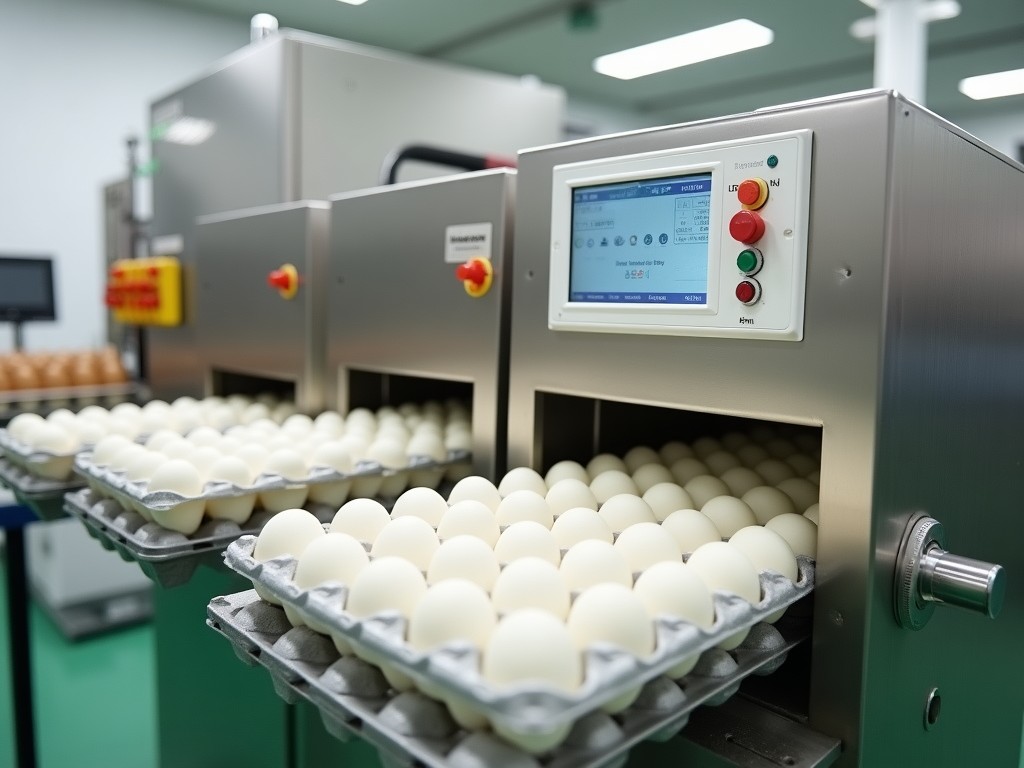
Egg Packing Machine – Factory Price Overview
This section explains the core function of egg packing equipment and why manufacturers publish factory‑level pricing.
Machine Function and Operating Principle
The machine receives loose eggs from upstream washing or grading lines, orients each egg with a gentle vacuum or mechanical picker, and places them into pre‑formed cartons or trays at a controlled rate.
A servo‑driven indexing system moves the carton shuttle while a synchronized placement head deposits eggs one by one, minimizing shock and maintaining shell integrity.
Core Technical Specifications
| Parameter | Typical Value |
|---|---|
| Model series | EPM‑200 to EPM‑800 |
| Capacity (eggs/hour) | 200 – 8000 (depends on lane count) |
| Power consumption | 1.5 – 4.5 kW (motor + controls) |
| Overall dimensions (L×W×H) | 1800 mm × 900 mm × 1500 mm (base model) |
| Net weight | 350 – 620 kg |
| Control system | PLC with HMI touchscreen, optional IEC 61131‑3 programming |
| Primary construction material | Stainless steel 304 for food contact zones, powder‑coated carbon steel frame |
Typical Applications in Poultry Processing
Egg packing machines are installed after grading and before cold storage, where the goal is to transfer sorted eggs into retail‑ready cartons without increasing micro‑crack incidence.
By synchronizing placement speed with conveyor flow, the equipment reduces manual handling labor by up to 80 % and provides consistent carton fill levels that meet retailer weight tolerances.
Facilities processing free‑range, organic, or specialty eggs benefit from adjustable lane widths that accommodate varying egg diameters while maintaining gentle product contact.
Customization Options
- Number of packing lanes: 1 to 8, adjustable via modular shuttle.
- Egg size adaptability: interchangeable grippers for small (30 g) to jumbo (70 g) eggs.
- Integration kits: synchronized infeed/outfeed conveyors, lift‑turn tables, or robotic palletizers.
- Sanitary design: CIP‑spray nozzles, sealed bearings, and easy‑remove trays for daily cleaning.
- Control interface: standard HMI, optional SCADA connectivity, or remote diagnostics via Ethernet.
Quality Assurance and Manufacturing Considerations
Manufacturing follows EN 1672‑2 food machinery hygiene standards; all stainless‑steel components are passivated and welds are inspected with dye‑penetrant testing.
Before shipment, each unit undergoes a functional run‑test with a minimum of 10 000 egg cycles to verify placement accuracy (< 2 mm deviation) and to confirm that cycle time matches the rated capacity.
Documentation includes material certificates, electrical schematics, and a preventive maintenance schedule based on operating hours.
Factory Pricing Information
Factory price refers to the ex‑works cost before taxes, freight, and optional accessories. Final quotation depends on selected lane count, material grade, control upgrades, and any required integration engineering.
To obtain a precise figure, provide the required throughput (eggs per hour), egg size range, and preferred carton dimensions; the supplier will then generate a detailed bill of materials and lead‑time estimate.
Frequently Asked Questions
Can the machine be adapted for different carton styles?
Yes. The placement head can be re‑tooled for standard 6‑egg, 10‑egg, or 12‑egg cartons, and adjustable guides accommodate varying carton widths.
What information is needed for a quotation?
Required data include target capacity (eggs/hour), egg weight range, carton type, layout constraints, and any desired sanitary or automation options.
How is the equipment cleaned between shifts?
CIP spray balls are standard on food‑contact surfaces; removable trays allow manual cleaning, and the frame is designed for wash‑down with mild detergents.



