China Printed Paper Egg Tray Factories
China Printed Paper Egg Tray Factories
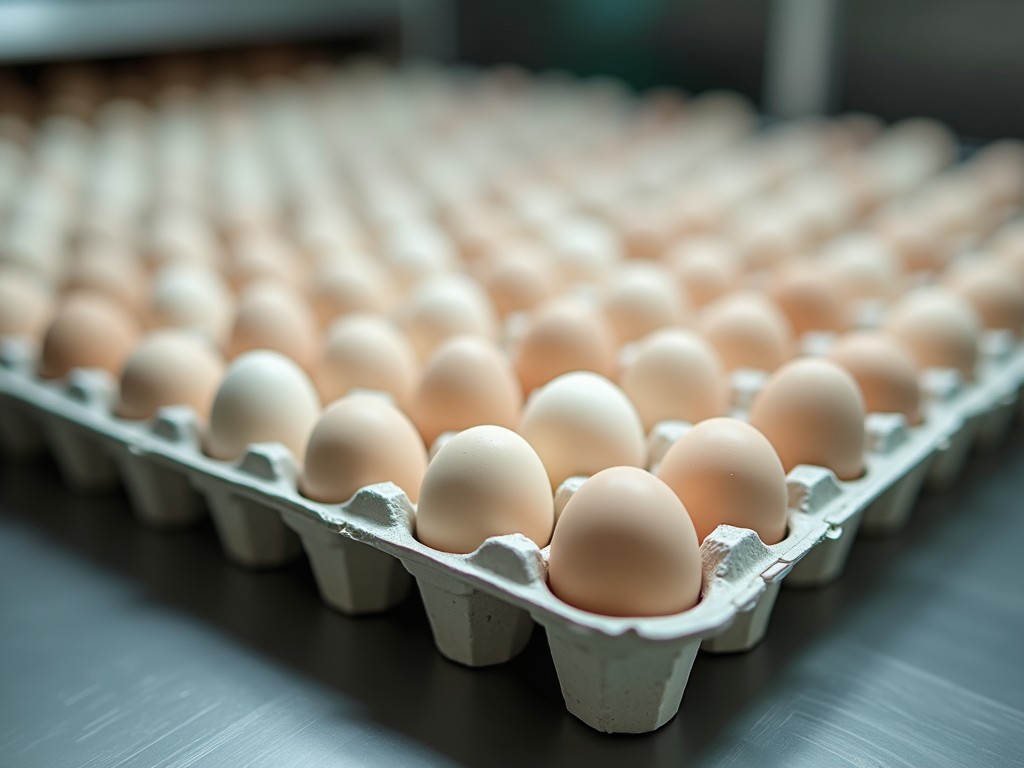
Printed paper egg trays are formed from recycled pulp and molded into cavities that securely hold eggs during transport and storage. The printing process applies food‑safe inks directly onto the tray surface, allowing branding, handling instructions, or product information to be integrated without additional labels.
Material Composition and Pulp Preparation
The base material consists of post‑consumer newspaper, cardboard, or office paper that is soaked, refined, and diluted to a slurry with a consistency of 3‑5 % solids. Additives such as wet‑strength agents (typically polyvinyl alcohol) and sizing agents (often alkyl ketene dimer) are introduced to improve moisture resistance and dimensional stability.
Molding and Forming Process
The prepared pulp is transferred to a vacuum forming mold where suction draws the slurry onto a heated screen, creating a uniform thickness of 0.8‑1.2 mm. Pressure is then applied to shape the cavities, followed by a transfer belt that moves the wet tray to a drying tunnel.
Drying occurs at temperatures between 80‑100 °C for 8‑12 minutes, reducing moisture content to below 8 % to prevent mold growth and ensure sufficient rigidity for stacking.
Printing Integration
After drying, trays pass through a flexographic printing station where water‑based, FDA‑compliant inks are applied via anilox rollers. Typical print resolution ranges from 150‑200 dpi, allowing clear logos, barcodes, or instructional text without affecting tray flexibility.
Ink curing is achieved with infrared lamps at 60‑80 °C for 30‑45 seconds, ensuring adhesion while maintaining the tray’s compostable nature.
Key Dimensional and Performance Characteristics
| Parameter | Typical Range | Notes |
|---|---|---|
| Cavity diameter | 44‑48 mm | Matches standard egg size (large) |
| Tray length | 295‑305 mm | Fits standard pallet dimensions |
| Tray width | 195‑205 mm | Allows 2‑tray side‑by‑side loading |
| Compressive strength (flat) | 0.8‑1.2 kN | Measured at 23 °C, 50 % RH |
| Moisture content | ≤8 % | Ensures dimensional stability |
Typical Applications in the Supply Chain
Printed paper egg trays are used by poultry farms to protect eggs from impact during collection and initial grading. The printed surface often displays farm identification, traceability codes, or handling warnings such as “Keep Refrigerated,” reducing reliance on secondary labels.
In retail environments, trays serve as point‑of‑sale units where branding and promotional messages are visible to consumers. The compostable nature of the tray aligns with sustainability goals of many grocery chains, supporting waste reduction initiatives.
Quality Control Measures
Each production batch undergoes visual inspection for defects such as incomplete molding, surface pitting, or ink smudging. Dimensional checks are performed on a statistical sample using calibrated calipers to verify cavity diameter and tray length within tolerance.
Moisture content is assessed with a capacitance meter on random samples, and compressive strength is tested using a universal testing machine on a subset of trays. Results are recorded and compared against internal specifications before release.
Customization Options
Customers can specify pulp blend ratios to target specific moisture resistance or stiffness levels. Printing colors are limited to food‑safe pigments, with Pantone matching available upon request. Additional features such as perforated tear lines or reinforced corners can be integrated into the mold design.
Lead time for tooling and sample approval typically ranges from 2‑4 weeks, depending on complexity of the print artwork and any required structural modifications.
Comparison of Standard vs. Custom Specifications
| Feature | Standard Offering | Customizable Upon Request |
|---|---|---|
| Pulp base | 100 % recycled newspaper | Mixed cardboard/office paper, added virgin fibers for strength |
| Print colors | Single‑color (black) | Up to four‑color process, spot colors, UV‑resistant inks | Tray depth | 12 mm (standard cavity) | 10‑15 mm adjustable for specialty eggs (e.g., duck, quail) |
| Additives | Wet‑strength agent, sizing | Antimicrobial agents, flame retardants (for non‑food applications) |
Environmental and Regulatory Considerations
The trays are manufactured from 100 % post‑consumer paper waste and are certified compostable under EN 13432 standards when appropriate additives are used. Printing inks comply with FDA 21 CFR 175.300 for indirect food contact, ensuring no migration of harmful substances.
Production facilities typically implement closed‑loop water recycling, achieving a reuse rate of 80‑90 % for process water. Energy consumption is monitored, with many factories adopting biomass boilers or natural gas to reduce carbon footprint.
Next Steps
To discuss specific requirements such as print artwork, pulp formulation, or delivery schedules, please provide your project details including estimated annual volume, target markets, and any regulatory constraints.
Our technical team will review the information and return a detailed quotation, lead time estimate, and sample availability within two business days.
Request Technical Consultation


