China Hatch Egg Grading And Packing Machine
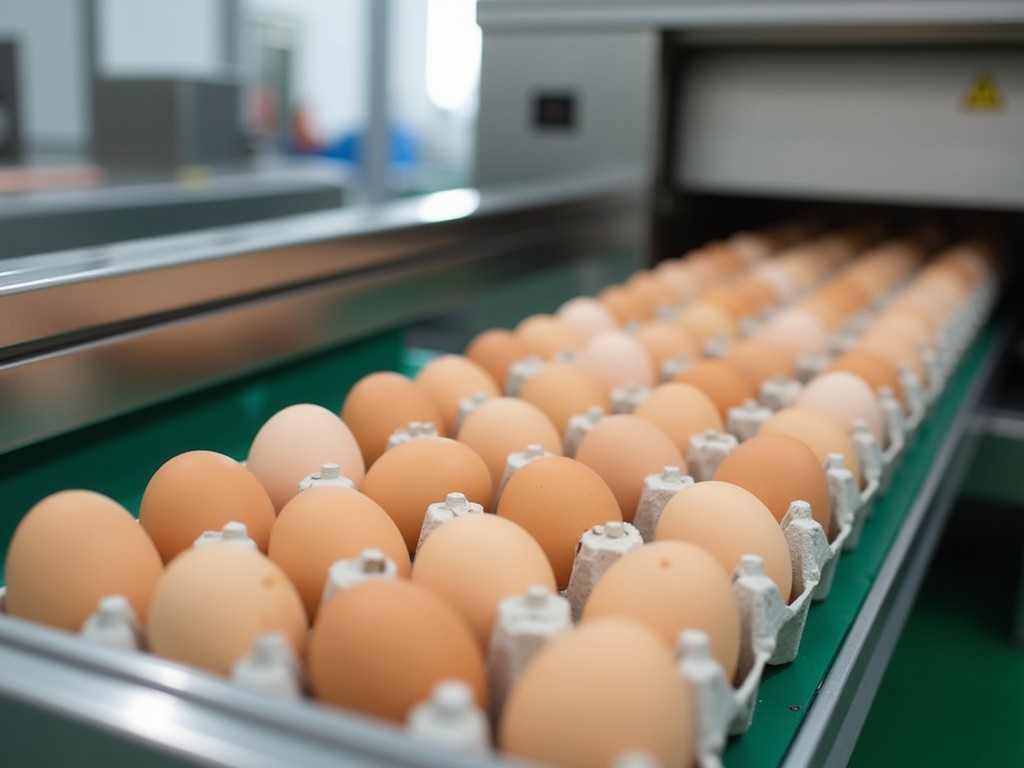
China Hatch Egg Grading and Packing Machine
Overview
This equipment separates hatch eggs by weight, size and shape before placing them into trays or cartons for further incubation or shipment. It handles chicken, duck and quail eggs ranging from 30 g to 70 g with a grading tolerance of ±2 g.
The machine integrates a conveyor feeding system, a series of load‑cell weighing stations and a mechanical diverting mechanism that directs each egg to the appropriate lane based on the measured parameter.
Working Principle
Eggs are singulated on a vibratory feeder and presented to a set of calibrated load cells that measure mass with a resolution of 0.1 g. Simultaneously, a laser displacement sensor records the egg’s length and width to detect abnormal shapes.
Based on preset weight brackets, a pneumatic diverter pushes the egg onto one of several parallel lanes. Each lane ends in a packing station where a mechanical placer aligns the egg into a pre‑formed tray or a robotic arm places it into a carton.
The control system logs each egg’s weight, dimensions and lane assignment, enabling traceability and real‑time yield reports.
Technical Specifications
| Parameter | Typical Value / Customizable |
|---|---|
| Maximum throughput | Up to 30 000 eggs/hour (depends on lane count) |
| Weight grading range | 30 g – 70 g (adjustable in 1 g steps) |
| Lane options | 2, 4, 6 or 8 parallel lanes |
| Power supply | 380 V ± 10 % 3‑phase, 50/60 Hz, 5 kW |
| Control interface | PLC with touch‑screen HMI (7‑inch), Ethernet/IP optional |
| Materials of construction | Food‑grade 304 stainless steel for contact surfaces; frame in powder‑coated carbon steel |
| Dimensions (L × W × H) | 2200 mm × 1200 mm × 1500 mm (varies with lane count) |
| Net weight | ≈ 850 kg |
Applications
- Large‑scale hatcheries that require uniform egg weight for consistent incubation results.
- Commercial poultry processing plants that pack graded eggs into retail trays before distribution.
- Research facilities needing precise sorting for experimental batches and data logging.
- Export operations where customs regulations demand traceable weight grading per shipment.
The machine’s ability to log each egg’s metrics supports quality assurance programs and reduces manual handling, thereby lowering breakage rates and labor costs.
Customization Options
- Number of grading lanes (2‑8) to match facility throughput.
- Packing format: tray loader, carton placer or bulk conveyor.
- Alternative sensors: vision‑based shape detection for specialty eggs.
- Software add‑ons: batch reporting, remote diagnostics via cloud.
- Enclosure upgrades: wash‑down rated (IP66) for high‑humidity environments.
Each option is engineered as a modular subsystem, allowing field upgrades without redesigning the main frame.
Quality Control & Materials
All surfaces that contact eggs are made from 304 stainless steel with a surface roughness Ra ≤ 0.8 µm to facilitate cleaning and prevent bacterial adhesion.
The load cells are calibrated against traceable weights before shipment and come with a calibration certificate valid for 12 months.
Frame components undergo powder‑coating with a thickness of 80 µm, providing corrosion resistance in environments with ambient humidity up to 85 %.
Final assembly includes a functional test run of at least 30 minutes at rated speed, verifying lane diversion accuracy within ±1 egg per 1000.
Frequently Asked Questions
Can the lane count be changed after installation?
Yes. The machine uses a modular lane rack; additional lanes can be added or removed by qualified service personnel, typically within a half‑day shutdown.
What information is required for a quotation?
Required inputs include desired hourly capacity, egg type and size range, preferred packing format, and any environmental constraints such as wash‑down requirements.
Which materials are available for the frame?
Standard is powder‑coated carbon steel; optional upgrades to 304 or 316 stainless steel are available for corrosive or clean‑room settings.
How is quality inspected before shipping?
Each unit undergoes a factory acceptance test covering weight accuracy, lane diversion reliability, emergency stop response, and insulation resistance.
What packaging methods are available for export?
Machines are packed in seaworthy crates with internal bracing, desiccant packs, and optional heat‑sealed plastic wrapping for moisture protection.
What is the typical production lead time?
Lead time ranges from 6 to 10 weeks depending on configuration complexity and current workshop load.
Contact for Technical Inquiry
To discuss how this grading and packing solution can be integrated into your production line, please provide your facility’s layout, target throughput, and any special material requirements.



