China Egg Packaging Machine For Poultry Farm
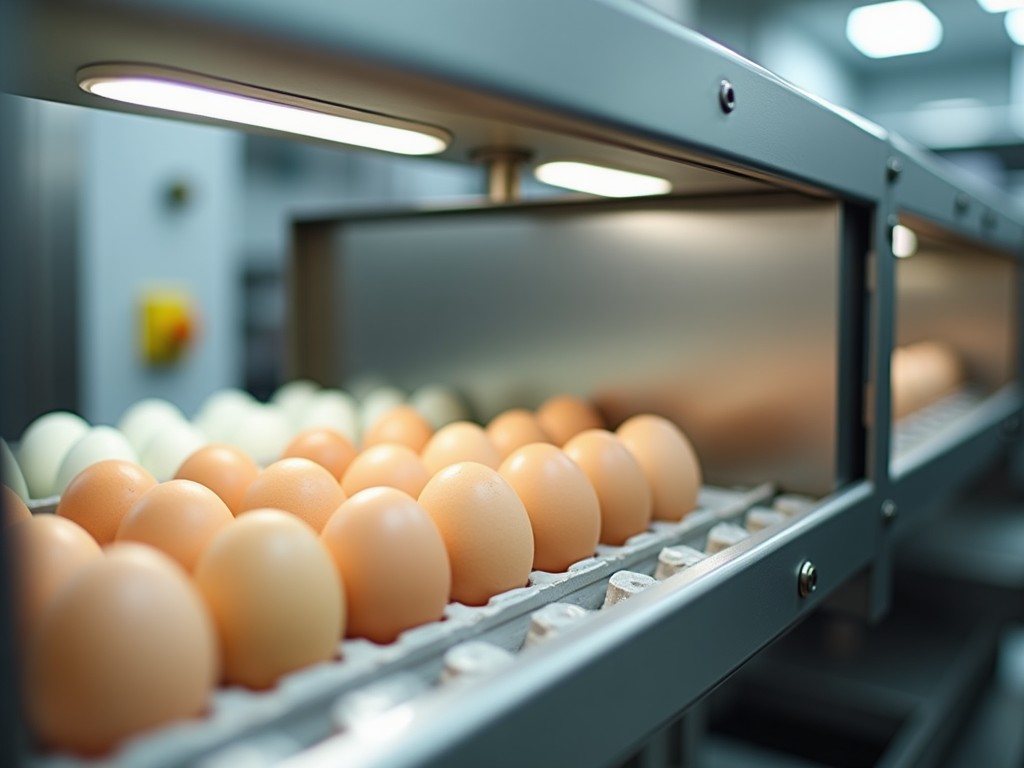
China Egg Packaging Machine for Poultry Farm
The machine receives freshly collected eggs from conveyor belts, orients them singly, and places each egg into a pre‑formed carton pocket using a pneumatic pick‑and‑place head. Cycle time is typically 0.8 seconds per egg, allowing throughput up to 4,500 eggs per hour depending on carton size and operator loading rate.
Operating Principle
Eggs are fed onto a vibratory aligner that corrects positional variance before a vision system confirms upright orientation. A servo‑driven rotary indexer positions the carton beneath the pick‑and‑place nozzle, where a vacuum gripper lifts the egg and releases it into the cell. After filling, a lid‑sealing module applies heat‑seal film or snap‑on lid, completing the package.
Key Technical Specifications
| Parameter | Typical Value |
|---|---|
| Maximum Egg Size Accommodated | 63 mm length × 44 mm width (Jumbo) |
| Carton Formats Supported | 6‑, 12‑, 18‑, 24‑, 30‑cell trays; custom sizes on request |
| Drive System | Servo motors for indexing; pneumatic actuators for gripper |
| Control Interface | PLC with touch‑screen HMI; optional Ethernet/IP |
| Power Requirement | 380 V 3‑phase, 50/60 Hz, 2.5 kW |
| Machine Footprint (L×W×H) | 1,200 mm × 800 mm × 1,500 mm |
| Net Weight | 350 kg |
Material Construction
The frame is built from 2.5 mm cold‑rolled steel with powder‑coat finish (RAL 7035) to resist corrosion in humid poultry environments. Contact surfaces that touch eggs are made of FDA‑compliant 304 stainless steel, ensuring no product contamination. Bearings and linear guides are sealed, lubricated for life, and rated for continuous operation at 80 % duty cycle.
- Main chassis: S235JR steel, powder‑coated
- Egg contact parts: AISI 304 stainless steel, Ra ≤0.8 µm
- Guides and shafts: hardened carbon steel, PTFE‑coated
- Pneumatic fittings: nickel‑plated brass
Typical Applications in Poultry Farming
In layer houses, eggs are collected multiple times per day and must be packed quickly to maintain quality and reduce breakage. The machine integrates directly with egg‑collection conveyors, allowing a seamless flow from nest to carton without manual handling. By automating orientation and placement, labor costs are lowered and packing consistency improves, which is essential for meeting retail grade specifications.
For broiler hatcheries, the same equipment can be adapted to handle hatching eggs that require stricter orientation controls to prevent embryo damage. Adjustable vacuum levels and soft‑start servo profiles accommodate the more fragile shells while maintaining the same throughput rates.
Customization Options
- Carton size adjustment ranges from 6‑cell to 36‑cell with quick‑change tooling
- Optional UV sterilization module for egg surface treatment
- Integration with robotic palletizers for end‑of‑line stacking
- Data logging package that records cycle counts, reject rates, and maintenance alerts
- Explosion‑proof wiring for facilities with dust‑explosion risk zones
Quality Control & Testing
Each unit undergoes a factory acceptance test that includes a 24‑hour run at 100 % rated speed, measuring egg breakage rate (target <0.2 %), carton seal integrity (peel strength ≥1.5 N/mm), and positional accuracy (±0.5 mm). Electrical safety is verified per IEC 60204‑1, and pneumatic circuits are leak‑tested at 8 bar. Documentation of test results is provided with the shipment.
Frequently Asked Questions
| Question | Answer |
|---|---|
| Can the machine handle different egg sizes without mechanical changes? | Size adjustment is performed via the HMI; servo positions and vacuum levels are recalibrated automatically for the selected carton cell dimensions. |
| What information is needed for a quotation? | Required inputs include target egg size, desired carton format, expected hourly output, and any integration points (e.g., existing conveyor height, power supply). |
| What materials are available for the frame? | Standard is powder‑coated S235JR steel; optional stainless steel 304 frame is available for highly corrosive environments. |
| How is quality inspected before shipment? | Each machine runs a functional test cycle, followed by a visual inspection of welds, coating uniformity, and fastener torque. Test certificates are enclosed. |
| What packaging methods are used for export? | Machines are wrapped in corrosion‑inhibiting film, placed on a wooden pallet, and secured with steel straps. Shock‑watch indicators monitor handling. |
| What is the typical production lead time? | Lead time ranges from 6 to 8 weeks after receipt of technical confirmation and deposit, depending on customization scope. |
Contact for Inquiry
To discuss your specific packing line requirements, request a detailed quotation, or arrange a virtual factory review, please use the link below. Our engineering team will respond with a technical proposal that includes layout drawings, power consumption estimates, and optional accessories.
Request Technical Proposal


