China Egg Case Packaging Machine Supplier
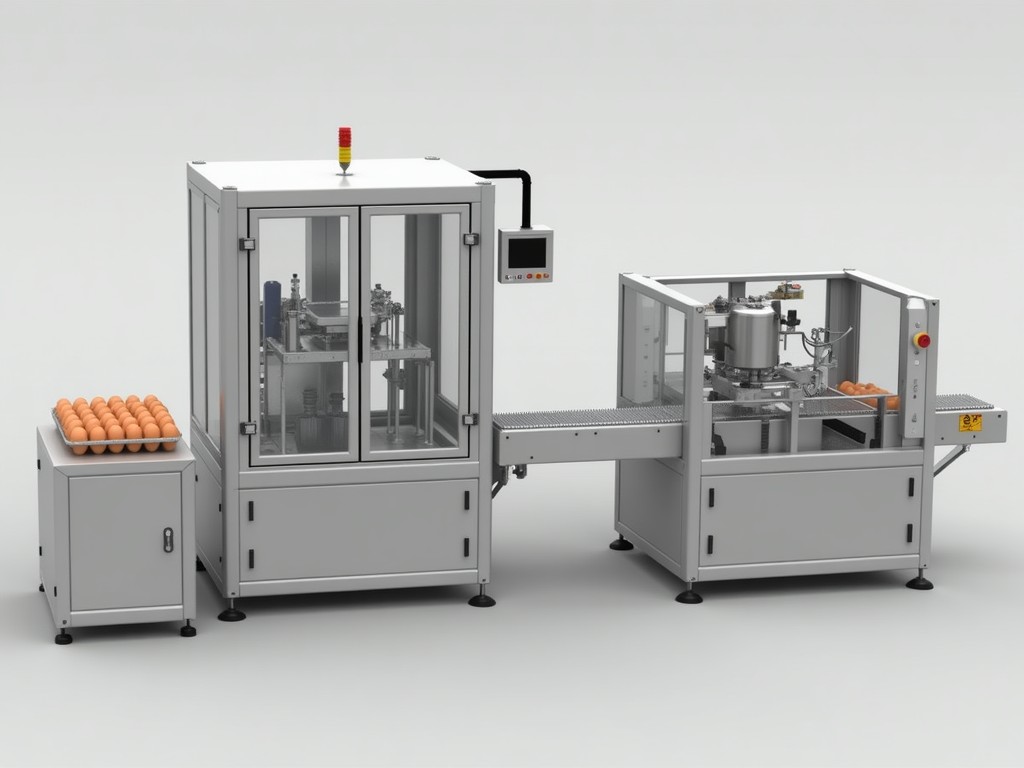
Egg Case Packaging Machine Solutions from China Suppliers
Egg case packaging machines automate the loading of eggs into protective cartons, reducing manual handling and minimizing breakage during transport. They are commonly integrated into grading lines or standalone stations where eggs arrive in bulk trays and must be oriented, counted, and sealed into standard case formats.
Typical machines use a combination of mechanical grippers and vacuum suction to pick eggs from a conveyor, rotate them into the correct orientation, and place them into pre‑formed case cavities. Drive systems often employ servo motors for precise positioning, allowing case size changes without mechanical retooling. Control is handled by a PLC with touch‑screen interface, storing recipes for different egg sizes and case patterns.
Key Features
- Adjustable case width range from 200 mm to 350 mm
- Servo‑driven pick‑and‑place mechanism for ±0.5 mm placement accuracy
- Low‑noise operation below 68 dB(A) at full speed
- Quick‑change tooling allowing case format switch in under 5 minutes
- Frame constructed of powder‑coated carbon steel with optional food‑grade stainless steel contact surfaces
Applications in Poultry Processing
In large‑scale egg farms, the machine bridges the gap between high‑speed grading and retail packaging, ensuring that each case meets weight and count specifications. By automating orientation, it reduces the likelihood of misshapen cases that can cause jamming in downstream palletizers. The ability to handle multiple case formats (e.g., 30‑egg, 36‑egg, or tray‑style) supports flexible order fulfillment without line stoppage.
Customization Options
- Case dimensions adjustable from 200 mm to 350 mm width and 100 mm to 250 mm length
- Integration of barcode printers or date‑coding modules
- Optional stainless‑steel grades (304 or 316) for corrosive environments
- Choice of pneumatic or electric actuators for gripping mechanisms
- Extended warranty and spare‑parts kits available upon request
Quality Assurance and Testing
Each unit undergoes a functional test cycle that simulates 8 hours of continuous operation, checking placement accuracy within ±0.5 mm and seal integrity at 0.8 MPa pressure. Documentation includes a test report, electrical schematic, and CE conformity declaration when requested.
| Parameter | Typical Value | Notes |
|---|---|---|
| Maximum speed | 30 cases/min | Dependent on case size and egg orientation |
| Power consumption | 2.2 kW | Three‑phase 380 V, 50 Hz |
| Case size range | 200‑350 mm W × 100‑250 mm L | Adjustable via touch‑screen |
| Control system | PLC with 7‑inch HMI | Recipe storage for up to 20 formats |
| Machine footprint | 1800 mm L × 900 mm W × 1500 mm H | Includes safety guarding |
Frequently Asked Questions
Can the machine be integrated into existing grading lines?
Yes, the unit provides standard electrical and mechanical interfaces that allow synchronization with upstream conveyors and downstream palletizers. Integration kits include mounting brackets and signal cables.
What information is required for a quotation?
To prepare an accurate quote we need the desired case dimensions, target production rate, egg size range, and any additional modules such as printing or coding.
Which materials are available for the frame and contact parts?
The frame is typically constructed from powder‑coated carbon steel, while all parts that contact eggs can be supplied in food‑grade stainless steel (304 or 316) upon request.
How is quality inspected before shipment?
Each machine runs a factory acceptance test that verifies speed, placement accuracy, and safety functions. A test report and video of the test are provided to the customer.
What is the typical production lead time?
Lead times vary from 6 to 8 weeks after receipt of the technical deposit, depending on the level of customization and current workshop load.



