Buy Egg Packing Automation System
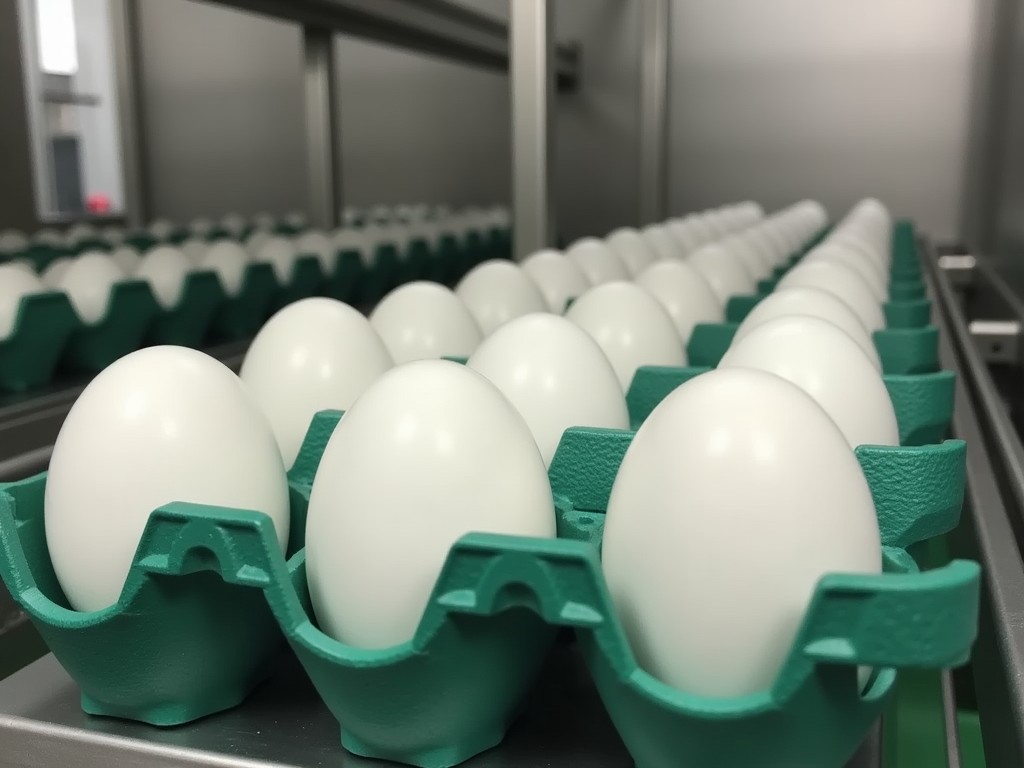
Egg Packing Automation System
Automated egg packing systems replace manual handling with precise mechanical transfer, reducing breakage risk while maintaining consistent pack rates. By integrating gentle grippers, vision‑guided orientation, and synchronized conveyors, the line can process thousands of eggs per hour with minimal operator intervention.
System Overview
The system consists of four main modules: an egg infeed conveyor that receives trays from upstream processing, an orientation unit that rotates each egg to the desired point‑up position, a packing station that places eggs into cartons or trays using compliant grippers, and a discharge conveyor that moves packed units to downstream packaging or palletizing. Each module is linked by servo‑driven belts that maintain precise spacing and timing. Sensors monitor egg presence, orientation, and grip force to prevent mishandling.
Technical Specifications
| Parameter | Typical Value | Unit | Notes |
|---|---|---|---|
| Throughput | Up to 30,000 | eggs/hr | Depends on egg size and carton format |
| Egg Size Range | 45 – 68 | mm (major axis) | Adjustable via change‑over kits |
| Packing Formats | 6‑egg, 10‑egg, 12‑egg cartons; 30‑egg trays | – | Custom tooling available |
| Power Supply | 380 V ± 10 % | V AC, 3‑phase | 50/60 Hz |
| Footprint (L×W×H) | 2.4 × 1.2 × 2.0 | m | Includes infeed and discharge conveyors |
Key Features
- Gentle silicone grippers with adjustable force to prevent shell cracking
- Vision system for orientation verification; rejects misaligned eggs automatically
- Modular design allows quick change‑over between carton sizes in under 15 minutes
- Stainless‑steel 304 frame with IP65 rated motor enclosures for wash‑down environments
- Integrated PLC with recipe management; stores up to 20 packing profiles
Applications
Egg producers benefit from automation when moving from manual packing to high‑volume lines because the system reduces labor dependence while maintaining product integrity. The low‑impact transfer minimizes micro‑cracks that can lead to spoilage during storage. Facilities that require frequent sanitary wash‑downs find the stainless construction and sealed drives advantageous for meeting food‑safety standards.
Customization Options
The line can be adapted to specific farm layouts by adjusting conveyor lengths, adding lateral mergers, or integrating with existing palletizers. Optional accessories include UV sterilization stations, data logging modules, and remote HMI access.
- Extended infeed buffer (up to 3 m) for fluctuating upstream flow
- Alternative gripper materials (FDA‑approved polyurethane) for specialty eggs
- Energy‑recovery braking on discharge conveyors
- Multilingual interface with configurable user levels
Quality Assurance
All structural components are fabricated from AISI 304 stainless steel, providing corrosion resistance against cleaning agents and egg‑derived acids. Critical moving parts use food‑grade lubricants and are sealed to IP65 to prevent ingress of water and particulates. Before shipment, each system undergoes a functional test cycle that verifies throughput, grip force repeatability, and vision‑based orientation accuracy.
Frequently Asked Questions
- Can the system handle both white and brown eggs?
- Yes, the vision‑guided orientation works irrespective of shell color; gripper force is adjusted based on size, not pigment.
- What information is required for a quotation?
- Required details include desired hourly output, egg size range, carton or tray format, facility layout constraints, and any upstream/downstream equipment interfaces.
- Which materials are available for the frame and grippers?
- Standard frames are AISI 304 stainless steel; optional frames in 316L for high‑chloride environments. Grippers come in food‑grade silicone or polyurethane.
- How is quality inspected during operation?
- Inline sensors monitor egg presence, orientation, and grip force; deviations trigger an automatic reject and log the event for traceability.
- What packaging options are available for the finished cartons?
- The discharge conveyor can feed directly into case packers, shrink‑wrap machines, or palletizers; custom adapters are provided upon request.
- How are export shipments protected?
- Systems are disassembled into modular skids, wrapped in vapor‑barrier film, and secured in ISPM‑15 compliant wooden crates.
- What is the typical production lead time?
- Lead time ranges from 8 to 12 weeks after approval of final layout drawings, depending on customization level.
Get a Quote
To receive a detailed proposal tailored to your facility, please provide your production requirements and site constraints. Our engineering team will respond with a layout diagram, equipment list, and indicative pricing within two business days.
Contact Sales


