Buy Automatic Egg Case Packing Machine
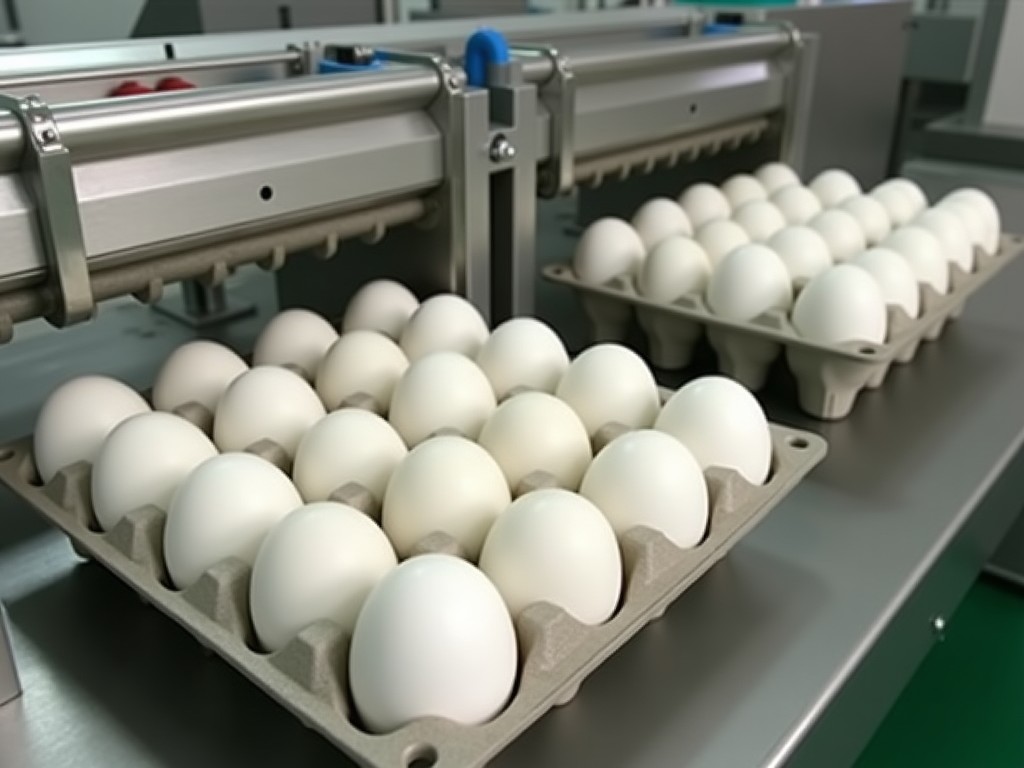
Automatic Egg Case Packing Machine
This equipment forms, fills, and seals corrugated or plastic egg cases directly from a production line, eliminating manual handling and reducing contamination risk. It integrates case erection, product loading, and closure in a single continuous cycle, suited for high‑volume hatchery and processing facilities.
Operating Principle
Flat case blanks are fed from a magazine, opened by vacuum suction, and shaped by forming plates. Eggs are transferred from an upstream conveyor into the opened case via a rotary distributor that matches the case cavity pattern. After filling, a closing mechanism folds the flaps and applies adhesive or tape, then the sealed case exits onto a downstream conveyor.
Technical Specifications
| Parameter | Typical Value | Customizable Range |
|---|---|---|
| Case throughput | Up to 120 cases/min | 60‑200 cases/min (servo drive) |
| Case size (L×W×H) | 300 mm × 200 mm × 100 mm | 150‑400 mm × 100‑300 mm × 50‑150 mm |
| Power consumption | 3.5 kW | 2.5‑5 kW (motor selection) |
| Air pressure | 0.6 MPa | 0.4‑0.8 MPa |
| Control system | PLC with HMI touchscreen | Optional SCADA integration |
Key Features
- Servo‑driven case forming ensures precise flap positioning within ±0.5 mm.
- Quick‑change tooling allows case size conversion in under 15 minutes without disassembly.
- All product contact surfaces are 304 stainless steel with Ra ≤ 0.8 µm for easy cleaning.
- Integrated weight check rejects under‑filled cases before sealing.
- Low‑noise operation (<78 dB) achieved through insulated drive housings.
- Energy‑recovery braking reduces peak power draw during cyclic stops.
Applications in Egg Processing
In line‑loading operations, manual case packing introduces variability in seal integrity and labor fatigue. By automating case erection and filling, the machine maintains consistent case geometry, which improves stackability in palletizers and reduces transport damage. The sealed case also provides a barrier against microbial ingress, supporting compliance with food‑safety standards such as BRCGS and SQF.
Customization Options
- Case dimensions adjustable via interchangeable forming plates.
- Throughput scalable by adding parallel filling stations.
- Material choice includes 316L stainless steel for corrosive environments.
- Control interface options: basic push‑panel, advanced HMI with recipe management, or remote IIoT gateway.
- Sealing methods: hot‑melt adhesive, tape, or ultrasonic welding depending on case material.
- Integration kits for upstream conveyors, weighers, and downstream palletizers.
Quality Control & Testing
Each unit undergoes a factory acceptance test that includes cycle‑run verification at 100 % rated speed, leak‑proof sealing assessment using dye penetrant, and dimensional accuracy checks on formed cases. Electrical safety is validated per IEC 60204‑1, and mechanical guards are inspected for compliance with ISO 13857. Test certificates are available upon request.
Frequently Asked Questions
- Can the machine handle both cardboard and plastic cases?
- Yes, forming plates can be swapped for corrugated board, solid plastic, or returnable tote styles.
- What information is required for a quotation?
- Desired case dimensions, target throughput, product weight range, preferred sealing method, and any facility constraints such as ceiling height or power availability.
- How is changeover time minimized?
- Tool‑less locking mechanisms and indexed positioning pins allow operators to replace forming plates and filling guides without specialized tools.
- What spare parts are recommended for stock?
- Forming plate sets, suction cups, sealing rollers, and PLC I/O modules are commonly kept on hand to reduce downtime.
Get a Quote
To receive a detailed technical proposal, please provide your application specifics using the inquiry form.
Request Quotation


