Bulk Automatic Egg Farm Packaging Machine
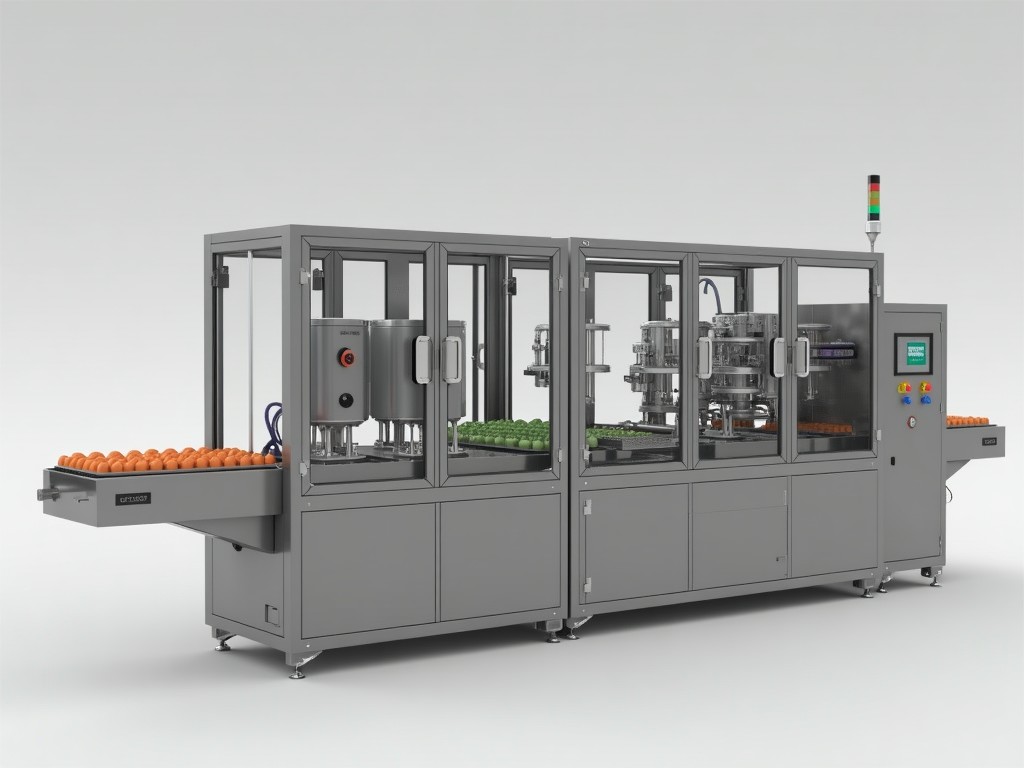
Bulk Automatic Egg Farm Packaging Machine
Overview
The machine receives eggs from upstream conveyors, orients them singly, and counts them into batches matching the selected carton size.
A servo-driven indexing system places each batch into a forming carton or tray while maintaining low impact forces (<0.5 N) to prevent shell damage.
Integrated weight verification rejects out‑of‑tolerance packs before they exit the line, ensuring consistent product weight.
Key Features
- Servo‑driven indexing with programmable pitch adjustment (5‑50 mm) for flexible batch sizing.
- Soft‑grip polyurethane paddles that engage the egg shell with a controlled force of 0.2‑0.4 N, minimizing micro‑cracks.
- Quick‑change carton format kit allows switching between 6‑, 12‑, 18‑, and 30‑egg cartons in under 4 minutes without tools.
- Inline checkweigher with ±0.5 g accuracy and automatic reject divert for under‑ or over‑weight packages.
- Allen‑Bradley PLC platform with recipe storage (up to 50 product codes) and Ethernet/IP connectivity for MES integration.
Technical Specifications
| Parameter | Typical Value |
|---|---|
| Throughput (eggs/hour) | Up to 30,000 (adjustable via speed reducer) |
| Egg size range (mm) | 40‑65 (covers small to jumbo) |
| Packaging formats | Cartons of 6, 12, 18, 30 eggs; trays; custom sizes available |
| Changeover time (min) | ≤4 for carton size, ≤2 for lane width adjustment |
| Power consumption (kW) | 3.5 at nominal speed |
| Dimensions (L×W×H) | 2200 mm × 1100 mm × 1800 mm |
| Machine weight (kg) | 1250 |
| Control system | Allen‑Bradley CompactLogix PLC with PanelView HMI |
| Supply voltage | 380‑480 V 3‑phase, 50/60 Hz |
| Air pressure requirement | 0.5‑0.8 MPa, dry filtered |
Applications
Large‑scale egg producers benefit from reduced labor because the machine automates orientation, counting, and packing steps that previously required multiple operators.
By limiting direct human contact, the system lowers the risk of microbial contamination and supports compliance with FDA egg safety regulations.
The modular design allows the machine to be positioned downstream of existing washing and drying lines, accommodating line speeds from 5,000 to 35,000 eggs per hour.
Integrated data logging provides traceability records (batch ID, time, weight) that can be exported to quality management systems.
Customization Options
- Adjustable lane width (30‑80 mm) to accommodate different egg diameters without changing parts.
- Optional UV‑C sterilization module positioned before packing to reduce surface bacterial load.
- Diverter conveyor options: 90° turn, side‑exit, or accumulation buffer for downstream equipment.
- Choice of carton materials: recycled cardboard, coated kraft, or food‑grade polypropylene trays.
- Labeling or code‑printing integration (inkjet, laser) for expiry dates and farm identification.
Quality Control
All food‑contact surfaces are fabricated from AISI 304 stainless steel or FDA‑approved polyethylene, facilitating cleaning and resisting corrosion.
Inline vision systems verify carton closure and label presence, triggering a reject if defects are detected.
The machine undergoes factory acceptance testing (FAT) that includes cycle‑run at 110 % of rated speed, weight accuracy verification, and sanitation clean‑in‑place (CIP) validation per ISO 22000.
Frequently Asked Questions
- Can the throughput be adjusted after installation? Yes, speed is changed via the PLC‑controlled variable frequency drive, allowing a range from 5,000 to 35,000 eggs per hour without mechanical changes.
- What installation requirements are needed? The machine needs a level foundation (±3 mm), a 380‑480 V three‑phase supply, and a compressed air line delivering 0.5‑0.8 MPa; detailed layout drawings are provided upon request.
- Which spare parts are recommended for preventive maintenance? Wear items include the polyurethane paddles, indexing belts, and checkweigher load cells; a spare‑parts kit covering 12‑months of operation is offered.
- How is the machine cleaned for sanitation? All contact surfaces are accessible for CIP; a quick‑release clamp system permits removal of paddles and belts for manual washing, and the enclosure is rated IP55 for wash‑down environments.
Contact / Inquiry
For technical details or a quotation, please contact our engineering team.



