B2B Automatic Egg Packer Machine Price
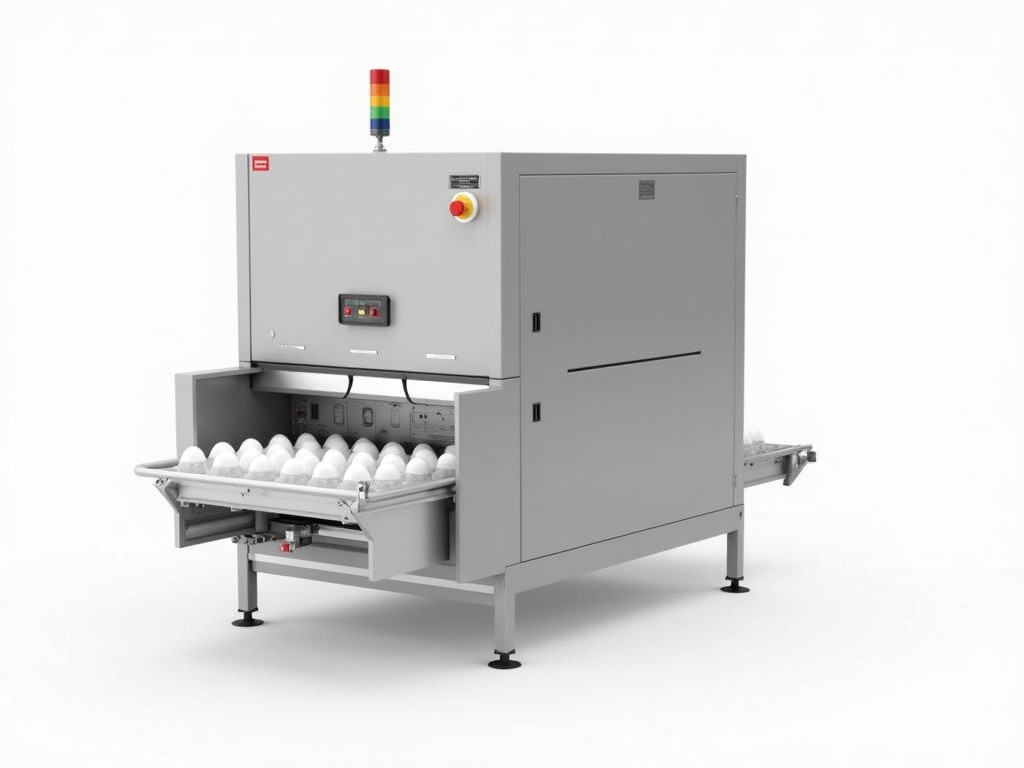
Automatic Egg Packer Machine for B2B Production Lines
These machines integrate vision‑guided orientation, soft‑grip handling, and synchronized carton feeding to pack fragile eggs at line speeds while minimizing breakage and labor input.
Operating Principle
Eggs are singulated on a conveyor and presented to a high‑resolution camera system that determines orientation and detects cracks.
Based on the image data, a series of food‑grade silicone paddles gently rotate each egg to the upright position and transfer it into a moving carton nest.
Carton nests are indexed by a servo‑driven belt, ensuring that each egg drops into its designated cell with a controlled impact force below 0.2 N to preserve shell integrity.
Key Technical Specifications
| Parameter | Typical Value | Notes / Customization |
|---|---|---|
| Throughput | Up to 30,000 eggs/hour | Scales with number of lanes; optional higher‑speed modules available |
| Egg size range | 40 – 63 mm diameter | Adjustable grip width accommodates small to jumbo grades |
| Supported carton formats | 6, 12, 18, 24, 30‑egg cartons (paper or polymer) | Changeover via tool‑less latch; programmable for custom counts |
| Power consumption | 3.5 kW (main drive) | Variable frequency drive for energy‑optimized profiling |
| Required air pressure | 0.6 MPa (clean, dry) | Used for pneumatic actuators; oil‑free supply recommended |
| Machine footprint | 2200 × 1100 × 1800 mm (L×W×H) | Modular frame allows side‑by‑side layout for multi‑lane configurations |
| Control system | PLC with HMI touchscreen | Supports recipe storage, fault diagnostics, and Ethernet/IP connectivity |
Typical Applications
- Poultry processing plants where eggs are collected post‑washing and require rapid packing into retail‑ready cartons.
- Food‑service distributors that need uniform pack weights for bulk shipping to institutions and catering companies.
- Retail egg brands seeking consistent presentation and reduced breakage to meet shelf‑life specifications.
In each setting the machine’s gentle handling reduces micro‑cracks, which directly lowers downstream waste and improves yield calculations for cost accounting.
Factors Influencing Price
Base cost reflects the standard frame, drive system, and control hardware; the following variables adjust the final quotation:
- Number of packing lanes (single, dual, or triple) – each lane adds approximately 18 % to the hardware cost.
- Level of automation – integrating a vision‑based crack detector or automatic reject conveyor raises the price by 12‑25 % depending on sensor resolution.
- Contact‑part material – upgrading from 304 stainless steel to 316L for corrosive environments adds roughly 8 % to the material budget.
- Installation scope – mechanical‑only supply versus turnkey (including electrical wiring, pneumatic tubing, and FAT/SAT) influences labor and engineering fees.
- Warranty and service package – extending coverage from 12 to 24 months or adding on‑site spare‑parts logistics increases the total by 5‑15 %.
Customization Options
- Adjustable lane width – quick‑change guides accommodate carton size changes without tools.
- Alternative carton styles – top‑load, sleeve, or tray formats with corresponding nest designs.
- Upstream integration – synchronization with egg washing, drying, or oiling stations via line‑speed encoder.
- Data logging – production counters, reject rates, and torque trends stored on internal memory or exported via OPC UA.
- Safety enhancements – light curtains, emergency stop zones, and guarded drive modules compliant with EN ISO 13849‑1.
Quality Assurance and Testing
Manufacturers typically apply a quality management system aligned with ISO 9001, ensuring traceability of critical stainless‑steel batches and weld procedures.
Before shipment, each unit undergoes a factory acceptance test (FAT) using synthetic egg shells to verify cycle timing, positioning accuracy (< 0.5 mm), and force limits.
A subsequent site acceptance test (SAT) is performed with customer‑specific egg grades to confirm that breakage rates remain below the agreed threshold, commonly 0.2 % for Grade A eggs.
Frequently Asked Questions
Yes, the nest brackets are adjustable and can be re‑configured for custom carton footprints; changeover typically takes under 15 minutes.
Required inputs include target eggs per hour, egg size range, carton type and count, facility air quality, and any desired upstream/downstream interfaces.
Standard is 304 stainless steel; 316L or food‑grade polymer coatings are offered upon request for higher corrosion resistance.
Each machine receives dimensional checks, functional test cycles, and a leak test for pneumatic circuits before final paint and packaging.
Machines are secured on a steel pallet, wrapped in vapor‑ barrier film, and placed in a wooden crate with shock‑absorbing corners to meet ISPM‑15 standards.
Lead times range from 8 to 12 weeks after receipt of technical specifications and deposit, depending on selected options and current shop load.



