Factory Direct Suction Cup Egg Loading Equipment
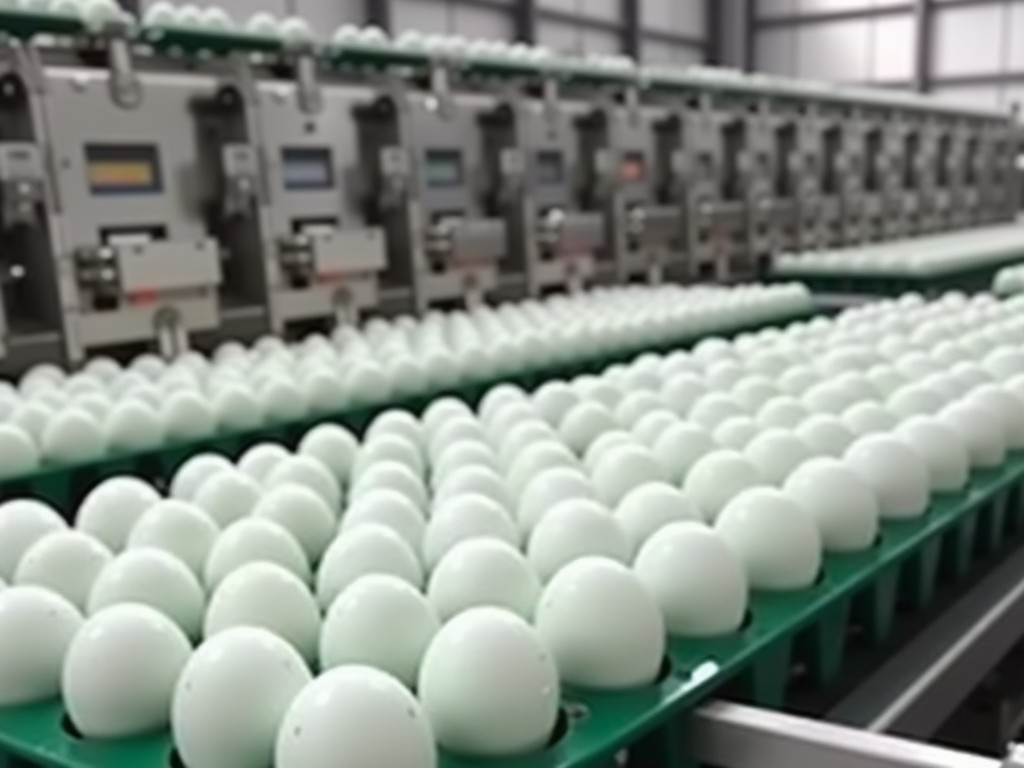
Factory Direct Suction Cup Egg Loading Equipment
This equipment transfers eggs from trays to processing lines using vacuum‑actuated suction cups. It is designed for gentle handling to minimize shell breakage while maintaining high throughput. The system integrates with existing conveyors and can be synchronized with upstream grading or downstream washing stations.
Operating Principle
A vacuum pump generates negative pressure inside a manifold that feeds individual suction cups. When a cup contacts an egg, the pressure differential holds the egg securely. A timed release valve then vents the vacuum, allowing the egg to drop onto the downstream conveyor. Cycle timing is controlled by a programmable logic controller (PLC) with adjustable dwell and release intervals.
Typical vacuum levels range from -0.05 MPa to -0.08 MPa, sufficient to lift eggs weighing up to 60 g without slippage. The cup material is selected to provide a low‑friction, food‑grade interface that does not leave residues.
Key Technical Specifications
| Parameter | Typical Value / Range | Remarks |
|---|---|---|
| Number of suction cups | 4 – 24 (configurable) | Determined by line speed and egg spacing |
| Cup diameter | 30 mm – 50 mm | Matches egg size; custom sizes available |
| Vacuum pressure | -0.05 MPa to -0.08 MPa | Adjustable via regulator |
| Cycle time | 0.8 s – 2.0 s per egg | Depends on vacuum build‑up and release settings |
| Power consumption | 0.5 kW – 1.2 kW | Based on pump size and number of cups |
| Material of construction | 304 stainless steel frame, FDA‑grade silicone cups | Corrosion resistant, food safe |
| Overall dimensions (L×W×H) | 800 mm × 600 mm × 1500 mm (typical) | Can be modified for site layout |
Material Selection and Construction
The frame uses 304 stainless steel tubing with a wall thickness of 2 mm, providing rigidity while resisting corrosion from cleaning agents. Suction cups are molded from silicone compound rated for direct food contact, with a Shore A hardness of 40 ± 5 to balance grip and gentle release. Seals between the cup and manifold are made of EPDM O‑rings, selected for their low compression set under repeated vacuum cycles.
All fasteners are stainless steel to avoid galvanic corrosion. The vacuum manifold is machined from aluminum alloy 6061, anodized for wear resistance, and includes internal channels designed to minimize pressure drop (<5 % of setpoint).
Applications in Egg Processing Lines
In a typical breaking line, eggs arrive on a flat tray conveyor. The suction cup loader picks each egg individually and places it onto a rotating breaker or a washing belt. Because the cups apply only normal force, there is no rolling or sliding that could cause micro‑cracks. The equipment can handle speeds up to 180 eggs per minute when configured with 12 cups and a 1.2 s cycle.
For downstream processes such as pasteurization or drying, the same loader can be inverted to place eggs onto carriers without re‑orientation, reducing the need for additional handling stations. The low‑profile design allows installation beneath existing overhead conveyors, preserving floor space.
Customization Options
- Number and arrangement of suction cups (linear, radial, or custom patterns)
- Cup diameter and material (silicone, polyurethane, or specialty food‑grade elastomers)
- Vacuum pump size and control method (PLC, relay, or manual valve)
- Mounting brackets for side‑load, top‑load, or inverted configurations
- Interface options: 24 V DC discrete signals, Ethernet/IP, or analog voltage for speed synchronization
Quality Control and Testing
Before shipment, each unit undergoes a leak‑down test where the vacuum circuit is pressurized to -0.09 MPa and monitored for pressure loss over five minutes; acceptable loss is less than 0.5 % of setpoint. Cup pull‑off strength is measured using a tensile tester, confirming a minimum holding force of 12 N per cup at -0.07 MPa.
Functional validation includes a run‑test with 10 000 eggs at line speed, recording breakage rate and placement accuracy. All welds are inspected via dye penetrant, and electrical components are certified to IP54 for dust and splash resistance.
Frequently Asked Questions
Can the cup spacing be adjusted for different egg sizes?
Yes. The manifold incorporates sliding brackets that allow cup centers to be set between 25 mm and 45 mm, accommodating eggs from 40 g to 70 g without changing hardware.
What information is needed for a quotation?
Required details include desired eggs per minute, tray pitch, available vacuum supply (if any), and any environmental constraints such as wash‑down temperature or cleaning chemical type.
How are export shipments protected?
Units are packed in double‑wall corrugated boxes with interior foam corners, sealed with poly‑strapping, and marked with handling symbols. A moisture‑absorbent packet is included to protect electrical contacts during transit.
Contact for Inquiry
To discuss your specific line speed, egg size, or integration requirements, please use the form below or send an email to our technical sales team.
Request Technical Quote


