Factory Direct Egg Loading Machine For Poultry Farms
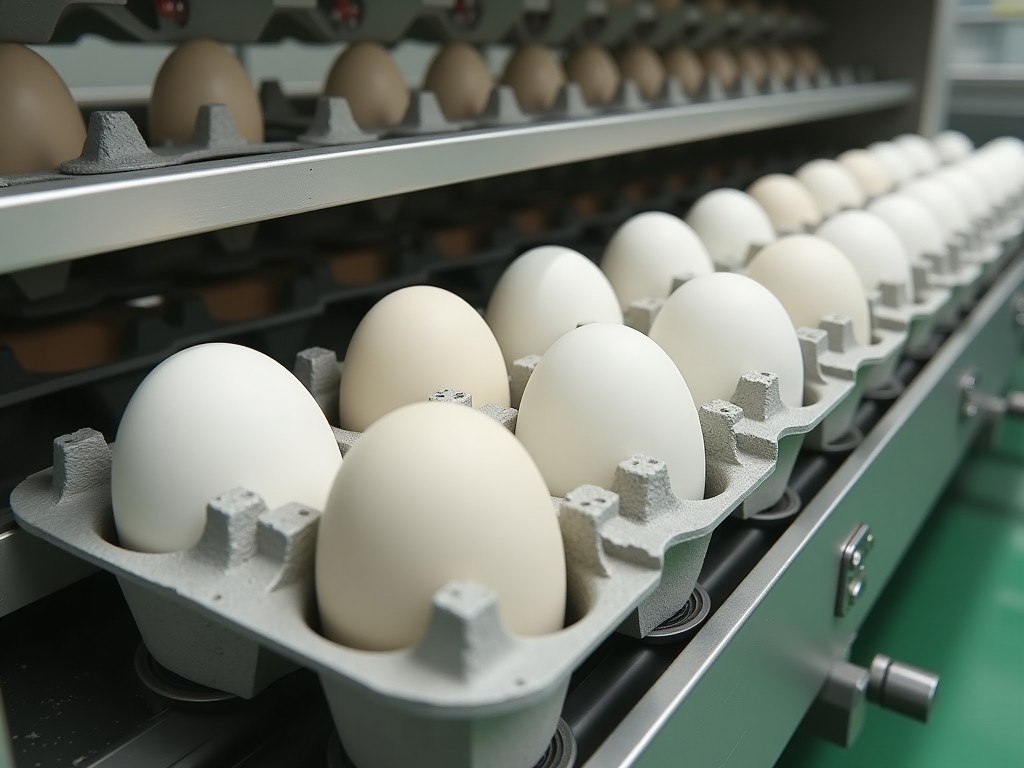
Factory Direct Egg Loading Machine for Poultry Farms
This machine transfers eggs from collection belts or trays to processing lines or packaging stations. It operates at a controlled speed to minimize shell damage and maintain product integrity.
Operating Principle
Eggs are fed onto a gently vibrating or belt‑driven conveyor that aligns them in a single layer. A series of soft‑padded paddles or rollers then lift and transfer the eggs onto a downstream conveyor at a programmable pitch.
The transfer mechanism uses low‑impact actuation (typically < 0.5 J per egg) to reduce crack incidence. Speed is adjustable from 5 to 30 m/min, allowing synchronization with upstream collection rates and downstream processing capacity.
Key Technical Specifications
| Parameter | Typical Value |
|---|---|
| Egg throughput | Up to 30 000 eggs/h (depending on egg size) |
| Conveyor width | 400 mm – 600 mm (customizable) |
| Drive power | 0.75 kW – 1.5 kW AC motor |
| Control system | PLC with touch‑panel HMI; speed adjustment ±5 % |
| Frame material | Powder‑coated carbon steel (optional stainless steel 304) |
| Noise level | ≤ 78 dB(A) at 1 m |
| Dimensions (L×W×H) | 1500 mm × 800 mm × 1200 mm (base model) |
| Weight | ≈ 180 kg |
Design Features and Materials
The frame uses welded C‑channel sections with a minimum wall thickness of 3 mm, providing rigidity for continuous operation. All contact surfaces that touch eggs are made of food‑grade UHMW‑PE or stainless steel 316L to prevent contamination and facilitate cleaning.
Drive components include sealed ball bearings and a timing belt drive to eliminate lubrication points near the product zone. The conveyor belt is a modular polyurethane mesh with a pitch of 12.7 mm, offering low friction and easy belt replacement.
Adjustable side guides accommodate egg diameters from 42 mm to 58 mm. Guide positioning is achieved via rack‑and‑pinion mechanisms with lock‑nuts, allowing repeatable setup within ±0.5 mm.
Applications in Poultry Production
In layer farms, the machine receives eggs from nest‑box conveyors and transfers them to grading or candling lines, reducing manual handling and associated labor costs.
For broiler hatcheries, it moves freshly collected eggs from collection trays to incubation trolleys, maintaining orientation and minimizing vibration that could affect embryo viability.
The equipment can also be integrated into automated packaging cells, feeding eggs into cartoners or tray sealers at a synchronized rate, thus supporting high‑volume throughput while preserving egg quality.
Customization Options
- Variable conveyor width (400 mm–800 mm) to match line layout
- Adjustable transfer pitch (20 mm–100 mm) for different packaging formats
- Stainless steel 304 or 316L frame for corrosive environments
- Explosion‑proof motor rating for dust‑hazard zones
- Integration kits for existing PLC platforms (Modbus TCP, Profibus)
Quality Control and Testing
Each unit undergoes a functional test cycle at 100 % rated speed for 30 minutes, monitoring egg transfer success rate (target ≥ 99.5 % intact). Vibration analysis is performed on the drive system to ensure amplitudes remain below 0.02 mm RMS.
Material certification is provided for all food‑contact surfaces, including FDA 21 CFR 177.1520 compliance for UHMW‑PE. Welds are inspected via visual and dye‑penetrant methods per ASME Section VIII.
Final documentation includes a test report, CE conformity declaration, and a spare‑parts list with part numbers and recommended replacement intervals.
Frequently Asked Questions
- Can dimensions be customized? Yes, length, width, and height can be adjusted to fit specific facility layouts; please provide site drawings for quotation.
- What information is required before quotation? Required data include egg size range, desired throughput (eggs/h), line speed, power supply voltage, and any environmental constraints (e.g., washdown, explosive dust).
- What materials are available for the frame? Standard is powder‑coated carbon steel; optional stainless steel 304 or 316L for corrosive or washdown areas.
- How is quality inspected? Each machine receives functional run‑test, vibration analysis, and material certification checks before shipment.
- What packaging methods are available? Units are skid‑mounted, wrapped in stretch film, and secured in a wooden crate; container‑loading options are available upon request.
- How are export shipments protected? Crates include corner protectors, moisture barrier film, and shock‑absorbing pallets to meet ISTA‑3A standards.
- What is the typical production lead time? Lead time ranges from 6 to 10 weeks depending on configuration and current workload.
Contact for Inquiry
To discuss your specific requirements, request a detailed quotation, or arrange a technical consultation, please use the link below.
Request Quotation & Technical Support


