Factory Direct Egg Loading Conveyor System
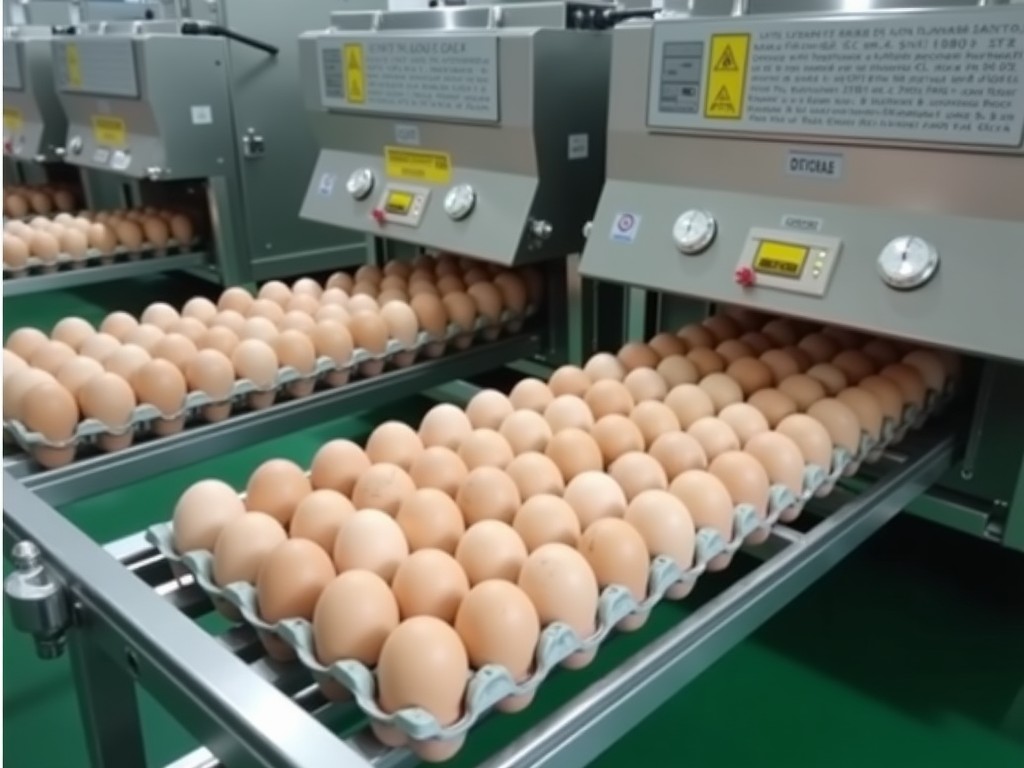
Factory Direct Egg Loading Conveyor System
This conveyor transports eggs from collection points to processing lines while maintaining orientation and minimizing shell damage. It is designed for continuous operation in high‑volume poultry facilities where gentle handling and precise spacing are critical.
The system uses a low‑speed, positively driven belt that moves eggs in a single file, reducing the chance of collisions or stacking. Drive torque is calibrated to the egg weight range typical of commercial breeds, typically 50–70 g per egg.
Key Technical Characteristics
Construction relies on food‑grade stainless steel (AISI 304) for frames, rollers, and contact surfaces, providing corrosion resistance against cleaning agents and humid environments.
The belt is made of FDA‑approved polyurethane with a smooth, non‑porous surface that prevents egg adhesion and facilitates sanitation. Belt width is commonly 150 mm, adjustable in 25 mm increments to match lane spacing.
Drive options include a gear‑reduced AC motor with variable frequency drive (VFD) allowing speed adjustment from 0.5 to 2.0 m/min. Motor power typically ranges from 0.37 kW to 0.75 kW depending on line length and load.
Roller bearings are sealed, low‑friction units rated for continuous operation at 80 °C ambient temperature, with a design life exceeding 20 000 hours under normal load.
Typical Specifications
| Parameter | Typical Value | Notes |
|---|---|---|
| Frame Material | AISI 304 stainless steel | Food‑grade, weldable |
| Belt Type | Polyurethane, FDA approved | Non‑porous, easy to clean |
| Belt Width | 150 mm (standard) | Customizable 100–300 mm |
| Speed Range | 0.5–2.0 m/min | VFD controlled |
| Motor Power | 0.37–0.75 kW | Dependent on length & load |
| Load Capacity | Up to 30 kg/min (egg mass) | Varies with egg size & line speed |
| Operating Temperature | ‑10 °C to 60 °C | With optional heating/cooling |
Applications in Poultry Processing
The conveyor integrates directly after egg collection belts or washing stations, delivering eggs to grading, candling, or packaging machines at a controlled rate. By keeping eggs upright and separated, it reduces the incidence of micro‑cracks that can occur during turbulent transfer.
In facilities with multiple lanes, the system can be synchronized with upstream sensors to adjust speed based on real‑time flow, preventing bottlenecks and excess accumulation. This adaptability supports both batch and continuous processing modes.
Typical installations include broiler hatcheries, layer farms, and egg‑processing plants where hygiene standards require easy‑to‑clean surfaces and resistance to frequent sanitation cycles.
Customization Options
- Variable belt width (100 mm–300 mm) to match lane spacing
- Adjustable side guides for different egg sizes (small, medium, large)
- Stainless steel grades (304, 316) for heightened corrosion resistance
- Motor options: AC gear‑reduced, servo‑driven for precise positioning
- Length extensions with modular frame sections
- Integrated sensors for egg presence, speed feedback, and fault detection
- Optional heating or cooling jackets for temperature‑sensitive products
Quality Assurance & Testing
Each unit undergoes dimensional verification of frame straightness and belt tension before shipment. Electrical systems are inspected for proper grounding, insulation resistance, and VFD parameter settings according to IEC standards.
Functional tests include running a simulated egg load at maximum speed for 30 minutes, monitoring belt slip, motor temperature, and noise levels. Any deviation beyond predefined tolerances triggers adjustment or rework.
Documentation provided with each shipment includes material certificates, test reports, and a maintenance schedule outlining lubrication intervals for rollers and bearing inspections.
Frequently Asked Questions
A: Yes, side guides and belt width are adjustable to accommodate small, medium, and large eggs without changing the core frame.
A: Required details include desired lane spacing, line speed, egg size range, facility layout (length & elevation changes), and any special material or sanitation requirements.
A: Frame options are AISI 304 or 316 stainless steel; belts are food‑grade polyurethane with optional antimicrobial coating.
A: Each unit is checked for dimensional accuracy, belt tension, electrical safety, and functional performance under load, with test reports supplied.
A: Units are disassembled into modular sections, wrapped in protective film, and secured in wooden crates or steel frames suitable for container transport.
A: Lead time depends on configuration complexity but generally ranges from 4 to 6 weeks after receipt of final specifications and deposit.
Contact for Inquiry
To discuss how this conveyor can be integrated into your egg handling line, provide your project specifications, or request a detailed quote, please reach out using the contact form below.



