Commercial Egg Loading Machine Factory Price
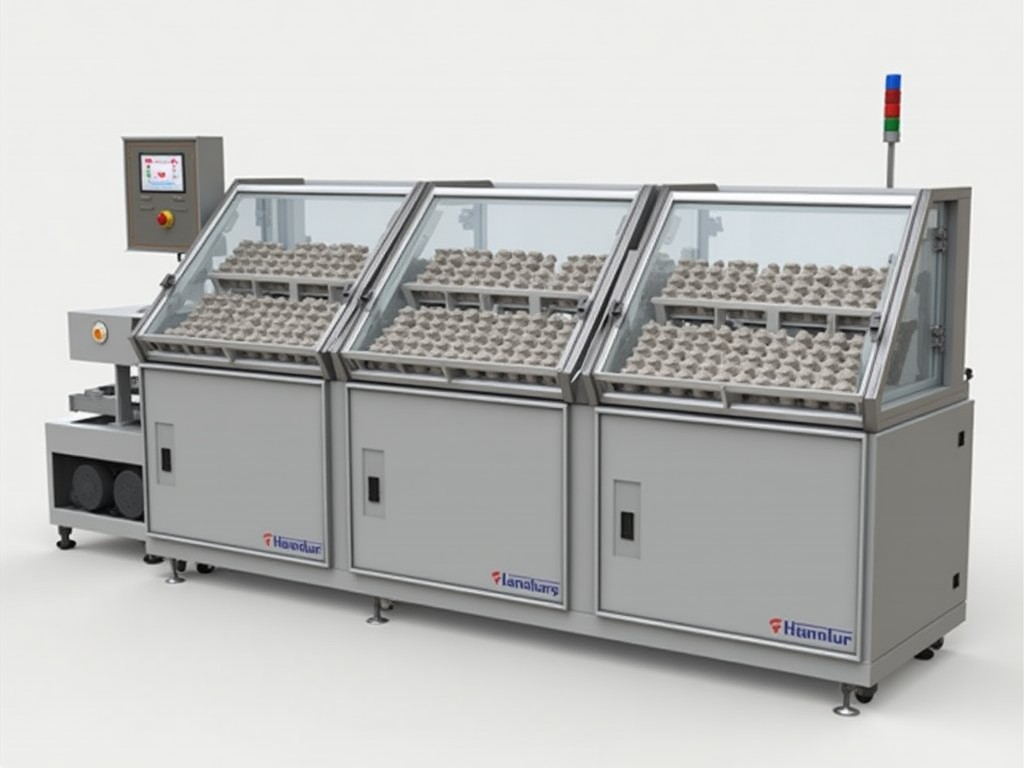
commercial egg loading machine Factory Price
Modern poultry operations require high-precision egg handling systems to maintain product integrity from collection to final packaging. A commercial egg loading machine serves as the critical bridge between de-nesting units and storage or transport, ensuring that egg trays are transitioned with minimal impact to prevent micro-fractures. By utilizing automated mechanical transport and sensor-driven logic, these systems significantly reduce labor dependency while maintaining a consistent throughput rate that manual handling cannot match.
Engineering design for these units focuses on the synchronization of conveyor belt speeds with the loading arm oscillation. High-efficiency models utilize soft-touch polyurethane belts and pneumatic guides to distribute weight evenly, which minimizes the risk of tray tipping during the vertical or angled descent into crates. This mechanical stability is essential for facilities operating at high volumes where breakage rates directly impact the profitability metric.
Technical Specifications
| Parameter | Standard Configuration |
|---|---|
| Processing Capacity | 2,000 - 6,000 trays per hour |
| Tray Compatibility | 30-egg plastic or pulp trays |
| Frame Material | 304 Stainless Steel / Galvanized Steel |
| Drive System | Variable Frequency Drive (VFD) controlled |
| Power Requirement | 380V 3-Phase 50Hz standard |
| Sensor Type | Photoelectric and Ultrasonic proximity |
Factors Influencing Factory Price
Determining the factory price of a commercial egg loading machine requires evaluation of the level of automation and the material grade selected for construction. A semi-automated system using carbon steel frames offers a lower entry point, but for high-moisture or wet-wash environments, 304 stainless steel is the standard to prevent corrosion and ensure hygiene compliance.
The complexity of the control logic also dictates the investment. Basic models operate on simple start-stop triggers, whereas advanced systems integrate PLC (Programmable Logic Controller) interfaces that allow for real-time data monitoring and seamless line synchronization. Furthermore, customization requirements—such as specific tray dimensions or the need to integrate with existing curved conveyor layouts—will adjust the engineering hours and final unit cost.
- Material Selection: Choice between industrial-grade steel and food-grade stainless steel for longevity.
- Automation Level: Single-arm loading versus fully automated multi-arm robotic integration.
- Throughput Requirements: The motor horsepower and belt speed required to meet specific trays-per-hour targets.
- Integration Complexity: Custom brackets and software logic needed to match existing factory floor plans.
Industrial Applications
In large-scale hatcheries, these machines are utilized to move trays from the de-nesting area directly into transport crates. The primary objective here is the reduction of mechanical shock to the eggs, which is critical for maintaining the shell integrity before the product reaches the final distribution phase.
Export-grade packing facilities also employ egg loading machines to handle high-speed grading and sorting lines. Because these machines provide uniform movement, they ensure that the trays are packed tightly without misalignment, which is vital for pallet stability and maximizing space utilization during long-distance shipping transit.
Manufacturing & Quality Control
Manufacturing begins with the precision TIG welding of the frame to ensure the structure can withstand the constant vibrations of high-speed belt operation. Every structural joint is inspected for uniformity to prevent future fatigue cracks, which could lead to misalignment of the loading arms.
Quality control protocols include the calibration of all photoelectric sensors to ensure they detect tray edges with millimetric accuracy without false triggers. We also perform load-bearing tests on the conveyor belts to verify that the VFD-driven motors can maintain the rated speed under maximum capacity without thermal strain or belt slip.
Frequently Asked Questions
Can the machine dimensions be customized for specific factory floor plans?
Yes, the frame length and height of the conveyor can be adjusted to accommodate specific spatial constraints or to align with existing conveyor heights.
What is the typical production lead time for custom orders?
Typically, production ranges from 4 to 8 weeks, depending on the material specifications selected and the complexity of the PLC programming required.
How are shipments protected during international transit?
Machines are crated in heavy-duty wooden frames with internal shock-absorbing materials to prevent shifting and mechanical damage during sea or air freight.
To receive a detailed technical drawing or a formal factory quote based on your facility requirements, contact our engineering sales team.
Request Technical Consultation & Quote


