China Egg Loading Machine For Sale
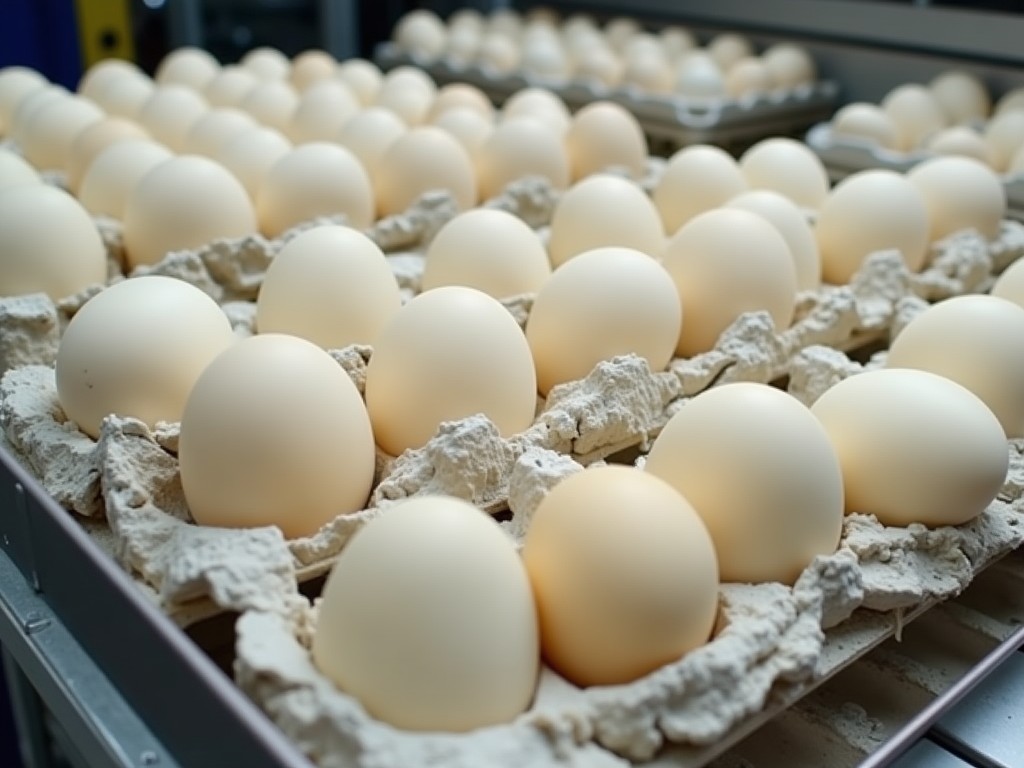
China Egg Loading Machine for Sale
An egg loading machine automates the transfer of eggs from trays or flats onto a processing line, reducing manual handling and minimizing shell breakage. Typical units handle between 15,000 and 35,000 eggs per hour, with adjustable cycle rates to match line speed. The system is designed for integration into hatcheries, breaking stations, and packaging facilities where consistent, gentle egg flow is essential.
For detailed technical datasheet, contact our technical team.
Technical Specifications
| Parameter | Typical Value |
|---|---|
| Maximum throughput | Up to 35,000 eggs/hour |
| Speed range | 10 – 50 cycles/minute (adjustable) |
| Power consumption | 0.75 – 1.5 kW (depending on model) |
| Overall dimensions (L×W×H) | 1200 mm × 800 mm × 1500 mm (customizable) |
| Net weight | 180 – 250 kg |
| Contact material | Stainless steel 304 (food grade) |
| Control system | PLC with HMI touch panel |
| Power supply | 380 V / 3 ph / 50 Hz (optional 220 V) |
The drive mechanism uses a servo‑controlled cam profile to synchronize gripper opening and closing with egg position, limiting impact forces to under 0.2 N. Adjustable gripper spacing accommodates egg sizes from 45 mm to 65 mm diameter without changeover parts.
Applications
In hatcheries, the loader transfers incubated eggs from setter trays to vaccination or candling lines, reducing labor exposure and maintaining biosecurity. At breaking stations, it feeds eggs onto conveyor belts at a steady rate, preventing jams that cause downtime. Packaging lines benefit from consistent orientation, which improves downstream carton sealing efficiency by up to 12 % compared with manual loading.
- Hatchery egg transfer (setter to candling)
- Breaking and separation lines
- Liquid egg processing feed
- Carton and tray loading stations
Design & Construction
The frame is constructed from welded carbon steel with a powder‑coat finish for corrosion resistance in wet environments. All moving shafts are supported by sealed ball bearings rated for 20,000 hours L10 life. The drive motor is an IP65‑rated asynchronous unit with variable frequency drive for smooth acceleration and deceleration.
Sanitary design features include sloped surfaces, minimal horizontal ledges, and quick‑release grippers that can be removed for CIP (clean‑in‑place) procedures without tools.
Customization Options
Standard units can be adapted to specific line layouts through the following options, each confirmed during project engineering:
- Adjustable discharge angle (0° – 90°)
- Integration of UV sterilization module upstream
- Alternative belt types (modular plastic, stainless mesh)
- Extended hopper capacity for bulk tray feeding
- Remote diagnostics via Ethernet/IP
Quality Assurance
Material certificates for stainless steel components are provided with each shipment. Welds on the frame undergo visual inspection and dye‑penetrant testing per ASME Section VIII standards. Functional validation includes a 24‑hour run‑test at maximum throughput, recording egg breakage rate (target <0.05 %) and power consumption.
Final inspection covers dimensional tolerances (±1 mm on critical interfaces), gripper force calibration, and emergency stop response time (<150 ms). Documentation package includes IEC 60204‑1 electrical safety declaration and CE conformity where applicable.
Frequently Asked Questions
Can dimensions be customized to fit an existing line?
Yes. The frame length, width and height are adjustable within ±200 mm of the standard envelope; custom brackets are designed based on supplied layout drawings.
What information is required before quotation?
Required data include: target eggs per hour, egg size range, line speed (m/min), available power supply, and any space constraints (clearance heights, obstructions). Providing a sketch or CAD file accelerates the quote process.
What materials are available for contact parts?
Standard contact components are stainless steel 304. Optional upgrades to 316L or food‑grade polymer coatings are available upon request for highly corrosive environments.
How is quality inspected?
Each unit undergoes material traceability check, weld inspection, functional run‑test, and final safety verification. Test reports are shipped with the machine.
What packaging methods are available for export?
Machines are secured on steel skids with corrosion‑inhibiting film, then wrapped in stretch film and placed in ISPM‑15 compliant wooden crates. Shock‑absorbing corner protectors are added for ocean freight.
Call to Action
To discuss your specific egg loading requirements and receive a formal quotation, reach out to our engineering team today.



