Buy Poultry Egg Crate Robot Loader Machine
Buy Poultry Egg Crate Robot Loader Machine
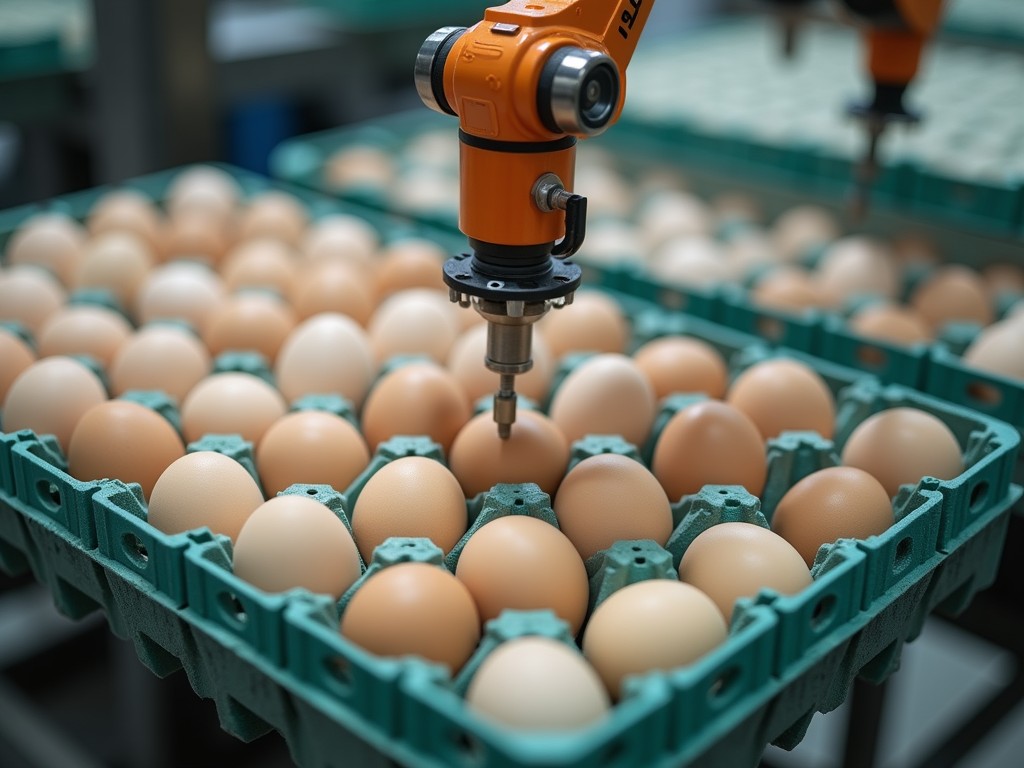
A poultry egg crate robot loader machine automates the transfer of filled egg crates from upstream conveyors to downstream palletizers or packing stations. By replacing manual crate handling, the system reduces labor intensity, minimizes product damage, and supports continuous line operation in high‑volume hatcheries and processing plants.
Operating Principle
The machine consists of a six‑axis industrial robot mounted on a rigid base, equipped with a vacuum‑based gripper designed to engage the standard poultry egg crate without contacting the eggs. A vision system locates crate position and orientation on the infeed conveyor, while the robot controller executes a programmed pick‑place trajectory that maintains crate level throughout the motion.
Cycle time is determined by the reach, speed settings, and crate dimensions, typically ranging from 3.5 to 5.0 seconds per crate when operating at rated payload. Safety interlocks and light curtains stop robot motion if personnel enter the safeguarded zone, complying with ISO 10218‑1 and ISO/TS 15066.
Technical Specifications
| Parameter | Typical Value |
|---|---|
| Maximum payload | 12 kg (crate + eggs) |
| Crate size range (L×W×H) | 300 mm × 250 mm × 120 mm to 400 mm × 350 mm × 150 mm |
| Robot reach | 1300 mm |
| Cycle time (pick‑place) | 3.5 s – 5.0 s (adjustable) |
| Power supply | 380 V ± 10 % 3‑phase, 50/60 Hz, 2.5 kVA |
| Control system | PLC‑based with IEC 61131‑3 programming, optional Ethernet/IP |
| Footprint (L×W) | 1200 mm × 800 mm |
| Machine weight | 350 kg |
Key Features
- Modular steel frame with adjustable mounting brackets for quick line integration
- Vacuum gripper with replaceable suction cups rated for food‑grade sanitation (FDA‑compliant materials)
- Integrated 2D vision system with ±2 mm positional repeatability
- Safety-rated stop‑category 0, PLd according to ISO 13849‑1
- User‑friendly HMI for recipe selection, speed adjustment, and diagnostic logs
- Low‑maintenance brushless DC drives with >20 000 h MTBF
Applications in Poultry Processing
In hatcheries, egg crates are filled manually or by semi‑automatic fillers and then conveyed to loading stations. Manual transfer introduces variability in crate orientation and increases the risk of shell breakage due to sudden impacts. The robot loader provides repeatable, gentle placement that keeps crate tilt within ±2°, preserving egg integrity and supporting downstream grading equipment that assumes consistent crate positioning.
For processing plants that pack eggs into retail cartons, the loader feeds crates directly into high‑speed cartoners, eliminating a bottleneck caused by operator fatigue. The system’s ability to handle multiple crate formats enables a single line to serve both broiler and layer operations without mechanical changeover.
Customization Options
- Alternative gripper types: mechanical clamps for crates with reinforced edges or magnetic fixtures for steel‑based trays
- Extended reach variants up to 1800 mm for larger cell layouts
- Higher speed configurations achieving sub‑3‑second cycles with servo‑upgrade packages
- Stainless‑steel (AISI 304) construction for wash‑down environments requiring IP69K rating
- Integration kits for specific conveyor brands, including mounting plates and signal adapters
Quality Control and Testing
Each unit undergoes a factory acceptance test (FAT) that includes payload verification at 12 kg, cycle‑time measurement across the full speed range, and vision system accuracy checks using calibrated fiducial marks. The robot’s motion is logged for repeatability, with standard deviation of end‑effector position kept below 0.8 mm over 100 consecutive cycles.
Electrical safety is validated with dielectric strength testing (1500 V AC for 1 min) and insulation resistance exceeding 10 MΩ. Mechanical components are inspected for surface finish (Ra ≤ 0.8 µm) to facilitate cleaning and prevent bacterial harborage. Documentation of test results is provided with the shipment.
Installation and Integration
The loader is delivered as a pre‑aligned module with base plate, robot arm, gripper, vision enclosure, and control cabinet. Installation requires anchoring the base to a level floor slab using M16 chemical anchors, aligning the infeed and outfeed conveyors within ±5 mm of the robot’s pick and place points, and connecting the 380 V power supply and safety circuit to the plant’s emergency‑stop loop.
Commissioning includes teaching the robot three reference points (pick, intermediate, place) via the HMI, uploading crate‑specific programs, and performing a trial run with empty crates to verify clearance. Optional on‑site training for operators covers routine maintenance, gripper cup replacement, and fault reset procedures.
Frequently Asked Questions
- What crate dimensions can be handled? The standard gripper accommodates crates from 300 mm × 250 mm × 120 mm up to 400 mm × 350 mm × 150 mm; custom jaws are available for sizes outside this range.
- Is the robot compatible with existing PLC‑based line controls? Yes. The controller supports Ethernet/IP, Modbus TCP, and discrete I/O, allowing seamless start/stop and status signals to interface with your line PLC.
- What is the typical production lead time? Lead time ranges from 8 to 10 weeks after receipt of purchase order, depending on selected options and current factory load.
- Which safety standards does the machine meet? The system complies with ISO 10218‑1 for robots, ISO/TS 15066 for collaborative safety, and IEC 60204‑1 for electrical equipment.
- How is sanitation maintained in wash‑down areas? Stainless‑steel (AISI 304) construction, IP69K rated components, and smooth surfaces with ≤0.8 µm Ra enable effective cleaning with approved detergents and high‑pressure water jets.
Contact for Inquiry
To receive a detailed quotation, lead time confirmation, or to discuss specific line integration requirements, please submit an inquiry using the contact form below. Our technical team will respond with a tailored proposal that includes layout drawings, utility requirements, and commissioning scope.
Submit Inquiry


