Buy Egg Loading And Handling Machine
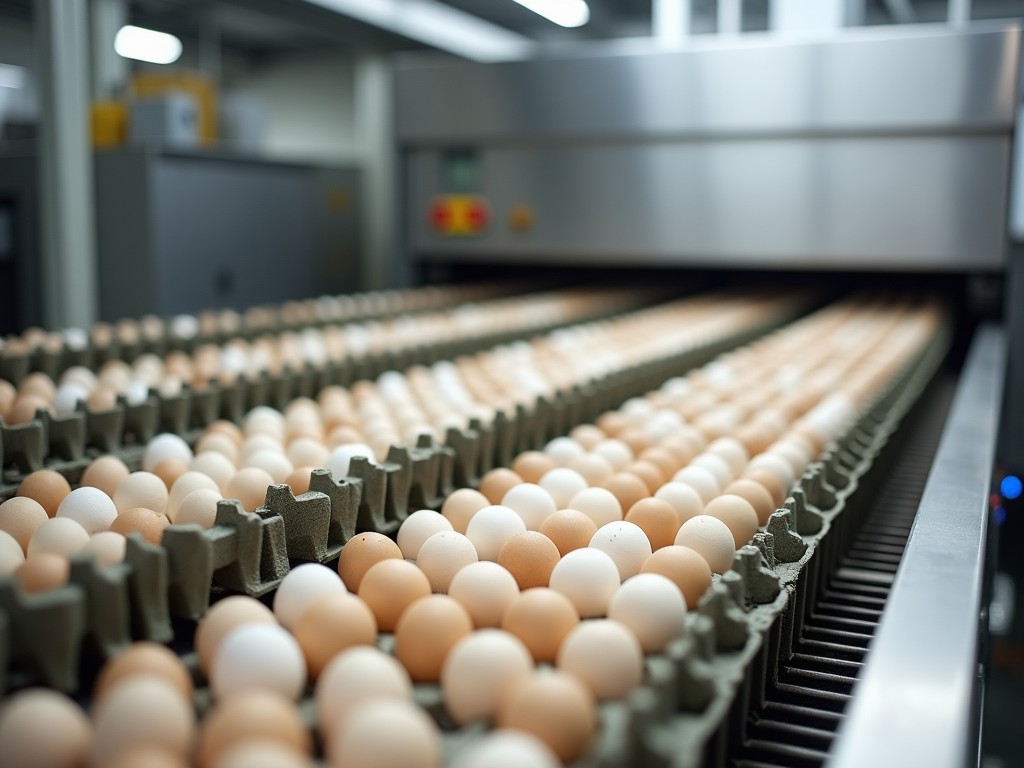
Egg Loading and Handling Machine – Technical Overview
In modern poultry processing lines, eggs must be transferred from collection trays to washing, grading, or packaging stations with minimal mechanical shock and strict hygiene control. Manual handling introduces variability, labor cost, and risk of shell damage, which directly affects yield and product safety. An automated loading and handling system addresses these issues by providing consistent, gentle movement at line speed.
Operating Principle
The machine receives eggs from a feeding conveyor or bulk hopper and positions them onto a synchronized outfeed conveyor. Depending on the model, transfer is achieved using food‑grade polyurethane grippers, vacuum suction cups, or soft‑touch mechanical fingers that engage the egg’s equatorial plane. All contact surfaces are designed to distribute force over a wide area, keeping peak impact below 0.2 N to prevent micro‑cracks.
- Adjustable gripper spacing accommodates egg sizes from 40 mm to 65 mm diameter.
- Variable speed drive allows line matching from 10 000 to 60 000 eggs per hour.
- Optional sensor feedback detects missing or mis‑oriented eggs and triggers a reject divert.
- Low‑profile frame height under 800 mm facilitates integration into existing conveyor layouts.
Key Technical Specifications
| Parameter | Typical Value | Customizable Range |
|---|---|---|
| Maximum Throughput | 45 000 eggs/h | 10 000 – 80 000 eggs/h (drive & gripper sizing) |
| Power Consumption | 1.2 kW @ 45 k eggs/h | 0.8 – 2.0 kW (depends on speed & gripper type) |
| Egg Diameter Range | 42 mm – 58 mm | 38 mm – 65 mm (custom gripper sets) |
| Machine Footprint (L×W×H) | 1800 mm × 700 mm × 750 mm | Length adjustable ±200 mm; Height 650‑900 mm |
| Construction Material | AISI 304 stainless steel | AISI 316L available for high‑salinity environments |
Material Construction and Durability
All load‑bearing frames, guards, and contact surfaces are fabricated from AISI 304 stainless steel, offering a minimum yield strength of 215 MPa and resistance to corrosion from alkaline cleaning agents (pH up to 12). Seams are continuously welded and ground to a surface roughness Ra ≤ 0.8 µm to eliminate crevices where bacteria could harbor. Food‑grade polymers used for grippers comply with FDA 21 CFR 177.2600 and retain flexibility after 10⁶ flex cycles at 23 °C.
Customization Options
- Belt width: 300 mm, 400 mm, 500 mm (standard) – custom widths up to 800 mm available.
- Lift height adjustment for elevation changes between upstream and downstream conveyors.
- Speed control options: VFD with programmable ramp, or fixed‑speed gearbox for constant‑rate lines.
- Communication interfaces: discrete I/O, Modbus TCP, or PROFINET for PLC integration.
- Sanitary enhancements: CIP spray balls, quick‑release guards, and sloped surfaces for drainage.
Applications in Poultry Processing Lines
The primary role of this equipment is to eliminate manual egg transfer between the collection area and the washing station, where shells are exposed to water jets and detergents. By automating this step, processors achieve a more uniform dwell time in the washer, reducing the risk of under‑ or over‑cleaning. Additionally, the gentle handling minimizes micro‑fractures that could lead to leakage during later stages, thereby improving overall grade‑A yield by approximately 1‑2 % in typical high‑volume operations.
Quality Assurance and Testing
Each unit undergoes a factory acceptance test that includes: (1) verification of throughput at set speed using calibrated egg simulators, (2) measurement of impact force with a piezoelectric sensor array, (3) leak test of all welded joints under 0.5 bar water pressure, and (4) visual inspection of surface finish per ISO 4287. Documentation providing test records, material certificates, and CE conformity declaration is supplied with shipment. Optional third‑party validation can be arranged upon request.
Inquiry and Support
To discuss how the egg loading and handling machine can be adapted to your line layout, throughput requirements, or cleaning protocol, please contact our technical team. Provide details such as target eggs per hour, egg size range, existing conveyor heights, and any environmental constraints (e.g., wash‑down temperature, chemical exposure). We will respond with a preliminary concept layout and quotation.



