Automatic Egg Loading Equipment Factory Price
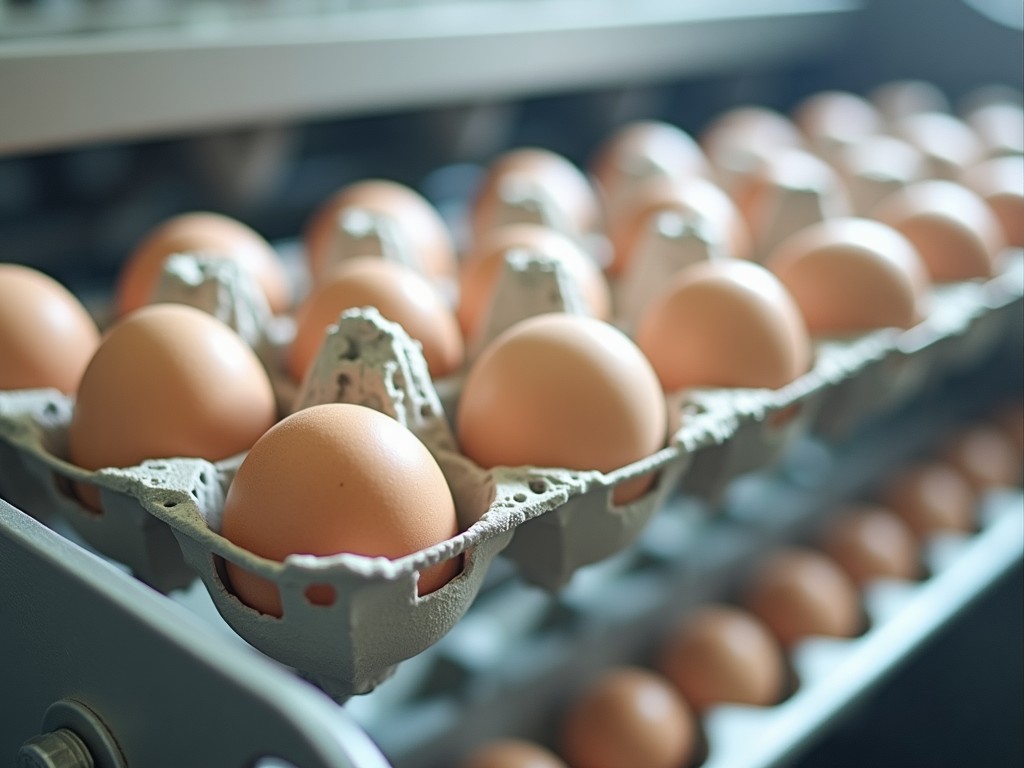
Automatic Egg Loading Equipment – Factory Price
Overview
Automatic egg loading equipment transfers table eggs from bulk storage containers to downstream processing lines such as washing, grading, or packaging stations. The system is designed to handle continuous flow while minimizing mechanical shock that can cause micro‑cracks or shell damage. By automating the transfer step, facilities reduce labor dependency, improve hygiene control, and achieve more consistent feed rates to subsequent operations.
Key Technical Specifications
| Parameter | Typical Value | Unit / Notes |
|---|---|---|
| Maximum throughput | Up to 30,000 | eggs per hour |
| Egg size accommodation | 45 – 68 | mm diameter (small to jumbo) |
| Drive power | 0.75 – 1.5 | kW, three‑phase AC |
| Conveyor speed range | 0.1 – 0.6 | m/s, variable frequency drive |
| Overall footprint | 1200 × 800 × 1500 | mm (L × W × H), configurable |
| Construction material | AISI 304 stainless steel | food‑grade, corrosion resistant |
Design and Construction
The frame is fabricated from welded AISI 304 stainless steel tubes and sheets, providing a smooth surface that resists bacterial adhesion and withstands frequent wash‑down cycles. Eggs are gently guided by a series of food‑grade polyurethane paddles mounted on a rotating drum; the paddle profile is engineered to cradle each egg without applying point loads that exceed 0.2 N. All moving shafts are supported by sealed stainless‑steel bearings lubricated with food‑grade grease, eliminating the need for external lubrication points that could contaminate the product line.
Motor torque is transmitted through a helical gear reducer with a ratio of 20:1, delivering smooth start‑stop characteristics and limiting backlash to less than 0.5°. The control electronics reside in an IP65‑rated enclosure mounted on the frame, isolating them from splash zones while allowing easy access for maintenance.
Operational Characteristics
At nominal speed the system achieves a loading rate of 25,000 eggs per hour with a standard deviation of less than 2% across a ‑hour run, as measured by inline optical counters. Power consumption under full load averages 1.1 kWh per 10,000 eggs, which translates to approximately 0.044 kWh per thousand eggs when accounting for idle periods. The variable frequency drive allows operators to ramp speed from 10% to 100% of maximum in under 3 seconds, facilitating synchronization with upstream buffer stations.
Noise emission measured at 1 meter distance remains below 70 dB(A) during continuous operation, complying with typical workplace acoustic limits for food processing environments. Vibration levels on the frame are kept under 2 mm/s RMS, reducing transmission to adjacent equipment.
Applications in Poultry Processing
In line‑integrated egg processing plants, the loading unit replaces manual transfer from collection trays to washing machines, thereby eliminating a point where shell fragments could be introduced into the wash water. By delivering eggs at a controlled orientation (point‑up) the downstream candling and grading stations experience fewer mis‑reads, improving overall yield by an estimated 0.5‑1% depending on initial egg quality.
The equipment is also suited for break‑and‑separate lines where eggs are directed to cracking units; consistent feeding prevents jamming at the cracker inlet and reduces downtime caused by egg‑shell blockages. Because the loading mechanism does not rely on vacuum or suction, it can handle eggs with varying moisture content without loss of performance.
Customization Options
- Adjustable paddle geometry to accommodate specialty egg shapes (e.g., double‑yolked or organic varieties)
- Alternative construction in AISI 316L for environments with high chloride exposure
- Integration kits for existing conveyor systems, including side‑mount brackets and synchronization encoders
- Optional UV‑C surface treatment module mounted above the loading zone for additional microbial reduction
- Custom control panel layouts with analog potentiometers or touchscreen interfaces per customer specification
Quality Assurance and Testing
Before shipment each unit undergoes a functional test cycle of 50,000 egg equivalents at rated speed, during which torque, speed, and vibration are logged and compared against predefined thresholds. Material certificates for all stainless‑steel components are verified, and welds are inspected via dye penetrant to confirm absence of cracks exceeding 0.1 mm depth. The final inspection includes a hygiene swab test on food‑contact surfaces, with acceptable limits set at <10 CFU/cm² for total aerobic count.
All test data are compiled into a factory test report that is made available to the buyer upon request. The report includes traceability numbers for critical sub‑assemblies such as the gear reducer and motor, facilitating future spare‑part ordering.
Factory Price Considerations
The base price for a standard unit configured for 25,000 eggs/hour, AISI 304 construction, and a basic variable frequency drive starts in the range of USD 18,500 – 22,000, depending on the selected motor size and control enclosure rating. Price adjustments apply for the following factors:
- Increase of approximately USD 1,200 per 5,000 eggs/hour increment in maximum throughput
- Upgrade to AISI 316L stainless steel adds roughly USD 2,800 to the base cost
- Addition of a UV‑C surface treatment module contributes about USD 1,900
- Custom control panel with touchscreen HMI raises the price by USD 1,500 – 2,200 based on screen size and software licensing
All prices are quoted ex‑works (EXW) factory, and do not include freight, insurance, or local taxes. Final pricing is confirmed after a technical review of the customer’s layout drawings and any required ancillary equipment such as infeed conveyors or exit chutes.
Frequently Asked Questions
Can the loading angle be adjusted to match existing line heights?
Yes. The frame includes adjustable mounting brackets that allow the inlet and outlet elevations to be set within a 100 mm range without altering the core mechanism. Custom brackets can be fabricated for larger discrepancies.
What information is required before a quotation can be issued?
To prepare an accurate quote we need the desired eggs‑per‑hour rate, the egg size range to be handled, the construction material preference (304 or 316L), details of the upstream and downstream conveyors (speed, width, height), and any optional features such as UV‑C or specialized control interfaces.
How is quality inspected for food‑contact surfaces?
All food‑contact parts are cleaned, then swabbed according to ISO 18593. The swabs are cultured for total aerobic count and Enterobacteriaceae; acceptance criteria are <10 CFU/cm² and <1 CFU/cm² respectively. Results are documented in the final inspection report.
What packaging methods are available for export shipments?
Units are typically secured on a steel pallet with stretch‑film wrapping and corner protectors. For sea freight, a wooden crate conforming to ISPM 15 standards can be provided upon request. Shock‑absorbing foam is placed around the motor and control enclosure to mitigate transit impacts.
Contact for Quotation
To discuss your specific requirements and receive a detailed factory price proposal, please reach out to our sales engineering team. You can initiate the conversation by visiting the contact page or sending an email with your project specifications.



