Small Farm Egg Grading Machine Manufacturer And Supplier
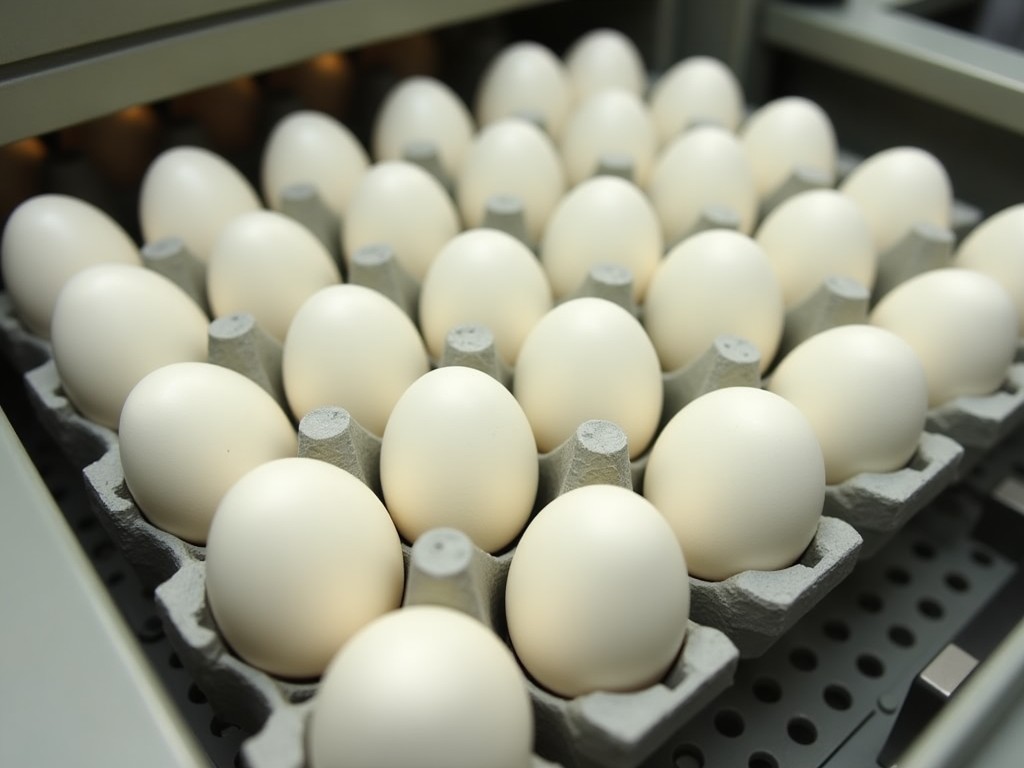
Small Farm Egg Grading Machine Manufacturer and Supplier
This page explains the technical basis for egg grading equipment suited to small‑scale poultry farms. It presents measurable design parameters, material selections, and integration factors that enable procurement engineers to evaluate performance risk and lifecycle cost.
Technical Specifications
| Parameter | Typical Value | Notes |
|---|---|---|
| Throughput | 1 200 eggs/h | Adjustable via feed speed |
| Egg size range | 40 mm – 65 mm diameter | Covers most table‑egg grades |
| Grading accuracy | ±2 g weight tolerance | Based on load‑cell feedback |
| Power consumption | 0.45 kW | Single‑phase 220 V/50 Hz |
| Overall dimensions (L×W×H) | 1 200 mm × 600 mm × 1 100 mm | Footprint fits standard barn aisle |
| Net weight | 180 kg | Stainless‑steel frame |
| Contact material | Food‑grade 304 stainless steel | Polished to Ra ≤ 0.8 µm |
The table above lists typical performance figures; actual values can be adjusted to match specific flock size, egg shape distribution, or facility layout. All mechanical components are designed for continuous operation with a mean time between failures exceeding 4 000 h under normal loading.
Core Functional Characteristics
Eggs enter a rotating belt where each item is weighed by a pair of load cells positioned under a transparent weighing plate. The weight signal triggers a pneumatic diverter that routes the egg into one of three output chutes corresponding to weight classes. Sensor sampling occurs at 200 Hz, providing real‑time classification with less than 0.05 s latency per egg.
The drive system uses a sealed gearbox with a 1:30 reduction ratio, delivering smooth belt speed variation from 0.1 m/s to 0.6 m/s. Belt tension is maintained by a spring‑loaded idler, eliminating slippage even when shell fragments are present. All moving parts are lubricated with food‑grade grease rated for −10 °C to + 40 °C ambient temperature.
Applications and Operational Fit for Small Farms
Small‑scale poultry producers often face labor‑intensive manual sorting, which limits market access due to inconsistent weight grading. By automating the weighing and diversion steps, the machine reduces sorting labor by approximately 70 % and improves pack‑line uniformity, enabling compliance with retailer weight‑class specifications.
The compact footprint allows installation in existing egg‑collection rooms without major structural changes. Low power draw permits operation from a standard farm outlet, and the stainless‑steel construction withstands frequent wash‑down cycles required for biosecurity.
Quality Assurance and Manufacturing Considerations
Each unit undergoes dimensional inspection of critical interfaces using a coordinate measuring machine with ±0.02 mm tolerance. Weld seams on the frame are examined via dye penetrant testing to confirm absence of surface‑breaking defects before passivation.
Material traceability is maintained from mill certificate to final assembly; stainless‑steel batches are verified for chromium and nickel content per ASTM A240. Electrical components are sourced from suppliers with ISO 9001 certification and are subjected to dielectric strength testing at 1 500 V AC for one minute.
Customization Options
- Variable number of output chutes (2 – 5) to accommodate different grading schemes.
- Alternative belt materials such as polyurethane‑coated fabric for reduced egg‑shell wear.
- Integration of a UV‑coded stamp applicator for farm‑specific branding.
- Optional remote monitoring module delivering real‑time throughput and error logs via MQTT.
- Adjustable inlet hopper height to match varying collection conveyor elevations.
Frequently Asked Questions
| Question | Answer |
|---|---|
| Can the machine be adapted for duck or quail eggs? | Yes, by changing the weighing plate size and adjusting the pneumatic diverter thresholds; these parts are available as retrofit kits. |
| What information is required before a quotation? | Average daily egg count, size distribution profile, available power supply voltage, and any specific integration constraints such as existing conveyor height. |
| Which surface finishes are offered for the food‑contact zones? | Standard finish is Ra ≤ 0.8 µm electropolished 304 SS; a optional passivated Ra ≤ 0.4 µm finish can be specified for higher hygiene requirements. |
| How are export shipments protected against corrosion? | Units are packed with vapor‑corrosion inhibitor film, placed in wooden crates with internal bracing, and sealed with desiccant packs; crates are ISPM‑15 compliant for international transport. |
| What is the typical production lead time? | Lead time ranges from 6 to 8 weeks after receipt of technical confirmation, depending on selected customization options. |



