On Farm Egg Grading Solution Company
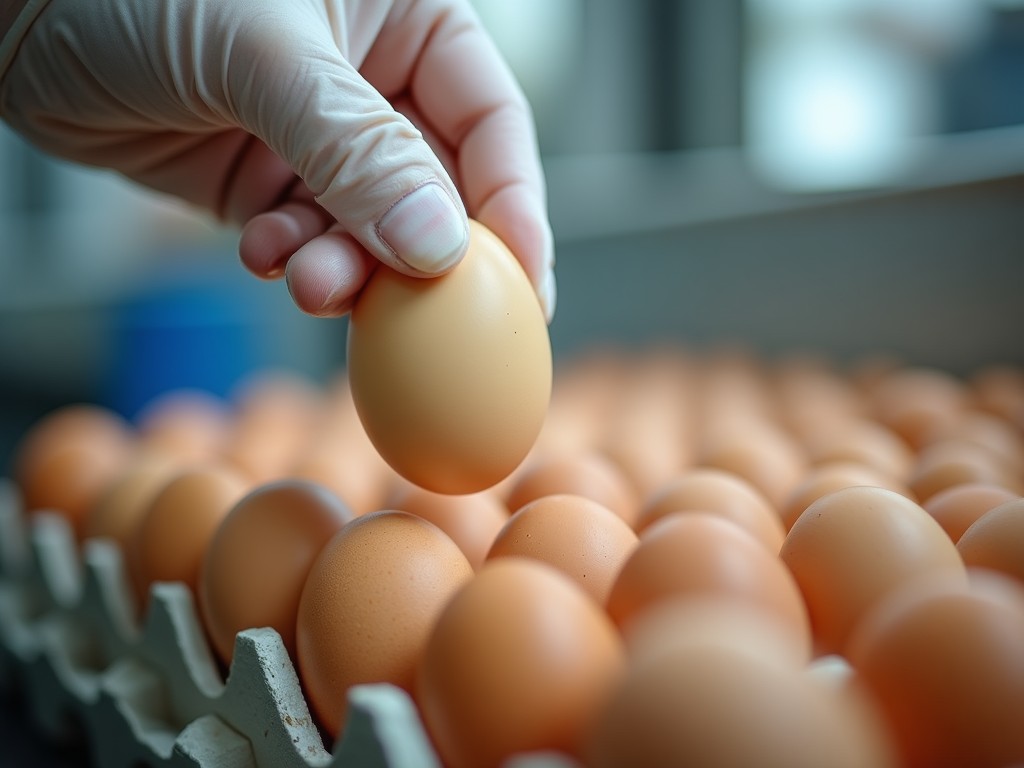
On‑Farm Egg Grading Solution
This system grades eggs directly at the poultry house, separating them by weight, size, and shell integrity before they leave the farm. By performing grading on site, producers reduce handling steps, lower the risk of shell damage, and obtain immediate data for flock management.
How the System Works
Eggs are introduced onto a gently vibrating feeder that presents them in a single lane. A combination of laser‑based size sensors and load cells measures each egg’s longest diameter and weight within 0.2 mm and 0.1 g resolution. Based on preset thresholds, pneumatic diverters route each egg into one of three to five collection chutes labeled for size class, grade, or reject.
The processing rate depends on lane width and egg flow; a typical configuration handles up to 30 000 eggs per hour with less than 2 % mis‑grade. All moving parts are enclosed in stainless‑steel housings rated IP66 for wash‑down compatibility.
Technical Specifications
| Parameter | Typical Value | Unit | Note |
|---|---|---|---|
| Lane width | 100‑150 | mm | Adjustable in 5 mm steps |
| Weight resolution | 0.1 | g | Load cell accuracy |
| Size resolution | 0.2 | mm | Laser triangulation |
| Throughput | 30 000 | eggs/hour | Single lane, 65 % fill |
| Power consumption | 1.2 | kW | At nominal load |
| Supply voltage | 380‑480 | V AC | Three‑phase, 50/60 Hz |
| Material of construction | AISI 304 | – | Optional 316 for corrosive environments |
Key Features
- Modular lane design – add or remove lanes without stopping the line.
- Quick‑change sensor cartridges for weight‑only, size‑only, or combined grading.
- Clean‑in‑place (CIP) spray nozzles with 360° coverage, compatible with alkaline and acidic detergents.
- Integrated data logger stores each egg’s metrics for 30 days; export via USB or Ethernet.
- Low‑vibration drive reduces wear on mechanical parts, extending mean time between failures to >8 000 h.
Applications on the Farm
Placing the grader inside the poultry house eliminates the need to transport eggs to a central facility for sorting. This reduces the time eggs spend in ambient conditions, helping maintain interior quality attributes such as yolk index and albumen height. The system also provides real‑time flock feedback: shifts in average egg weight can indicate feed efficiency changes, while increased reject rates may signal shell quality issues linked to nutrition or disease.
Because the grader handles eggs gently, the proportion of cracked or micro‑cracked shells drops by roughly 15 % compared with conventional conveyor‑based grading. This translates directly into higher marketable yield and lower downgrade losses.
Customization Options
The base unit can be configured with one to four parallel lanes, each independently programmable for different grade thresholds. Customers may select between pneumatic diverters, mechanical flap gates, or servo‑driven pushers depending on the required rejection speed and product fragility.
Housing material is offered in AISI 304 stainless steel as standard; for environments with high chloride exposure, AISI 316L is available. Control software supports Modbus TCP, OPC UA, and discrete I/O for integration with existing farm management systems.
Optional accessories include an UV‑curing station for surface sanitization, a barcode printer for individual egg traceability, and a remote monitoring dashboard that alerts operators to lane jams or sensor drift via SMS or email.
Quality Assurance and Testing
Every unit undergoes a factory acceptance test that verifies sensor accuracy across the full operating range, checks lane synchronization at maximum throughput, and confirms IP66 sealing under spray pressure of 10 bar. Calibration certificates are traceable to national standards and are supplied with each shipment.
In‑field validation is supported by a portable test kit containing reference eggs of known weight and dimensions; users can perform a quick verification after cleaning or after a prolonged shutdown.
Frequently Asked Questions
Can the lane width be adjusted for different egg sizes? Yes, the lane width is adjustable in 5 mm increments from 100 mm to 150 mm to accommodate small pullet eggs up to large jumbo eggs.
What information is required before a quotation? We need the expected hourly egg volume, desired number of grades, preferred rejection method, and any site‑specific constraints such as ceiling height or wash‑down frequency.
Which materials are available for the frame and contact surfaces? Standard frame is AISI 304 stainless steel; contact surfaces can be upgraded to AISI 316L. Food‑grade polypropylene belts are optional for low‑friction lanes.
How is quality inspected during manufacturing? Each sensor undergoes a three‑point calibration; welded seams are inspected with dye‑penetrant testing; final assembly receives a functional run test with a minimum of 5 000 eggs.
What packaging methods are used for shipment? The unit is secured on a steel pallet, wrapped in stretch film, and placed inside a wooden crate with corner protection. Shock indicators are attached to monitor handling.
Next Steps
To discuss how this on‑farm egg grading solution can be tailored to your operation, please use the link below to request a detailed quotation and layout review.



