Odm Egg Washer Grader Sorter 10000 Eggs Hour
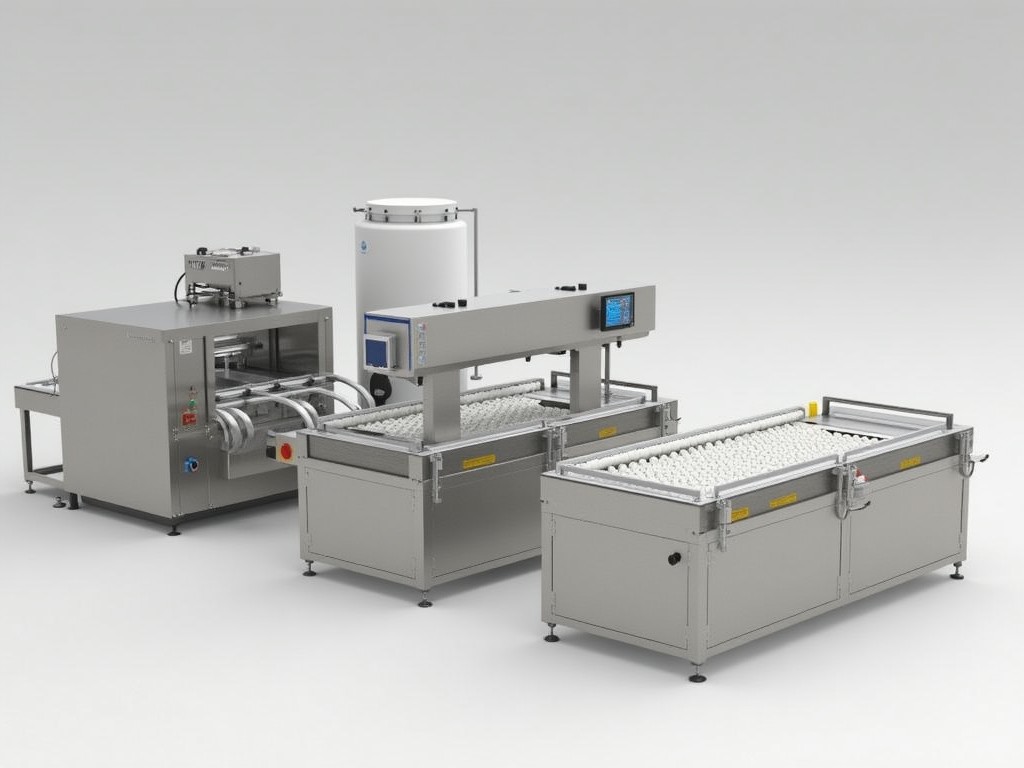
ODM Egg Washer Grader Sorter 10,000 Eggs/Hour
The ODM egg washer grader sorter is a continuous‑flow system designed to clean, classify, and separate shell eggs at a rate of up to 10,000 eggs per hour. It integrates three sequential modules—washing, grading, and sorting—within a single stainless‑steel frame to minimize transfer losses and maintain product integrity.
Technical Specifications
| Parameter | Typical Value / Option |
|---|---|
| Maximum throughput | 10,000 eggs/hour (adjustable via conveyor speed) |
| Washing method | Low‑pressure spray nozzles (80 psi) + soft‑touch brush rollers |
| Water consumption | ≈ 12 L/min (recirculation with filtration) |
| Power requirement | 3 kW motor (wash) + 1.5 kW motor (conveyor) @ 380 V 3 ph |
| Overall dimensions (L×W×H) | 3 200 mm × 1 100 mm × 1 600 mm |
| Machine weight | ≈ 850 kg (stainless steel 304 frame) |
| Grading criteria | Weight (± 2 g) and/or diameter (± 0.5 mm) via load‑cell sensors |
| Sorting outlets | 3‑way pneumatic diverters (configurable to 2‑4 outlets) |
| Construction material | AISI 304 stainless steel (food grade), FDA‑approved seals |
| Control system | PLC with touch‑screen HMI, recipe storage for 10 product profiles |
Working Principle
Eggs are introduced onto a stainless‑steel infeed conveyor that transports them into the washing chamber. Inside the chamber, a series of oscillating spray nozzles deliver a controlled mist of potable water mixed with an approved sanitizing agent, while soft‑touch brush rollers rotate at low speed to remove surface contaminants without cracking shells. The washed eggs then pass over a set of load‑cell weighing stations; each station measures the dynamic force as the egg crosses a short vibratory track, converting the signal to weight data. Based on pre‑set weight or size thresholds, the PLC activates pneumatic diverters that route each egg to the appropriate outlet lane. All motions are synchronized via encoder feedback to maintain consistent spacing and prevent egg‑to‑egg contact during high‑speed operation.
Applications
This equipment serves integrated egg‑processing lines where high volume and hygiene standards are critical, such as large‑scale layer farms supplying breaking plants, egg‑product manufacturers requiring uniformly graded shells for liquid egg production, and hatcheries that need clean, sorted eggs for incubation. By combining washing, grading, and sorting in a single footprint, the system reduces the number of transfer points, lowers labor handling, and minimizes the risk of re‑contamination between process steps.
Customization Options
- Adjustable conveyor speed range: 0.5 – 2.0 m/s to match upstream or downstream equipment.
- Number of sorting outlets: 2‑4 pneumatic diverters with optional mechanical gates.
- Washing chemistry dosing: programmable peristaltic pumps for chlorine, peracetic acid, or ozone‑based sanitizers.
- Additional inspection modules: UV crack detection or UV fluorescence for blood spots.
- Frame material upgrade: AISI 316L for environments with high chloride exposure.
Quality Control
Each unit undergoes a factory acceptance test that verifies throughput accuracy within ± 3 % of the set rate, water consumption under recirculation conditions, and grading repeatability using calibrated test eggs. The PLC logs cycle counts, sensor diagnostics, and alarm history for traceability. Surface finish of all food‑contact areas is inspected to a roughness average (Ra) ≤ 0.8 µm to ensure cleanability and compliance with 3‑A sanitary standards.
Frequently Asked Questions
Can the machine be integrated with existing packing lines?
Yes. The outlet conveyors are equipped with standard 50 mm roller guides and can be height‑adjusted ± 50 mm to match the elevation of downstream packing or case‑forming equipment.
What information is required for a quotation?
To generate a quote we need the desired eggs‑per‑hour rate, water supply pressure and quality, available electrical service (voltage, frequency, phase), and any specific grading or sorting criteria (weight range, size bands, number of outlets).
Which materials are available for the frame and food‑contact parts?
Standard construction uses AISI 304 stainless steel. Optional upgrades include AISI 316L for higher corrosion resistance and FDA‑approved polypropylene for certain non‑metallic components such as brush rollers.
How is the machine protected during export shipment?
The unit is disassembled into transport‑friendly modules, each wrapped in VCI‑treated film, placed in a wooden crate with corner bracing, and sealed with desiccant packs to control humidity during transit.
Contact for Technical Inquiry
To discuss how this system can be adapted to your facility’s layout and processing requirements, please reach out to our engineering team.



