In Line Egg Grader Video 300 Cases Per Hour
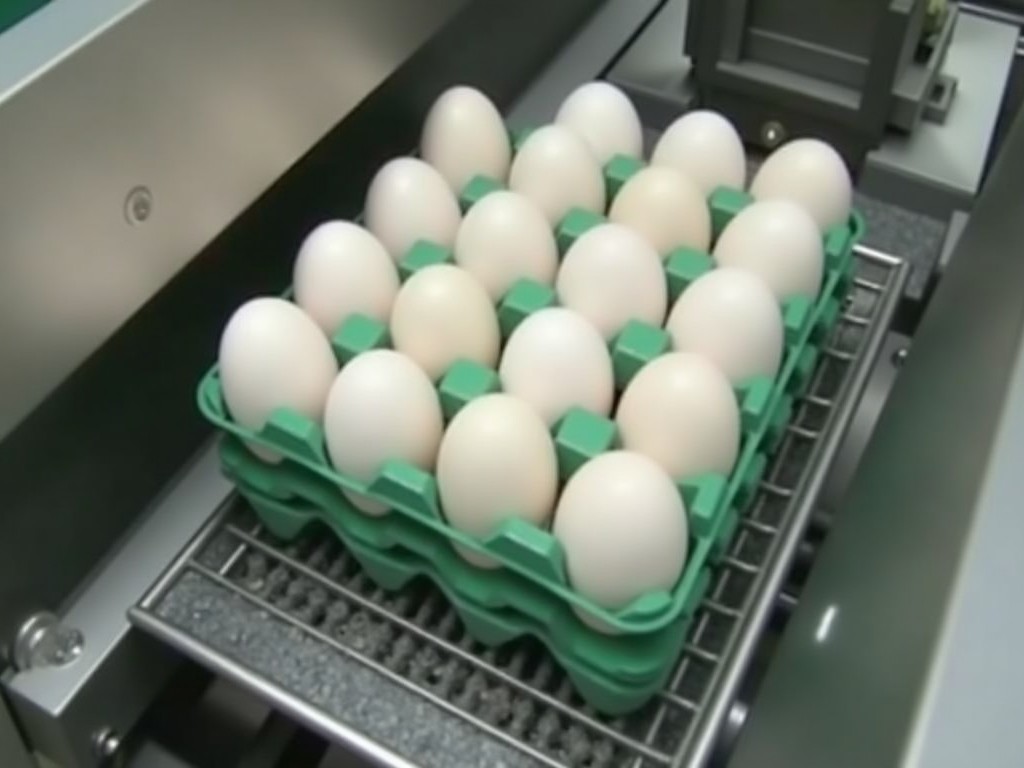
In-Line Egg Grader – 300 Cases per Hour Video System
This equipment integrates high‑speed video inspection with mechanical grading to sort eggs directly on the production line at a rated capacity of 300 cases per hour. Each case is conveyed individually, illuminated, and imaged from multiple angles before a decision algorithm assigns it to the appropriate quality stream.
Technical Operation
A continuous belt transports cases past a series of LED‑lit inspection chambers where dual‑camera arrays capture top and side views at 500 frames per second. Image data is processed by an embedded vision system that measures egg length, width, shell thickness and detects cracks or discoloration within 12 milliseconds per egg. Based on user‑definable tolerances, pneumatic diverters route each egg to one of three outlet lanes: premium, standard, or reject.
The system maintains a constant line speed of 0.45 m/s, which corresponds to the 300‑case‑per‑hour rating when handling standard 30 × 40 × 15 cm egg cases. Power consumption averages 1.2 kW under full load, with a peak draw of 1.6 kW during camera illumination cycles.
Key Features
- Throughput: 300 cases/hour (±5 % tolerance) with a maximum egg flow of 18 000 eggs/hour.
- Inspection resolution: 0.05 mm pixel size, enabling detection of shell defects as small as 0.2 mm.
- Grading criteria: size (weight ±2 g), shell integrity (crack detection threshold 0.1 mm depth), internal quality (yolk index, albumen height) – all adjustable via touchscreen.
- Construction: stainless steel 304 frame, FDA‑compliant contact surfaces, IP65 rated electronics.
- Changeover time: less than 8 minutes for different case sizes, tool‑free belt adjustment.
Applications in the Egg Processing Industry
In-line grading eliminates the need for offline sorting stations, reducing handling time and the risk of mechanical damage that can occur during manual transfers. By integrating directly after washing and before packaging, the system ensures that only eggs meeting the defined quality envelope proceed to carton filling, thereby lowering reject rates and improving overall yield.
Facilities that process mixed‑size batches benefit from the rapid changeover capability, allowing a single line to switch between small‑case retail packs and large‑case bulk containers without stopping production. The vision‑based approach also provides traceable data logs for each case, supporting compliance with food safety audits and customer specifications.
Because the grading decision is made objectively by algorithms, operator subjectivity is minimized, leading to more consistent product quality across shifts and helping producers meet stringent retailer standards for uniform egg size and shell appearance.
Typical Specifications
| Parameter | Value / Range |
|---|---|
| Maximum throughput | 300 cases/hour (≈18 000 eggs/hour) |
| Case dimensions (L×W×H) | 300 mm × 400 mm × 150 mm (customizable) |
| Line speed | 0.45 m/s (adjustable ±10 %) |
| Power consumption | 1.2 kW average, 1.6 kW peak |
| Video resolution | 2 MP per camera, 500 fps global shutter |
| Grading outlets | 3 lanes (premium, standard, reject) – configurable to 2 or 4 |
| Control interface | 7‑inch touchscreen, Ethernet/IP, optional Profibus |
| Materials of construction | Frame: AISI 304 stainless; contact surfaces: FDA‑approved polypropylene |
| Environmental rating | IP65 for electronics, IP54 for mechanical zones |
Frequently Asked Questions
Can the grader be adapted for different egg sizes?
Yes, the belt width and diverter positioning are adjustable via modular guides, allowing accommodation of case sizes ranging from 250 mm to 350 mm width without changing hardware.
What data is exported for quality tracking?
The system logs timestamp, case ID, individual egg measurements, and pass/fail status for each outlet. Data can be exported as CSV or pushed to an MES via Ethernet/IP.
What maintenance is required for the vision system?
The LED illumination modules have a rated life of 30 000 hours. Camera lenses are sealed and require only periodic cleaning with approved solvents; no recalibration is needed under normal operating conditions.
Is the equipment suitable for explosive‑dust environments?
The standard build meets IP65 protection; for ATEX Zone 22 locations, an optional purge and pressurization kit is available upon request.
Get More Information
To discuss how this in‑line egg grader can be integrated into your existing line or to request a detailed quotation, please contact our technical sales team.



