Factory Supply Reusable Egg Tray Washing Machine
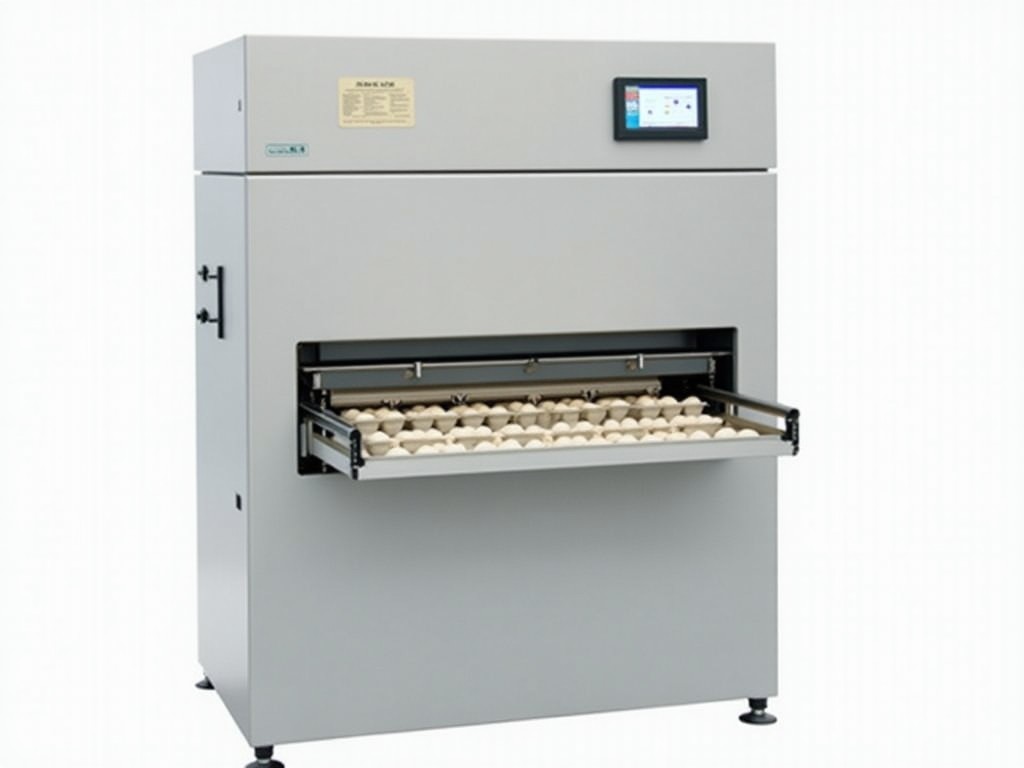
Factory Supply Reusable Egg Tray Washing Machine
Overview
The machine is designed to clean and sanitize reusable plastic or paper pulp egg trays in high‑volume poultry processing lines. It removes organic residue, bacteria, and film while preserving tray integrity for multiple reuse cycles.
Throughput is adjustable to match line speed, typically ranging from 800 to 1500 trays per hour depending on tray size and soiling level. Water consumption is regulated by a closed‑loop spray system that recirculates filtered wash fluid.
Working Principle
Trays are loaded onto a stainless‑steel conveyor that carries them through a series of spray zones: pre‑wash, main wash with alkaline detergent, rinse, and optional sanitizing spray. Each zone uses precisely timed nozzles to impinge fluid at 2–3 bar pressure.
After the final rinse, trays pass through an air‑knife drying section (optional) that removes surface moisture using filtered compressed air at 0.5 MPa. The conveyor then returns trays to the stacking point for reuse.
Technical Specifications
| Parameter | Typical Value | Customization Options |
|---|---|---|
| Throughput (trays/hour) | 1200 (standard) | 800–1800 adjustable via conveyor speed |
| Wash cycle time | 45 s | 30–60 s depending on soil level |
| Water consumption per cycle | 8 L | Recirculation reduces fresh water to 2 L/cycle |
| Power rating | 2.2 kW (main pump) + 0.4 kW (drying fans) | Motor size scalable to line requirements |
| Overall dimensions (L×W×H) | 1800 mm × 900 mm × 1500 mm | Length adjustable in 200 mm increments |
| Construction material | SUS304 stainless steel (food grade) | SUS316 available for corrosive environments |
| Control system | PLC with touchscreen HMI | Optional remote monitoring via Ethernet/IP |
| Drying option | Air‑knife (optional) | Hot‑air dryer available for higher moisture removal |
Key Features
- Closed‑loop wash circuit minimizes fresh water usage and effluent load.
- Adjustable spray pressure and temperature accommodate different tray materials.
- Stainless‑steel construction resists corrosion from alkaline detergents.
- Modular design allows easy integration into existing conveyor lines.
- Touchscreen HMI stores multiple wash programs for quick change‑over.
Applications
Egg processing facilities that reuse trays benefit from consistent sanitation, reducing the risk of cross‑contamination between production batches. The machine handles trays used for table eggs, hatching eggs, and specialty products.
By automating the wash step, labor costs associated with manual scrubbing are cut, and tray life is extended because mechanical agitation is avoided in favor of controlled spray impingement.
Customization Options
- Conveyor width and length to match tray dimensions and line layout.
- Number and arrangement of wash zones (pre‑wash, main wash, rinse, sanitize).
- Choice of detergent injection system for alkaline or neutral cleaners.
- Integration with existing plant SCADA or MES for data logging.
- Optional UV‑C post‑rinse zone for additional microbial reduction.
Quality Assurance
Each unit undergoes hydrostatic testing of the wash circuit at 1.5× operating pressure to verify leak‑free performance. Functional tests confirm spray nozzle flow rates within ±5 % of set points and conveyor speed accuracy.
Material traceability is maintained for all stainless‑steel components, with mill certificates available upon request. Final inspection includes a visual check of weld integrity and a functional run‑through with sample trays to verify cleaning efficacy.
Frequently Asked Questions
Can the machine be adapted for different tray sizes?
Yes. The conveyor width and guide rails are adjustable, and spray nozzle height can be repositioned to accommodate tray heights from 20 mm to 45 mm.
What information is needed for a quotation?
Required details include tray dimensions, material (plastic or pulp), desired throughput (trays per hour), water supply pressure, and any specific cleaning agents used.
How is the machine protected during export shipment?
Units are skid‑mounted, wrapped in corrosion‑inhibiting film, and secured in wooden crates with foam edge protection. Shock indicators are attached to monitor handling.
For a detailed technical proposal or to discuss site‑specific integration, please contact our engineering team.



