Factory Supply Egg Grading Machine Price In South Africa
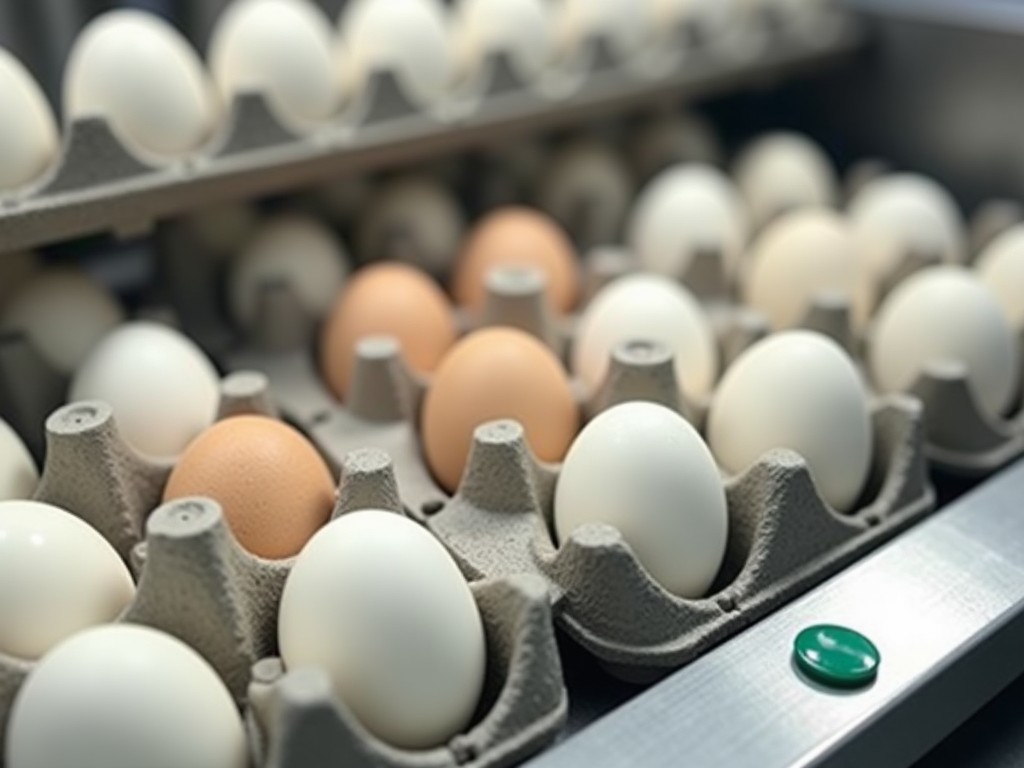
Factory Supply Egg Grading Machine Price in South Africa
Egg grading machines automate the sorting of eggs by weight or size, enabling consistent product quality for packaging and distribution. By integrating load‑cell sensors and programmable logic controllers, these systems replace manual inspection, reduce labor costs, and minimize breakage during high‑volume processing.
Technical Overview
The core weighing module typically uses a stainless‑steel load cell with a resolution of 0.1 g, allowing precise classification into predefined weight brackets. Throughput is driven by a belt or roller conveyor whose speed can be adjusted to match line capacity, commonly ranging from 2 000 to 8 000 eggs per hour depending on model configuration.
Machine dimensions are designed to fit standard poultry processing lines, with a typical footprint of 1 200 mm (L) × 800 mm (W) × 1 500 mm (H). Power consumption is usually between 0.75 kW and 1.5 kW, supplied via a three‑phase 380 V/50 Hz connection, though single‑phase options are available for smaller installations.
Key Specifications
| Parameter | Typical Value / Customizable |
|---|---|
| Throughput (eggs/hr) | 2 000 – 8 000 (adjustable via conveyor speed) |
| Weight measurement accuracy | ±0.2 g (load‑cell dependent) |
| Power supply | 380 V 3‑phase / 50 Hz (optional 220 V 1‑phase) |
| Dimensions (L×W×H) | 1 200 mm × 800 mm × 1 500 mm (customizable) |
| Construction material | AISI 304 stainless steel (food grade) |
| Control system | PLC with touch‑screen HMI (optional remote monitoring) |
| Sensor type | Strain‑gauge load cell (optional laser‑based size detection) |
| Optional features | Automatic reject chute, data logging, UV‑sterilized conveyor, integration with packing line |
Applications in Poultry Processing
- Ensures uniform egg size for retail packaging, reducing customer complaints and returns.
- Supports traceability by recording weight data for each batch, useful for quality audits.
- Minimizes manual handling, lowering the risk of shell damage and contamination.
- Facilitates compliance with South African agricultural standards (e.g., DAFF grading regulations).
Pricing Factors in the South African Market
The quoted price for an egg grading machine depends primarily on the required throughput level, as higher‑speed conveyors and reinforced frames increase material and motor costs. The choice of stainless‑steel grade (304 vs. 316) affects corrosion resistance and price, particularly in facilities with aggressive cleaning agents. Additional cost drivers include the extent of automation (e.g., integrated reject systems, data logging), local installation and commissioning services, and applicable import duties or VAT. After‑sales support availability, such as spare‑part stockholding in Johannesburg or Cape Town, also influences the total cost of ownership.
Frequently Asked Questions
- Can the machine be customized for specific egg sizes? Yes, the weight brackets and conveyor speed can be programmed during commissioning to match customer‑defined size ranges.
- What information is required before a quotation? Required details include target eggs per hour, desired weight categories, preferred material grade, and any needed optional features such as reject chutes or data logging.
- Which materials are available for the frame and contact surfaces? Standard frames are supplied in AISI 304 stainless steel; AISI 316 is offered upon request for higher corrosion resistance.
- How is quality inspected before shipment? Each unit undergoes functional testing of load‑cell accuracy, conveyor speed stability, and safety interlock verification, followed by a visual weld and finish inspection.
- What packaging methods are used for export? Machines are wrapped in corrosion‑inhibiting film, placed on sturdy pallets, and secured with straps; optional wooden crates are available for extra protection.
- What is the typical production lead time? Lead times range from 6 to 10 weeks after receipt of technical confirmation, depending on configuration complexity.
Request a Quotation
To obtain a detailed proposal tailored to your facility’s capacity and specifications, please provide your operational requirements.
Request a quotation


