Commercial Egg Grader Washer For Poultry Farm
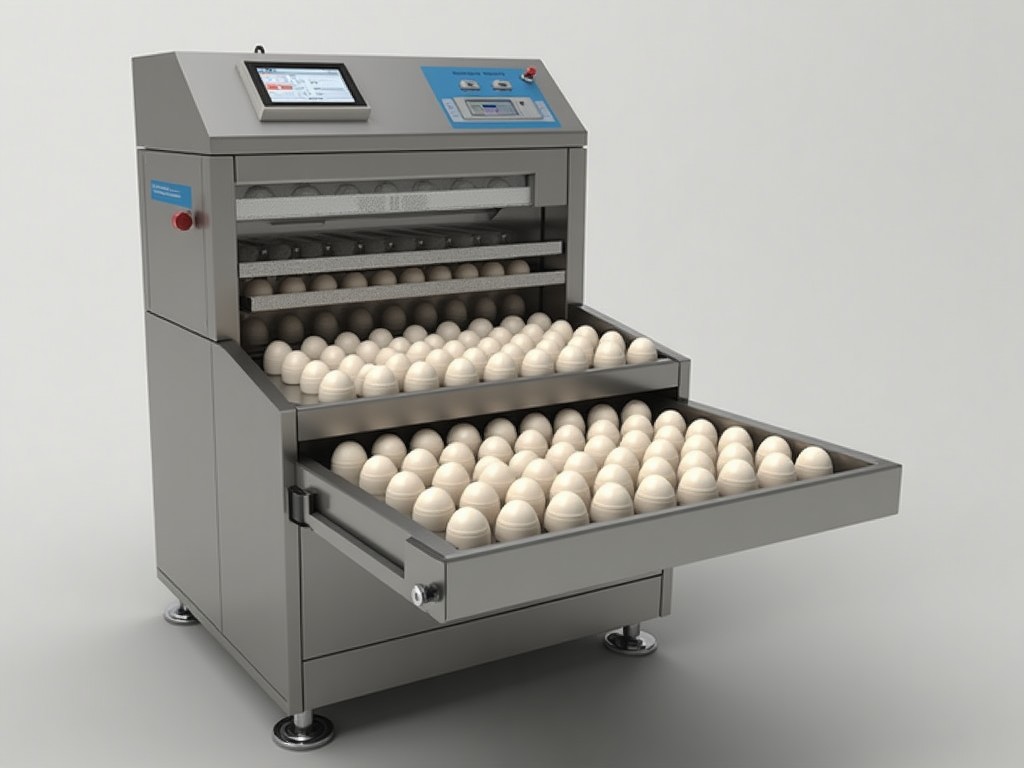
Commercial Egg Grader Washer for Poultry Farm
This unit combines mechanical grading with a spray‑wash system to sort eggs by size while removing surface contaminants before packing. It is designed for continuous operation in high‑volume poultry farms where throughput and hygiene are critical. The following sections detail its functional principle, specifications, and integration considerations.
Operating Principle
Eggs enter a rotating drum equipped with interchangeable grading slots that separate them into predefined weight classes. As each egg passes through the slot, a series of high‑pressure nozzles spray a food‑grade sanitizing solution, followed by an air‑knife drying stage. The graded, washed eggs exit onto a conveyor for downstream packaging.
Key Specifications
| Parameter | Typical Value |
|---|---|
| Maximum Capacity | Up to 30,000 eggs/hour |
| Grading Accuracy | ±2 g weight tolerance |
| Wash Pressure | 1.2–1.5 MPa adjustable |
| Power Consumption | 4.5 kW (3‑phase 380 V) |
| Overall Dimensions (L×W×H) | 2200 mm × 1100 mm × 1500 mm |
| Control Voltage | 24 VDC PLC |
Construction Materials
- Food‑grade stainless steel (AISI 304) for all contact surfaces
- Powder‑coated carbon steel frame for structural support
- FDA‑approved polyurethane seals on rotating shafts
- Corrosion‑resistant PVC spray nozzles
Capacity and Throughput
The grading drum accommodates up to six interchangeable slot sets, enabling rapid change‑over between size categories without stopping the line. With a synchronized wash cycle, the system maintains a steady output of 25,000–30,000 eggs per hour under typical farm conditions.
Control System
A programmable logic controller (PLC) manages slot rotation speed, wash pressure, and conveyor synchronization via a touch‑screen HMI. Operators can select preset grading profiles or adjust parameters in real time to accommodate variations in egg size or shell condition.
Feedback from load cells on the grading drum provides continuous weight monitoring, allowing the PLC to compensate for wear and maintain grading tolerance within ±2 g. Fault diagnostics are logged and displayed on the HMI for rapid troubleshooting.
Cleaning and Maintenance
- CIP (clean‑in‑place) system with automated detergent and rinse cycles
- Quick‑release grading slots allow removal for inspection in under five minutes
- Lubrication points are sealed and accessible via external grease fittings
- Scheduled maintenance interval: 500 operating hours for nozzle inspection, 2000 hours for drive gearbox
Safety Features
Emergency stop buttons are positioned at each operator station and are wired to a safety‑rated PLC that cuts power to all moving parts within 0.2 s.
Guarding interlocks prevent access to the grading drum while the drive is active, and overload protection trips the motor if torque exceeds 150 % of rated value.
Customization Options
- Adjustable slot widths for specialty egg sizes (e.g., jumbo, peewee)
- Alternative wash chemistries (chlorine‑based, peracetic acid, or ozone)
- Extended conveyor lengths for integration with existing packing lines
- Stainless steel (AISI 316) upgrade for high‑salinity environments
Applications in Poultry Farming
Egg producers benefit from reduced labor because the unit automates both size classification and surface sanitation, two steps that traditionally required separate manual operations. By delivering clean, uniformly graded eggs directly to the packing line, the system lowers the risk of downgrades due to dirt or size variance, thereby improving overall yield and market price consistency.
Quality Assurance
Each grader‑washer undergoes factory acceptance testing that includes a 24‑hour run at 110 % of rated capacity, verification of wash coverage using UV‑traceable dye, and validation of grading accuracy against calibrated test weights. Documentation of test results is provided with every shipment, and a one‑year limited warranty covers parts and labor for non‑wear components.
Frequently Asked Questions
A: Yes, the slots are designed with a quick‑release latch that allows manual exchange in under three minutes.
A: The nozzles operate effectively with potable water containing up to 150 ppm total dissolved solids; a pre‑filter is recommended for higher hardness.
A: The standard model is intended for indoor, temperature‑controlled environments; an optional weather‑proof enclosure is available for sheltered outdoor use.



