Buy Egg Grading And Washing Machine
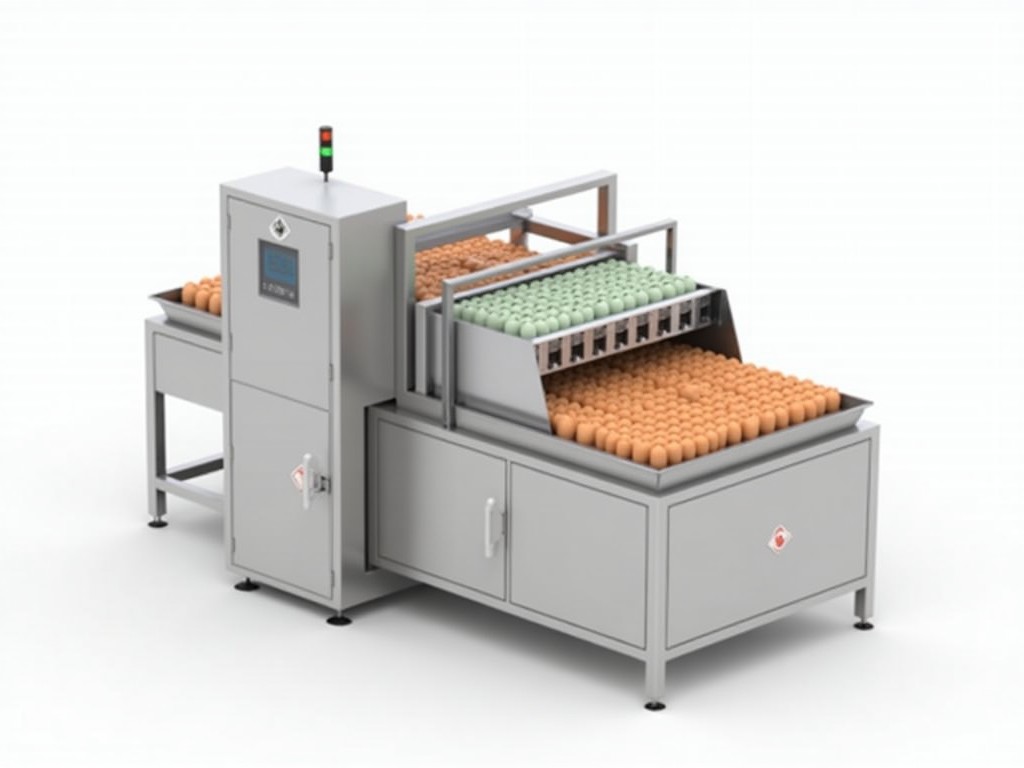
Egg Grading and Washing Machine – Technical Overview
This equipment combines size‑based grading with a sanitizing wash cycle to prepare table eggs for packing or further processing. By integrating both functions, the machine reduces handling steps, minimizes microbial load, and improves throughput in egg‑processing lines.
Operating Principle
Eggs are introduced onto a stainless‑steel belt that conveys them to a set of adjustable rollers. The roller gap is set according to the target size class; eggs smaller than the gap fall through to a lower chute, while larger eggs continue to the next roller set. After grading, the eggs enter a spray chamber where nozzles deliver potable water mixed with an approved chlorine‑based sanitizer at a controlled pressure. A short air‑knife stage removes excess water before the eggs exit onto a collection conveyor.
Key Technical Specifications
| Parameter | Typical Value |
|---|---|
| Model designation | EGW‑2000 series |
| Capacity | Up to 30 000 eggs/hour |
| Egg size range (gradable) | 40 mm – 65 mm major axis |
| Power consumption | 3.5 kW (motor) + 1.2 kW (pump) |
| Wash tank volume | 150 L |
| Wash cycle time | 8 s per egg (spray + dwell) |
| Grading accuracy | ±2 mm on major axis |
| Overall dimensions (L×W×H) | 2200 mm × 900 mm × 1500 mm |
| Net weight | 420 kg |
| Construction material | AISI 304 stainless steel (food grade) |
| Power supply | 380 V / 50 Hz 3‑phase |
Material Construction
All product‑contact surfaces are made from AISI 304 stainless steel, which provides resistance to corrosion from wash chemicals and facilitates cleaning-in-place (CIP). Food‑grade silicone gaskets seal the roller housings, preventing water ingress into bearings. The conveyor belt uses a polypropylene mesh with stainless‑steel edge reinforcement to maintain dimensional stability under wet conditions.
Applications in Poultry Processing
In a typical egg‑processing line, the grading and washing unit replaces two separate machines, thereby reducing floor space and the number of transfer points. Consistent size classification enables downstream packaging equipment to operate at optimal speed, while the wash cycle achieves a minimum 5‑log reduction of surface microbiota, helping meet ISO 22000 and BRCGS food‑safety standards.
Customization Options
- Adjustable roller gap increments of 0.5 mm for fine‑tuning size cuts
- Variable spray pressure (0.5–2.0 bar) and sanitizer concentration control
- Integrated UV‑C module for additional microbial inactivation
- Data‑logging interface (Modbus TCP) for production traceability
- Extended conveyor lengths up to 4 m for upstream buffering
- Optional hot‑air drying zone (80 °C, 3 s residence)
Quality Control and Testing
Before shipment each unit undergoes a factory acceptance test that verifies capacity, grading accuracy, and wash efficacy using standardized test eggs. Performance data are recorded and supplied with the equipment documentation. Routine maintenance intervals are based on operating hours, with wear‑part replacement schedules for rollers and seals provided in the manual.
Frequently Asked Questions
Can the roller gap be adjusted while the machine is running? Yes, the gap setting uses a manual micrometer that can be changed during a scheduled stop; the adjustment does not require disassembly.
What information is needed for a quotation? Required details include desired egg‑per‑hour capacity, egg size distribution, preferred wash chemical, and any optional modules such as UV‑C or hot‑air drying.
Which materials are available for the frame? The standard frame is AISI 304 stainless steel; AISI 316L is offered for higher chloride environments upon request.
How are export shipments protected? Units are packed in a wooden crate with foam corner protectors, sealed with shrink‑wrap, and include a moisture‑desiccant bag to prevent corrosion during transit.
Contact for Inquiry
To discuss your specific requirements or request a detailed quotation, please contact our technical sales team.



