Buy Egg Cleaning Grading Sorting Machine
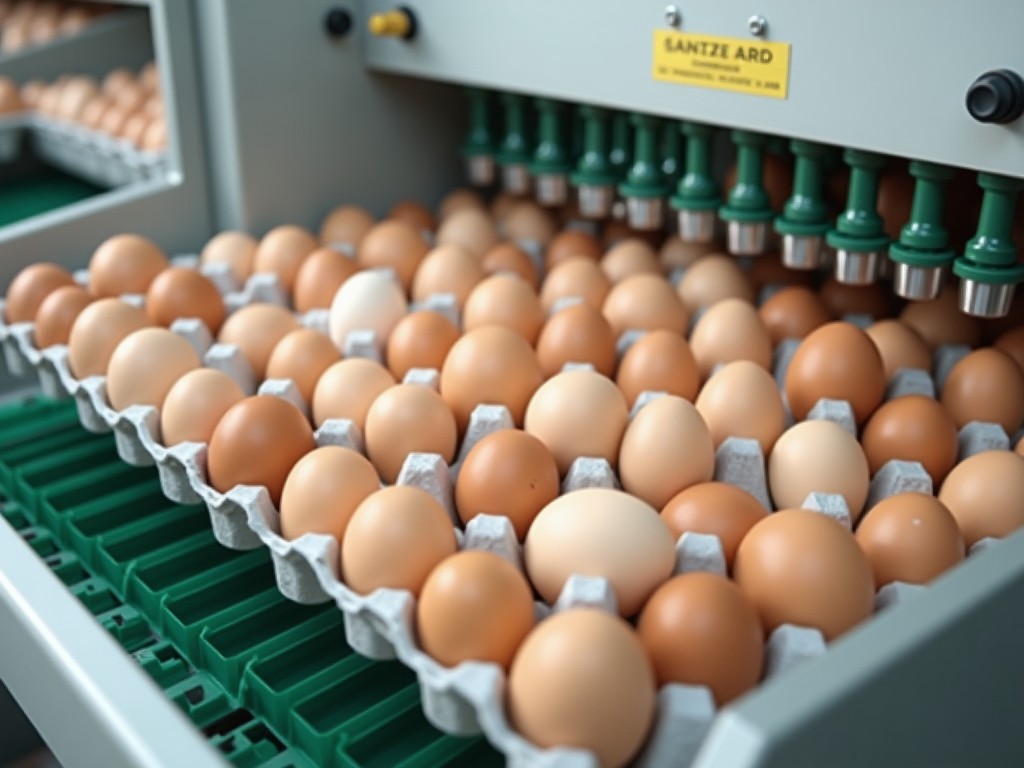
Buy Egg Cleaning Grading Sorting Machine
Overview
The machine performs three sequential operations on shell eggs: removing surface contaminants, classifying eggs by weight and size, and directing each egg to the appropriate downstream lane. It is intended for integrated lines in egg processing facilities, hatcheries, and food‑service preparation centers where consistent product quality and labor reduction are required.
Working Principle
Eggs enter a pre‑wash chamber where a low‑pressure spray loosens debris. They then pass through a rotating brush system with adjustable bristle pressure that scrubs the shell without cracking. After brushing, a forced‑air drying section removes surface moisture. Each egg is weighed by a load‑cell array and measured by optical sensors for diameter and length. Based on preset thresholds, pneumatic diverters route the egg to one of several graded outlets.
Technical Specifications
| Parameter | Typical Value / Customizable |
|---|---|
| Capacity | Up to 30,000 eggs/h (standard), scalable to 60,000 eggs/h with additional lanes |
| Egg size range | 35 mm – 65 mm length; adjustable via sensor calibration |
| Power consumption | 2.5 kW (main drive) + 0.8 kW (blowers), configurable for voltage 380‑480 V 3‑phase |
| Overall dimensions (L×W×H) | 2200 mm × 950 mm × 1500 mm (base model); extendable with extra modules |
| Contact material | Stainless steel 304 (food grade) for all surfaces contacting eggs; optional 316 for corrosive environments |
| Sorting grades | 3‑grade (small, medium, large) standard; up to 5 grades可选 |
| Cleaning method | Rotary brush + spray nozzles; CIP‑compatible with removable spray headers |
| Control system | PLC with touch‑screen HMI; recipes stored for quick change‑over |
Notable Features
- Modular lane design allows addition or removal of sorting outlets without line shutdown.
- Brush pressure is regulated by a closed‑loop feedback loop, maintaining consistent scrub force ±5 %.
- Integrated weight sensor accuracy ±0.2 g enables precise grading for weight‑based pricing.
- HMI provides real‑time throughput, reject rate, and maintenance alerts, reducing downtime.
- All major components are accessible for clean‑in‑place (CIP) procedures, meeting hygienic design standards.
Applications
In large‑scale egg breaking plants, the machine ensures that only eggs meeting strict weight and size criteria proceed to the breaker, reducing waste and improving yield. Hatcheries use the graded output to uniform incubation trays, which improves hatch consistency. For food‑service suppliers, the cleaning stage removes fecal matter and feathers, helping meet microbiological limits without excessive water usage.
Customization Options
Customers can specify the number of sorting lanes (from two to eight) to match downstream packaging equipment. Discharge chutes can be angled or fitted with conveyor belts for integration into existing lines. Optional UV‑C modules downstream of the dryer provide additional surface disinfection. The control software can be adapted to communicate with MES systems via Ethernet/IP or Modbus TCP.
Quality Assurance
Fabrication follows ASME BPE standards for stainless‑steel welding, with full traceability of material certificates. Before shipment, each unit undergoes a factory acceptance test that verifies throughput, weight‑sensor accuracy (±0.2 g), and brush‑force consistency. Test data are documented and available for review upon request.
Frequently Asked Questions
Can dimensions be customized? Yes, the frame length and width can be adjusted to fit facility layouts; consult engineering for specific limits.
What information is needed for a quotation? Required details include target egg size range, desired throughput (eggs per hour), number of sorting grades, and any optional features such as UV or CIP integration.
Are spare parts readily available? Critical wear items such as brushes, seals, and sensor modules are stocked for standard models; lead times are typically two weeks.
How is the machine cleaned between batches? The design supports clean‑in‑place with removable spray headers and drain valves; a full CIP cycle takes approximately 15 minutes.
Next Steps
To discuss how this equipment can be tailored to your processing line, request a detailed quotation or arrange a technical consultation.
Contact Us


