Bulk Industrial Egg Candling And Grading Machine
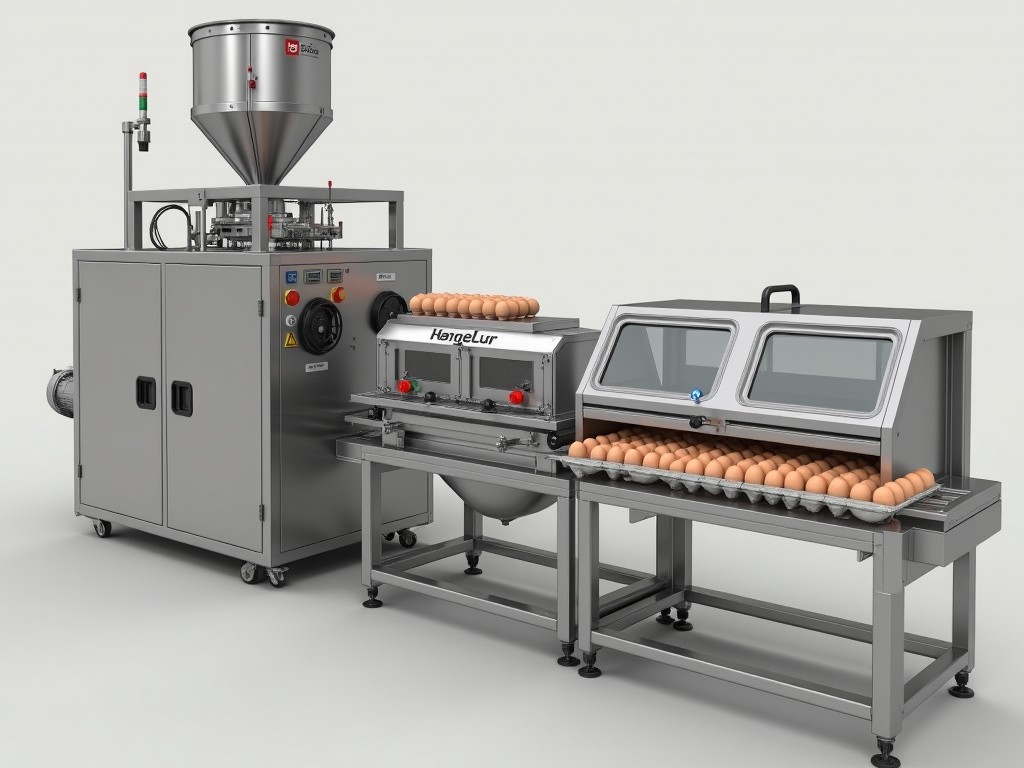
Bulk Industrial Egg Candling and Grading Machine
This equipment processes large volumes of eggs by transmitting light through each shell to detect internal defects and by measuring weight, shape, and shell texture to assign quality grades. The system is designed for continuous operation in hatcheries and poultry processing plants where throughput exceeds 30,000 eggs per hour.
Egg candling relies on a collimated LED light source positioned beneath a transparent conveyor; a line‑scan camera captures the shadow pattern, which is analyzed for blood spots, cracks, or irregular yolks. Grading combines the candling data with load‑cell weight measurements and laser‑based dimension scanning to sort eggs into predefined classes such as AA, A, B, or reject.
Key Technical Specifications
| Parameter | Typical Value | Notes |
|---|---|---|
| Egg size range | 35 mm – 65 mm length | Adjustable guides accommodate breed variations |
| Throughput | 30,000 – 60,000 eggs/hour | Depends on egg size and grading complexity |
| Candling light wavelength | 660 nm (red) ±10 nm | Optimized for hemoglobin absorption |
| Grading categories | AA, A, B, Reject (customizable) | Thresholds set via touchscreen |
| Power consumption | 2.5 kW (average) | Includes conveyor drives and illumination |
| Air pressure requirement | 0.5 MPa (clean, dry) | Used for eject actuators |
| Overall dimensions (L×W×H) | 3.2 m × 1.0 m × 1.8 m | Frame constructed of AISI 304 stainless steel |
| Net weight | 850 kg | Includes motor, electronics, and guarding |
| Control system | PLC with HMI (touchscreen) | Supports Ethernet/IP and Modbus TCP |
Typical Applications
Large‑scale hatcheries use the machine to separate fertile from infertile eggs before incubation, reducing wasted energy and improving chick uniformity. In egg‑processing facilities, the same unit provides rapid quality sorting for retail packing lines, ensuring that only eggs meeting interior and exterior standards proceed to carton filling.
The equipment integrates with upstream washing and drying stations and downstream packaging robots via standard communication protocols, enabling a fully automated flow from receipt to palletizing without manual intervention.
Customization Options
- Adjustable egg‑size guides for quail, duck, or turkey eggs
- Alternative illumination spectra (UV, blue) for specialized defect detection
- User‑definable grading algorithms via software updates
- Variable conveyor speed controlled by frequency inverter
- Optional reject‑divert mechanisms (air jet, mechanical flap)
- Enclosure upgrades to IP65 for wash‑down environments
Quality Assurance and Manufacturing
Frame components are CNC‑machined from AISI 304 stainless steel sheets, providing corrosion resistance against alkaline cleaning agents and high‑humidity conditions. All load‑cells and laser scanners undergo factory calibration with traceable weights and calibrated targets, with calibration certificates supplied per unit.
Before shipment, each machine runs a 24‑hour endurance test using a mixed batch of eggs to verify throughput consistency, defect detection accuracy, and reject‑actuation reliability. Statistical process control charts are generated for key parameters such as candling signal‑to‑noise ratio and weight‑scale repeatability.
Frequently Asked Questions
- Can the machine be adapted for different egg sizes? Yes, the guide rails and sensor mounting brackets are adjustable and can be re‑set for egg lengths from 30 mm to 75 mm without mechanical redesign.
- What information is needed for a quotation? Required details include expected hourly volume, egg species and size range, desired grading classes, facility power supply (voltage/frequency), and any integration constraints such as existing conveyor height.
- Which materials are available for food‑contact surfaces? All surfaces that contact eggs are made of AISI 304 stainless steel or FDA‑approved polycarbonate for transparent guards; alternative materials such as AISI 316L are offered upon request for high‑chloride environments.
- How is quality inspected during production? Each unit undergoes functional testing, electrical safety verification (IEC 60204‑1), and an optical performance test using calibrated defect samples before packaging.
Next Steps
To discuss how this egg candling and grading system can be tailored to your production line, please provide your operational specifications using the contact form or email address listed below. Our engineering team will respond with a detailed layout drawing, power consumption estimate, and lead‑time estimate within two business days.



