Bulk Egg Washing Grading Machine For 20000 Layers
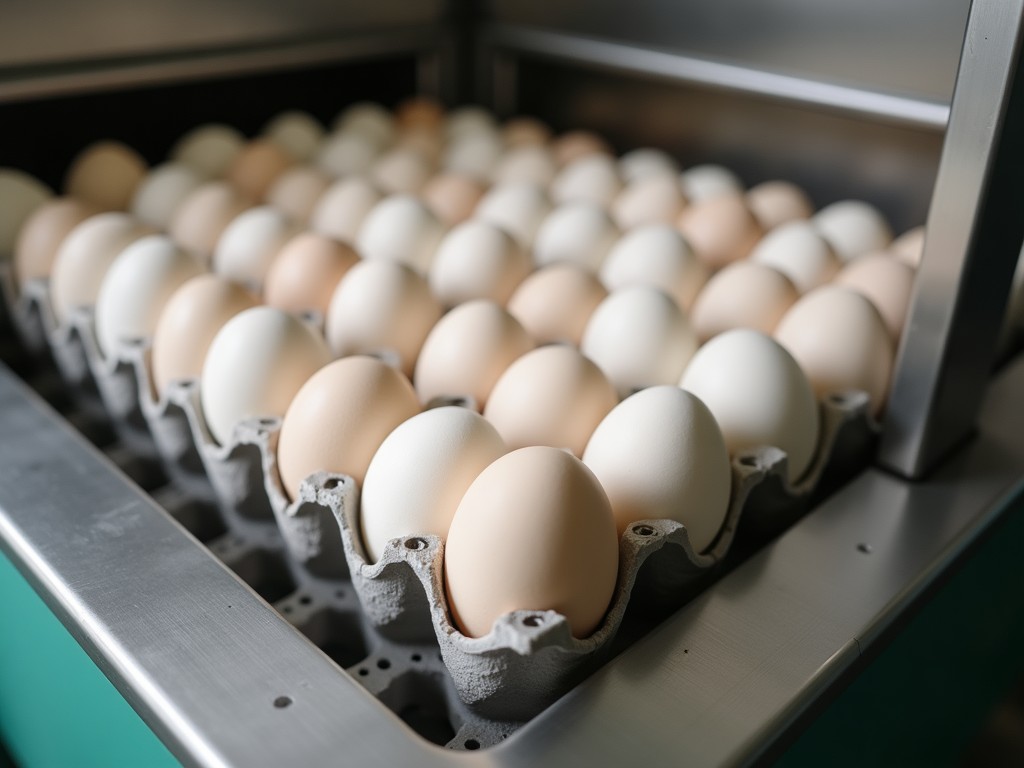
Bulk Egg Washing and Grading Machine for 20,000 Layers
A bulk egg washing and grading machine designed for farms with approximately 20,000 laying hens processes eggs from collection to market‑ready state in a continuous line.
Throughput typically ranges from 12,000 to 18,000 eggs per hour depending on egg size, water temperature, and selected wash cycle.
Technical Specifications
| Parameter | Value | Notes |
|---|---|---|
| Model | EWG‑20K‑S | Standard configuration |
| Capacity (eggs/h) | 12,000‑18,000 | Adjustable via conveyor speed |
| Wash tanks | 2 (pre‑wash + main wash) | Stainless steel construction |
| Grading method | Load‑cell weight stations (optional sieve) | Interchangeable |
| Conveyor speed | 0.15‑0.45 m/s | Variable frequency drive |
| Water consumption | 150‑250 L/h | Recirculation with filtration |
| Power rating | 3.5 kW | 3‑phase, 380 V |
| Dimensions (L×W×H) | 3200 × 1100 × 1500 mm | Includes infeed/outfeed conveyors |
| Material | 304 stainless steel (frame & contact parts) | Optional 316 for high chloride |
| IP rating | IP65 (electrical enclosures) | Suitable for wash‑down areas |
Design and Construction
The frame is constructed from 304 stainless steel tubing with a wall thickness of 2 mm, providing corrosion resistance in high‑humidity environments.
All contact surfaces with eggs and water are polished to Ra ≤ 0.8 μm to minimize bacterial retention and facilitate cleaning.
Drive units use sealed IP65 rated gear motors rated for 24/7 operation, with overload protection integrated into the control panel.
Operational Principles
Eggs enter the pre‑wash zone where a low‑pressure spray removes loose debris before entering the main wash chamber.
In the wash chamber, rotating soft‑brush rollers combined with heated water (45‑55 °C) and approved sanitizer achieve a 99.9 % reduction of surface microbiota.
After washing, eggs pass through an air‑knife drying section that reduces surface moisture to less than 0.5 % weight, preventing sticking during grading.
Grading is performed by a series of load‑cell weigh stations or mechanical sieves that sort eggs into predefined weight classes (e.g., small, medium, large, extra‑large) at a rate synchronized with the conveyor speed.
Applications
The machine integrates directly into egg collection systems of large layer houses, reducing manual handling and minimizing micro‑cracks caused by manual washing.
- Commercial layer farms with 15,000‑25,000 hens
- Integrated egg processing centers requiring inline washing
- Breaker and liquid egg plants needing pre‑graded shells
Customization Options
Customers can select the number of washing lanes (single, dual, or triple) to match peak flow requirements.
Grading modules can be configured for weight‑based sorting, size‑based sorting, or a combination of both, with interchangeable sieve sets.
Optional features include UV‑C water treatment, automated chemical dosing, and data logging for traceability.
Quality Assurance
All stainless steel components undergo passivation and electropolishing to achieve a surface chromium‑nickel ratio that resists pitting from chloride‑containing wash water.
Electrical panels are built to IEC 60204‑1 standards, with short‑circuit protection and emergency stop circuits accessible at each operator station.
Factory acceptance testing includes a 24‑hour run‑at‑capacity test, water‑tightness verification, and grading accuracy verification within ±2 % of target weight.
Frequently Asked Questions
Q: Can the machine dimensions be altered to fit an existing building layout? A: Yes, the frame length and conveyor infeed/outfeed angles are adjustable within ±15 % of standard dimensions.
Q: What information is required before a quotation is issued? A: Required data include average egg size, desired hourly output, water quality specifications, and any special grading criteria.
Q: Which materials are available for the wash tanks? A: Standard tanks are 304 stainless steel; 316L is offered for high‑chloride or disinfectant‑intensive processes.
Q: How is the machine quality inspected before shipment? A: Each unit undergoes a factory acceptance test covering mechanical run‑time, leak detection, sensor calibration, and functional verification of all safety interlocks.
Q: What packaging methods are used for export shipments? A: The machine is disassembled into transport‑ready modules, wrapped in corrosion‑inhibiting film, and secured in ISO‑standard wooden crates with shock‑absorbing pallets.
Q: What is the typical production lead time? A: Lead time ranges from 8 to 12 weeks after receipt of technical confirmation and deposit, depending on selected options.
Call to Action
To discuss how this machine can be adapted to your specific layer house layout and production goals, please contact our engineering team.
Request Quotation


