Bulk Best Small Scale Egg Washing Machine
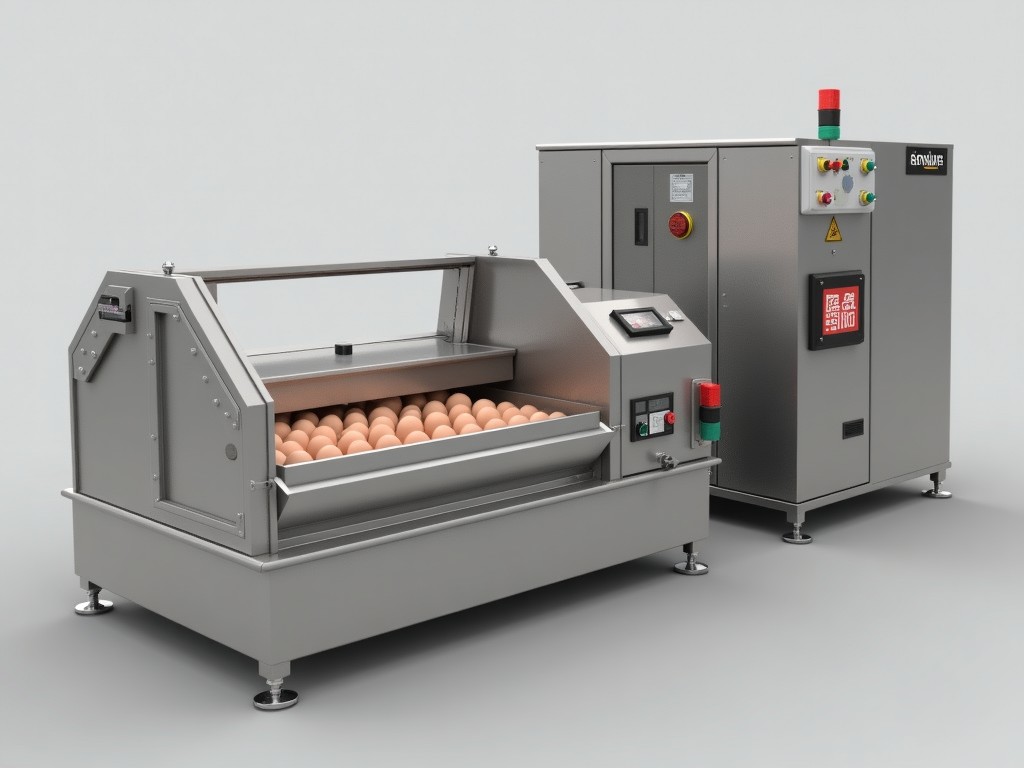
Bulk Best Small Scale Egg Washing Machine
Overview
The unit is designed for batch processing of table eggs in facilities that require gentle cleaning without shell damage. It combines a rotating drum with low‑pressure spray nozzles and a controlled‑speed conveyor to achieve consistent wash cycles.
Typical throughput ranges from 150 to 300 eggs per hour depending on drum diameter and rotation speed. The machine occupies a footprint of approximately 0.8 m × 0.6 m and stands 1.5 m tall, allowing integration into existing processing lines.
Key Technical Parameters
| Parameter | Typical Value | Adjustable Range |
|---|---|---|
| Drum diameter | 400 mm | 300 mm – 500 mm |
| Rotation speed | 12 rpm | 8 rpm – 20 rpm |
| Spray pressure | 0.3 bar | 0.2 bar – 0.5 bar |
| Conveyor speed | 0.15 m/s | 0.1 m/s – 0.3 m/s |
| Power consumption | 0.75 kW | 0.5 kW – 1.2 kW |
| Water usage per cycle | 12 L | 8 L – 18 L |
Design Features
The drum interior is perforated with 3 mm holes to allow water drainage while retaining eggs. Stainless steel AISI 304 construction provides corrosion resistance against cleaning agents and facilitates easy cleaning.
A variable frequency drive controls drum speed, enabling operators to adjust wash intensity based on egg size and soiling level. Spray nozzles are positioned at a 45° angle to impinge water uniformly across the egg surface, reducing impingement force to below 0.15 N to avoid micro‑cracking.
An integrated sensor monitors water turbidity and triggers automatic drain and refill when particulate load exceeds 50 NTU, maintaining wash effectiveness without manual intervention.
Typical Applications
Small‑scale farms and specialty egg producers use the machine to meet retail hygiene standards while preserving egg quality for direct‑to‑consumer sales.
Processing stations that handle organic or free‑range eggs benefit from the low‑impact wash, which minimizes cuticle removal and extends shelf life under refrigeration.
The equipment is also suitable for research laboratories requiring consistent egg cleaning for incubation trials, where repeatability of wash conditions is critical.
Material Options
- Drum and frame: AISI 304 stainless steel (standard) or AISI 316 for high‑chloride environments.
- Spray nozzles: Brass with PTFE coating or stainless steel for chemical resistance.
- Conveyor belt: Food‑grade polyurethane or modular plastic links.
- Seals and gaskets: EPDM or silicone, compliant with FDA 21 CFR 177.2600.
Customization Possibilities
Drum length can be altered in 50 mm increments to adjust residence time, allowing optimization for different egg sizes (from 45 g to 70 g).
Additional rinse stages with separate water tanks can be added for multi‑step cleaning, each stage equipped with independent flow control valves.
Control panels are available with push‑button interfaces or touchscreen HMIs, supporting programmable wash cycles and data logging of parameters such as temperature, pressure, and cycle count.
Quality Assurance
Each unit undergoes hydrostatic testing of the drum enclosure at 1.5 times operating pressure to verify leak‑free integrity.
Functional validation includes a wash efficiency test using a standardized soil load; the machine must achieve a minimum 95 % reduction in surface aerobe count after a single cycle.
Documentation provided with shipment comprises material certificates, welding inspection reports, and a calibrated flow‑meter verification sheet.
Frequently Asked Questions
Can dimensions be customized to fit existing line layouts?
Yes, drum diameter and overall footprint can be adjusted within the ranges specified in the technical table; custom frame extensions are available upon request.
What information is required before quotation?
Required inputs include desired egg throughput, egg size range, available water pressure and temperature, and any space constraints for installation.
What materials are available for corrosive environments?
AISI 316 stainless steel is offered for high‑chloride or acidic wash solutions; alternative coatings such as electroless nickel can be applied to critical components.
How is quality inspected before shipping?
Each machine undergoes pressure leak testing, functional wash cycle verification, and dimensional inspection against approved drawings; results are recorded in a test log supplied with the unit.
What packaging methods are available for export?
Standard packaging consists of a wooden crate with foam edge protection; heat‑treated pallets and moisture‑barrier wrapping are options for overseas shipments.
What is the typical production lead time?
Lead time ranges from 4 to 6 weeks after receipt of technical confirmation, depending on selected customizations and current workshop load.
Contact for Inquiry
To discuss specific requirements or request a detailed quotation, please use the inquiry form linked below. Our engineering team will respond with a technical proposal tailored to your facility.



