Robotic Palletizer And Depalletizer System
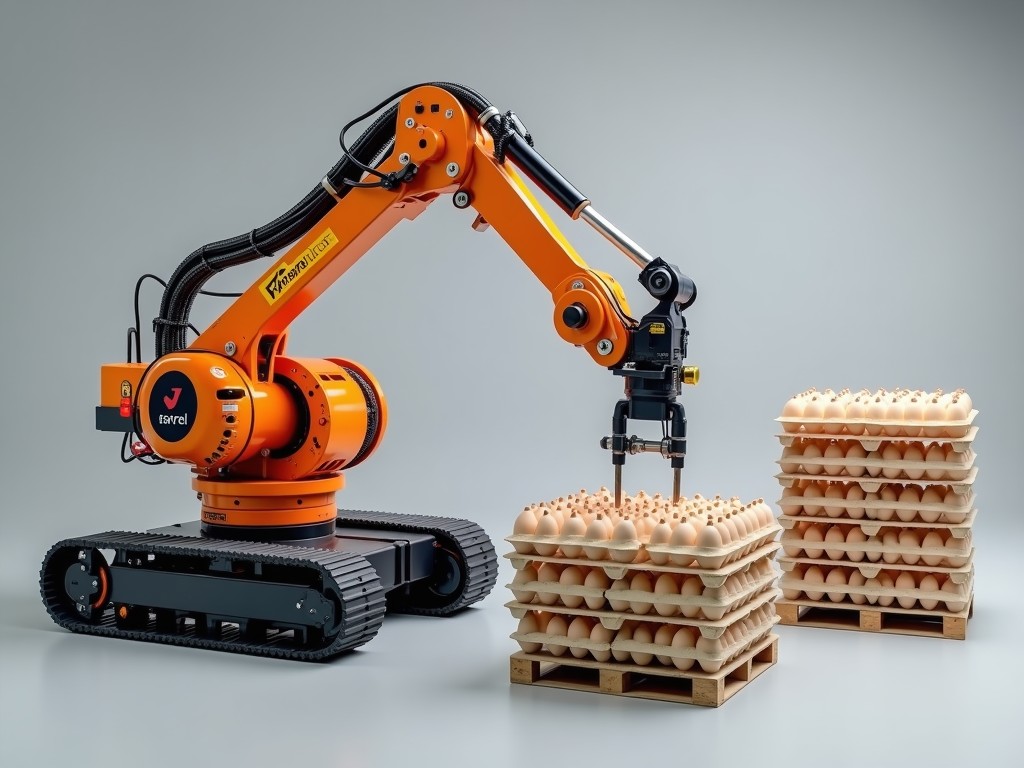
Robotic Palletizer and Depalletizer System
This system combines an industrial robot with specialized end‑of‑arm tooling to automatically stack products onto pallets (palletizing) or remove them (depalletizing). By replacing manual handling, it increases line throughput, reduces labor‑related injury risk, and provides consistent load formation for downstream logistics.
Working Principle
Incoming cases or packages travel on a conveyor to a pick position where a 3D vision system identifies each item’s exact location and orientation.
The robot controller calculates an optimal trajectory, directs the six‑axis arm to grasp the item with an adaptive gripper, and places it onto the pallet according to a predefined pattern.
For depalletizing, the vision system guides the robot to lift layers or individual items from the pallet and convey them to the next process station.
Technical Specifications
Typical values are shown; many parameters can be adjusted to match specific line layouts and product characteristics.
| Parameter | Typical Value / Customizable |
|---|---|
| Payload capacity | Up to 20 kg per pick (higher with custom grippers) |
| Pallet size range | 800 × 1200 mm to 1200 × 1600 mm (custom frames available) |
| Cycle time | 1.2–2.5 s per pick depending on product weight and pallet pattern |
| Robot axes | 6‑axis articulated robot (optional 7‑axis for extended reach) |
| Power supply | 3‑phase 400 V ± 10 %, 50/60 Hz |
| Footprint (robot + conveyor) | Approx. 2.5 m × 1.8 m (configurable) |
| Control interface | PLC‑based with Ethernet/IP, optional OPC UA or Modbus TCP |
Key Features
The following capabilities distinguish the system in high‑mix, high‑speed environments:
- Modular end‑effectors (vacuum, clamp, fork, hybrid) swap in under 5 min
- Adaptive grip force control minimizes product damage while maintaining secure hold
- Integrated 3D vision provides ±2 mm placement accuracy for varying case dimensions
- Safety‑rated collaborative mode allows operator interaction without physical guarding when speed is reduced
- Quick‑change tooling plate reduces downtime during product changeovers
- Energy‑regeneration drive recovers braking power, lowering overall consumption
- Remote diagnostics portal enables predictive maintenance and OEE tracking
Applications
In beverage bottling lines, the system handles cases of varying height and weight, building stable pallets that withstand stretch‑wrapping and transport vibration, which reduces product loss during distribution.
Pharmaceutical manufacturers benefit from the gentle, low‑impact grip and traceable motion logs, ensuring compliance with strict hygiene and validation standards while maintaining the throughput required for large‑scale vaccine production.
Consumer‑goods distributors appreciate the ability to palletize mixed‑SKU loads directly from the picking line, eliminating manual sortation steps and accelerating order fulfillment cycles.
Customization Options
Each project can tailor the following aspects to fit site constraints and product specifics:
- Robot reach and payload class (e.g., 1500 mm reach, 30 kg capacity)
- Gripper technology (vacuum cups with quick‑release, mechanical clamps, fork‑style for trays)
- Conveyor speed and accumulation zones to synchronize with upstream/downstream equipment
- Safety enclosure options (light curtains, safety scanners, or full guarding)
- Software integration layers (MES, WMS, SAP) via standard industrial protocols
- Paint finish and corrosion protection for wash‑down or humid environments
Quality Assurance and Lifecycle Support
Design validation includes finite‑element analysis of the robot base and custom tooling to confirm structural integrity under dynamic loads.
Factory Acceptance Testing (FAT) verifies cycle time, placement accuracy, and safety functions before shipment; Site Acceptance Testing (SAT) confirms integration with the customer’s line controls.
Spare parts are stocked for critical wear items (gripper seals, vision lenses, drive belts) with a guaranteed 2‑week dispatch window, and optional service contracts provide scheduled preventive maintenance and 24/7 technical support.
Frequently Asked Questions
Can the system handle mixed‑SKU pallets?
Yes. The vision‑guided robot can identify each item’s dimensions and place it according to a user‑defined pattern that accommodates varying case sizes on the same pallet.
What information is required before quotation?
We need product dimensions, weight, desired pallet layout, line speed, and any environmental constraints (e.g., wash‑down, temperature).
What materials are used for the robot base and safety guarding?
The base is constructed from powder‑coated steel frame; safety panels use 2 mm polycarbonate or powder‑coated steel mesh depending on the selected protection level.
How is functional safety ensured?
Safety‑rated speed and separation monitoring (SSM) is implemented in the controller, complemented by optional light curtains or safety scanners that trigger a controlled stop when the protected zone is breached.
What is the typical production lead time?
Lead time ranges from 10 to 14 weeks after design freeze, depending on the degree of customization and current factory load.
How is after‑sales support arranged?
Support includes remote diagnostics, on‑site service visits, and a dedicated parts logistics team; service level agreements can be tailored to response time requirements.
Contact Us
Discuss your specific palletizing or depalletizing challenge with our engineering team to receive a feasibility study and detailed quotation.
Request a Feasibility Study


