Intelligent Automatic Robot Palletizing Line
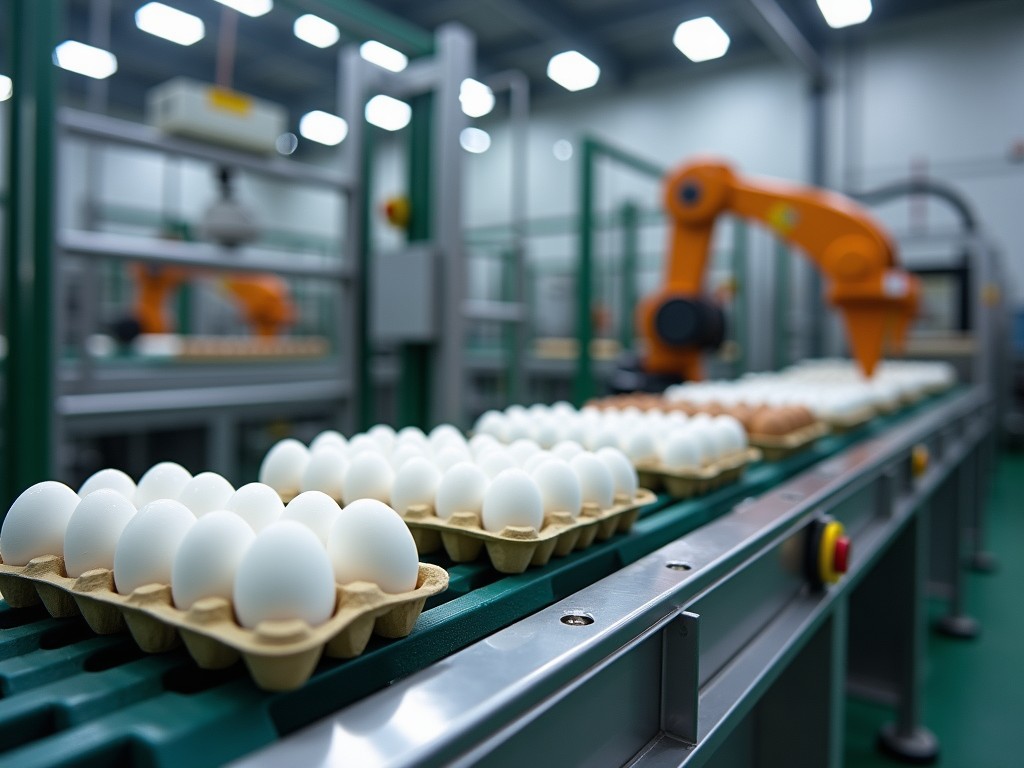
Intelligent Automatic Robot Palletizing Line
The cell combines a six‑axis articulated robot, a high‑resolution 3D vision system, and a modular conveyor to create a closed‑loop palletizing station that can switch between carton formats without mechanical tooling.
System Architecture
A robot arm with a reach of 1.8 m and a repeatability of ±0.05 mm positions cartons onto a pallet. The vision system provides 0.2 mm positional feedback at 30 fps, enabling real‑time correction of placement errors.
The conveyor belt operates at adjustable speeds from 0.1 m/s to 0.6 m/s, synchronized with the robot’s pick cycle through an EtherCAT‑based motion controller.
Operational Principle
When a carton enters the infeed zone, the vision system captures its dimensions and orientation. The controller calculates the optimal pallet location based on a pre‑programmed layer pattern and issues a motion command to the robot.
The robot grasps the carton using a vacuum gripper rated for 25 kg lift, moves it to the calculated drop point, and releases it with a controlled deceleration to minimize impact force below 15 N.
After each layer is completed, a pallet jack or automated guided vehicle retrieves the finished pallet while the line continues loading the next cycle.
Key Specifications
| Parameter | Typical Value | Notes |
|---|---|---|
| Robot payload capacity | 20 kg | Rated for standard secondary‑pack cartons |
| Maximum pallet height | 2.0 m | Equivalent to 20 layers of 100 mm cartons |
| Cycle time per carton | 1.8 s | Includes vision processing and motion settling |
| Power consumption | 3.5 kW | Average load at 60 % duty cycle |
| Footprint (L × W) | 3.2 m × 1.8 m | Includes safety guarding |
Typical Applications
In beverage bottling plants, the line handles 500 ml to 2 L PET bottles packed in shrink‑wrapped trays, maintaining a steady output of 120 trays per minute while adapting to varying tray dimensions without changeover.
For pharmaceutical secondary packaging, the system places blister packs into cartons with a placement tolerance of ±0.3 mm, ensuring compliance with strict regulatory stacking requirements.
In food processing facilities, the robot manages frozen food boxes up to 25 kg, operating continuously in environments down to ‑20 °C thanks to sealed joint housings and low‑temperature lubricants.
Customization Options
The architecture supports interchangeable robot models ranging from 10 kg to 50 kg payload, allowing scaling to heavier loads such as drums or bulk bags.
Vision configurations can be upgraded to include multi‑spectral imaging for label inspection or barcode verification, adding a decision‑making layer before placement.
Conveyor modules are available with variable width (0.6 m to 1.2 m) and surface materials (PVC, stainless steel, or anti‑static rubber) to match product handling needs.
Pallet patterns are fully programmable via the HMI, enabling custom layer schemes such as interlocking, pinwheel, or column stacking without hardware alteration.
Quality Assurance & Testing
Each robot arm undergoes a 48‑hour endurance test at 100 % duty cycle, logging joint temperature, encoder drift, and vibration levels to verify repeatability within ±0.05 mm over 500 000 cycles.
Vision systems are calibrated using a certified traceable target plate, ensuring measurement uncertainty below 0.1 mm across the full field of view.
The completed line passes a factory acceptance test that simulates a peak production rate of 200 cartons per minute, monitoring energy consumption, cycle time variance, and safety interlock response.
Frequently Asked Questions
Can the robot payload be increased after installation?
Yes, the mechanical interface is standardized; upgrading to a higher‑capacity arm requires only a controller firmware update and mechanical swap, typically completed within one shift.
What information is needed for a quotation?
Key inputs include carton dimensions (L × W × H), weight range, desired pallet pattern, line speed target, and environmental conditions such as temperature or wash‑down requirements.
How is the vision system integrated with existing PLCs?
The vision controller communicates via EtherCAT or Profinet, allowing seamless data exchange with most industrial PLCs without additional gateway hardware.
Next Steps
To discuss how this palletizing solution can be adapted to your specific product mix and facility layout, please contact our engineering team.



