High Speed Automatic Column Palletizing System
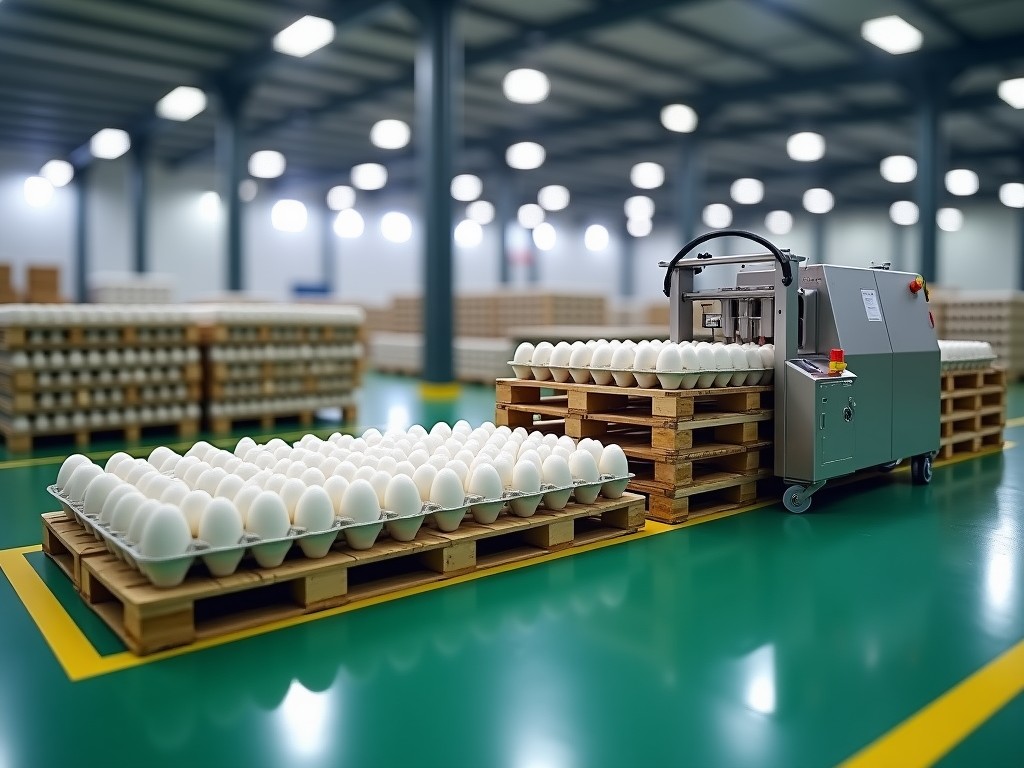
High Speed Automatic Column Palletizing System
A column palletizer lifts products from an infeed conveyor, transports them vertically along a mast, and places them in a vertical stack on a pallet. The system uses a servo‑driven carriage that moves in X, Y, and Z axes to achieve precise positioning. Typical cycle rates range from 1200 to 1800 cycles per hour depending on product weight and pallet pattern.
Operating Principle
The mast forms a rigid column that guides a carriage equipped with a gripper. Products are transferred from the conveyor to the gripper, which then retracts, lifts the item to the desired layer height, moves laterally over the pallet, and releases the load. After placement, the carriage returns to the home position for the next pick. All motions are coordinated by a motion controller with interpolation to minimize cycle time.
Safety is ensured by light curtains and safety scanners that stop motion if an obstruction is detected. The control system monitors position feedback with encoders providing repeatability within ±2 mm.
Key Technical Characteristics
| Parameter | Typical Value | Notes |
|---|---|---|
| Maximum payload capacity | 30 kg | Configurable up to 50 kg with reinforced gripper |
| Cycle rate | 1200‑1800 cycles/hour | Dependent on product dimensions and pallet pattern |
| Column height range | 1.5 m – 3.0 m | Adjustable via mast sections |
| Positioning repeatability | ±2 mm | Measured at gripper tip |
| Power supply | 380 V 3‑phase, 50/60 Hz | Optional 480 V version |
| Control system | PLC with motion module | IPC or SCADA interface available |
| Footprint (L×W) | 2.2 m × 1.4 m | Includes safety zone clearance |
Typical Applications
Industries that benefit from column palletizing include beverage canning, bottled water, and carton‑based consumer goods where product geometry is uniform and throughput is high. The vertical stacking pattern minimizes pallet footprint while maintaining stable loads for transport. Because the system handles each layer individually, it accommodates mixed SKU pallets without re‑tooling.
Typical product weights range from 0.5 kg to 25 kg, with case dimensions between 100 mm × 100 mm × 150 mm and 400 mm × 300 mm × 200 mm. The system’s speed and precision reduce labor dependence and lower the risk of stacking errors.
Customization Options
- Payload capacity: 10 kg – 50 kg (custom frames available)
- Maximum speed: up to 2400 cycles/hour with high‑servo drives
- Column height: 1.2 m – 3.5 m (modular mast sections)
- Gripper types: vacuum suction, mechanical fingers, magnetic clamps
- Infeed conveyor width: 400 mm – 1200 mm, adjustable side guides
- Control interface: PLC, IPC, or SCADA with optional remote diagnostics
- Safety enhancements: area scanners, safety mats, emergency stop stations
Quality and Reliability
The main structure is fabricated from welded S355 steel, stress‑relieved and shot‑blasted before applying a powder‑coat finish for corrosion resistance. Linear guides use recirculating ball bearings with C3 preload to ensure smooth motion under load. Servo motors are selected for continuous duty rating with thermal protection.
Each unit undergoes a factory acceptance test that includes a 500‑hour run‑at‑speed cycle, positional accuracy verification, and safety circuit validation. Documentation provides traceability of critical components such as bearings, drives, and control modules.
Frequently Asked Questions
Can the column height be adjusted after installation?
Yes, the mast is built from bolted sections; additional or fewer sections can be added to change the effective lifting range, subject to stability checks.
What information is required for a quotation?
Product weight, dimensions, pallet size, desired layer pattern, infeed conveyor speed, and facility power specifications.
Which gripper is suitable for porous cartons?
A vacuum suction cup system with adjustable vacuum level and cup diameter is recommended for porous surfaces; mechanical fingers are an alternative for rigid cartons.
How are export shipments protected?
The system is disassembled into transport‑friendly modules, each wrapped in corrosion‑inhibiting film and secured in a wooden crate with shock‑absorbing foam.
Contact Us
To discuss how a column palletizer can be integrated into your line, please provide your application details and we will prepare a technical proposal.



