Heavy Duty Automatic Palletizing System Factory
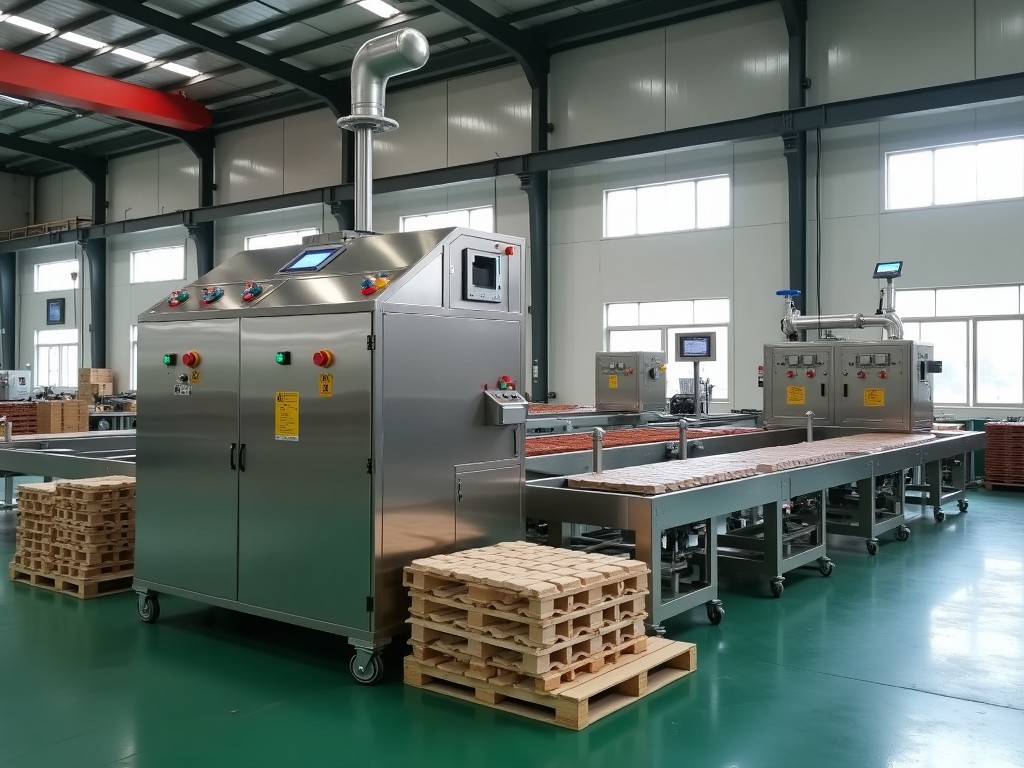
Heavy Duty Automatic Palletizing System – Factory Overview
A heavy duty automatic palletizing system is an end‑of‑line solution that stacks cases, bags, or cartons onto pallets without manual intervention. It integrates with upstream conveyors and downstream stretch‑wrapping or strapping equipment to create a continuous flow. The system is designed for environments where individual units exceed 500 kg and throughput demands require consistent layer formation.
Core modules typically include a high‑strength steel gantry or articulated robot, a custom end‑effector (gripper or vacuum head), a sensor‑rich safety zone, and a programmable logic controller (PLC) with motion coordination. The gantry provides linear motion along X, Y, and Z axes while maintaining positional repeatability within ±2 mm under rated load. The end‑effector is engineered to handle specific package geometries, allowing quick changeover between product families.
Performance characteristics are expressed in terms of payload capacity, cycle time, and footprint. Typical payload capacities range from 800 kg to 2000 kg per layer, depending on gantry size and drive selection. Cycle time per layer can fall between 4.0 s and 7.5 s when handling standard 600 mm × 400 mm cases at a nominal speed of 12 layers per minute. System footprint is often expressed as a rectangular envelope; a common configuration occupies approximately 3.2 m × 2.4 m of floor space, excluding conveyor extensions.
Key Technical Specifications
| Parameter | Typical Value | Notes |
|---|---|---|
| Maximum payload per layer | 800 kg – 2000 kg | Depends on gantry structure and motor torque |
| Cycle time per layer | 4.0 s – 7.5 s | Measured with standard 600 mm × 400 mm cases |
| System footprint (L × W) | ≈ 3.2 m × 2.4 m | Excludes infeed/outfeed conveyors |
| Power consumption | 5 kW – 12 kW | Average during continuous operation |
| Control interface | PLC with EtherCAT/IEEE 1588 | Supports SCADA integration |
| Safety compliance | ISO 13849‑1 PL d, IEC 61508 SIL 2 | Includes safety scanners and emergency stops |
Operational Principles
The system receives a continuous stream of packages on an infeed conveyor. A vision sensor or barcode reader identifies each item, triggering the motion planner to compute the optimal pick point. The gantry accelerates to the pick position, the end‑effector engages the package, and the payload is transferred to the pallet location defined by the layer pattern. After placement, the end‑effector retracts and the cycle repeats for the next item.
Layer patterns are stored as recipe files; changing from a brick pattern to a pinwheel pattern requires only a software update, eliminating mechanical re‑tooling. The controller monitors load cells on the gantry to detect overload conditions and will halt motion if forces exceed predefined thresholds. Energy recovery brakes on the drive axes recapture kinetic energy during deceleration, reducing overall power draw.
Design Considerations for Heavy Duty Applications
- Modular frame construction allows extension of the X‑axis without redesigning the base structure.
- Hardened linear guides and roller screws maintain accuracy under repeated high‑load cycles.
- End‑effector tooling uses interchangeable suction cups or mechanical grippers rated for the specific package material.
- Electrical cabinet is rated IP54 to protect against dust and moisture common in food‑processing environments.
- Safety zones are defined by laser scanners that create a 3‑dimensional protective field around the moving gantry.
Typical Industrial Applications
In beverage bottling lines, the system handles 2‑liter PET bottles packed in six‑pack trays, where each tray can exceed 12 kg and a full layer reaches 800 kg. The high payload capacity prevents the need for multiple lighter‑duty robots, reducing system complexity. In bagged fertilizer facilities, the end‑effector employs a wide‑mouth vacuum head capable of lifting 25 kg bags at a rate of 30 bags per minute, ensuring consistent pallet stability for outdoor storage.
Consumer goods manufacturers benefit from the system’s ability to switch between corrugated cases and shrink‑wrapped trays without mechanical changeover, supporting SKU proliferation. The precise placement accuracy (±2 mm) minimizes overhang, which reduces stretch‑film usage and improves load security during transit.
Customization Options
- Gripper types: mechanical fingers, vacuum suction, magnetic clamps, or hybrid designs.
- Conveyor height adjustment ranges from 800 mm to 1300 mm to match upstream equipment.
- Software modules for pattern optimization, label verification, and MES integration.
- Safety enhancements: area scanners, safety mats, and emergency stop pods with configurable reset logic.
Factory Quality Assurance
Before shipment, each system undergoes a factory acceptance test (FAT) that includes load‑cycle testing at 110 % of rated payload for 5000 cycles to verify structural integrity. Positional accuracy is verified using a laser tracker across the full travel envelope. Electrical safety is confirmed with hipot and insulation resistance testing per IEC 60204‑1. All test data, calibration certificates, and operation manuals are compiled into a documentation package delivered with the equipment.
Preventive maintenance recommendations are based on runtime hours and load spectra; typical intervals include lubrication of linear guides every 500 hours and inspection of end‑effector wear surfaces every 250 hours. The control firmware includes diagnostic logs that can be retrieved via USB or Ethernet for trend analysis.
Frequently Asked Questions
Can the system be adapted to handle both cases and bags?
Yes, by selecting a configurable end‑effector that can switch between mechanical grippers and vacuum heads, the same gantry can process different package types with minimal downtime.
What information is needed for a quotation?
Required inputs include package dimensions, weight, desired throughput (layers per minute), infeed conveyor speed, facility layout constraints, and any specific safety or hygiene standards applicable to the site.
Is the control system compatible with existing PLC platforms?
The motion controller supports EtherCAT, Profinet, and Modbus TCP, allowing integration with most mainstream PLC brands without proprietary gateways.
How are spare parts managed?
Critical wear items such as linear guide bearings, ball screws, and end‑effector seals are stocked as standard kits; lead times are typically 2‑3 weeks for express shipment.
What is the typical lead time for delivery?
Lead time varies with configuration complexity but generally ranges from 10 to 14 weeks after order acceptance and receipt of technical data package.



