Full Automatic Robot Palletizer With Gripper
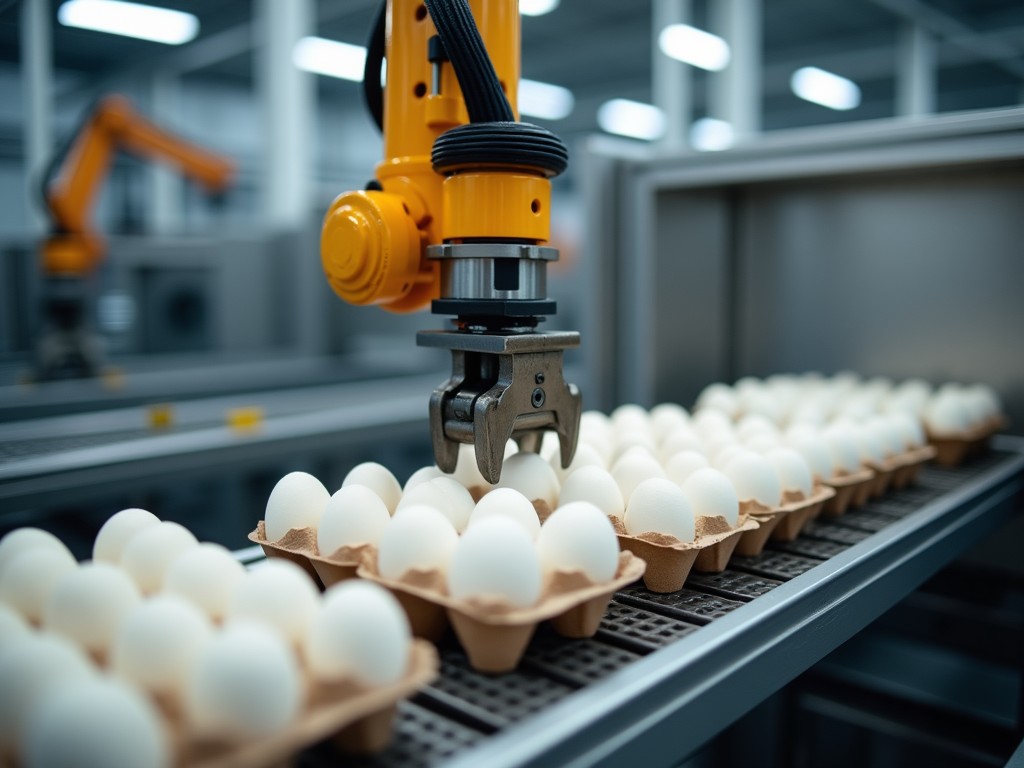
Full Automatic Robot Palletizer with Gripper
A full automatic robot palletizer integrates a six‑axis articulated robot, a programmable controller, and an end‑of‑arm gripper to stack products onto pallets without manual intervention. The system receives in‑feed conveyors, detects product orientation via vision sensors, and executes a pre‑programmed stacking pattern that optimizes load stability and pallet utilization.
Operating Principle
The robot follows a Cartesian trajectory defined by pallet dimensions and product size. Sensors provide real‑time feedback on product position, allowing the controller to adjust gripper angle and approach speed. After placing a layer, the pallet is indexed or rotated according to the pattern, and the cycle repeats until the target load height is reached.
Cycle time depends on pick‑place distance, product weight, and gripper actuation speed. Typical values range from 1.8 to 3.5 seconds per pick for lightweight cartons (<5 kg) and increase proportionally for heavier loads.
Key Technical Parameters
| Parameter | Typical Range | Notes |
|---|---|---|
| Robot payload capacity | 5 kg – 20 kg | Determines maximum product weight per pick |
| Maximum reach | 1.2 m – 2.5 m | Horizontal distance from robot base to gripper tip |
| Repeatability | ±0.1 mm | Positional accuracy under steady‑state conditions |
| Gripper closing force | 50 N – 300 N (adjustable) | Set according to product fragility and surface material |
| Power consumption | 1.5 kW – 4.0 kW | Includes robot drive, controller, and peripheral sensors |
| Control interface | PLC‑compatible (Ethernet/IP, Modbus TCP) or PC‑based HMI | Allows recipe selection and remote diagnostics |
Typical Applications
In beverage bottling lines, the palletizer handles filled cans or bottles arriving at rates up to 60 units/min. The gripper uses vacuum cups or mechanical fingers adapted to the container geometry, enabling tight, layer‑by‑layer stacking that minimizes void space and reduces transport damage.
For bagged goods such as fertilizers or seeds, a compliant gripper with adjustable finger spacing accommodates variations in bag thickness and bulk density. The system can switch between patterns (e.g., interlocking, column) without mechanical retooling, supporting rapid changeover between product SKUs.
In pharmaceutical secondary packaging, the robot handles cartons with strict hygiene requirements. Stainless‑steel gripper components and sealed joints meet cleanroom Class ISO 7 standards, while the controller logs each pick‑place event for traceability.
Customization Options
- Gripper type: vacuum, mechanical fingers, magnetic, or hybrid configurations
- End‑effector tooling quick‑change system for <2 minute swap
- Conveyor integration: roller, belt, or chain types with variable speed control
- Safety scanning: laser area scanners or safety-rated light curtains with PLd rating
- Software: recipe management, OEE monitoring, and remote diagnostics via Ethernet
Quality Assurance
Each robot undergoes a factory acceptance test that includes repeatability verification over 10 000 cycles, load‑capacity testing at 110 % of rated payload, and emergency stop validation. Gripper actuation is checked for force consistency using a calibrated load cell across the full adjustment range.
Electrical components conform to IEC 60204‑1 standards, and all wiring is routed through protected cable trays to reduce wear. Documentation provides wiring diagrams, PLC ladder logic, and maintenance intervals for lubrication of joint gearboxes (typically every 500 h).
Frequently Asked Questions
- Can the palletizer handle mixed‑size products? Yes, with a vision system that detects dimensions and selects the appropriate gripper pose and stacking pattern.
- What information is required for a quotation? Product dimensions, weight, material, desired throughput (units/min), pallet size, and any special environmental conditions (e.g., temperature, humidity).
- Is the gripper force adjustable? Yes, most pneumatic or electric grippers provide a force range that can be set via pressure regulator or motor current limit.
- What is the typical lead time? Standard configurations ship within 8‑10 weeks after order confirmation; customized tooling may extend this period.
- How are spare parts managed? Critical spares (gripper seals, joint bearings, encoder cables) are stocked and can be dispatched within 48 hours upon request.



