Egg Tray Robotic Packaging Machine Source Factory
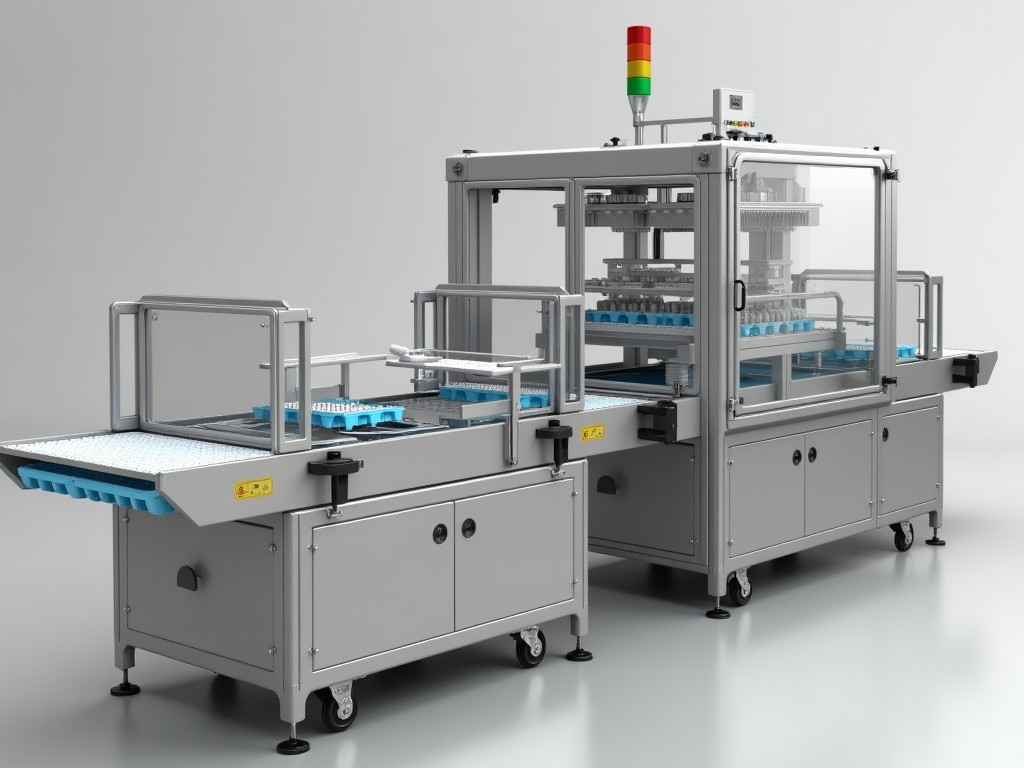
Egg Tray Robotic Packaging Machine – Source Factory
Overview
Egg tray robotic packaging machines integrate a six‑axis articulated robot with a vision‑guided gripping system to place formed trays into secondary cartons or pallet stacks. The system replaces manual handling, reduces cycle time variability, and eliminates ergonomic strain associated with repetitive lifting of trays weighing 150‑250 g each.
A typical installation includes a conveyor infeed that delivers trays at a regulated rate, a 3D camera system for orientation detection, and a programmable logic controller that synchronizes robot motion with carton indexing. The machine operates continuously for 20 h/day with scheduled maintenance intervals of 500 h.
Technical Specifications
| Parameter | Typical Value | Notes |
|---|---|---|
| Robot reach | 1200 mm | Covers 600 mm wide carton lines |
| Payload capacity | 5 kg | Handles up to 30 trays per grip |
| Cycle time | 1.8 s per tray | Includes vision pick and place |
| Power consumption | 2.2 kW | Average load at 80 % duty |
| Footprint | 2200 mm × 1500 mm | Includes safety guarding |
Key Features
Vision‑guided picking uses a 2‑MP camera and LED illumination to detect tray orientation within ±2 °, allowing the robot to adjust grip angle on the fly without mechanical fixturing.
End‑of‑arm tooling employs vacuum cups with configurable array patterns (4‑cup, 6‑cup, 8‑cup) to accommodate tray thicknesses from 3 mm to 6 mm while maintaining a holding force of at least 150 N.
Safety system includes laser scanners and safety‑rated PLC inputs that stop robot motion within 150 ms when a personnel breach is detected, complying with ISO 13849‑1 PLd.
User interface is a 10‑inch touchscreen HMI that displays real‑time production counts, fault logs, and allows recipe changeover for different carton sizes in under 30 seconds.
Working Principle
Trays exit the forming line onto a belt conveyor equipped with a photoelectric sensor that triggers the vision system. The camera captures top‑down images, processes them to determine centroid and rotation, and sends coordinates to the robot controller.
The robot moves to the pre‑calculated pick point, lowers the vacuum gripper, activates suction, and lifts the tray. After a short dwell to ensure secure grip, the robot transports the tray to the carton nest where a secondary sensor confirms correct placement before releasing vacuum.
Carton indexers advance the packaging line synchronously; the robot repeats the cycle until the preset batch count is reached, at which point the HMI signals a batch complete and initiates a palletizing routine if downstream equipment is present.
Applications
The machine is suited for high‑volume egg tray producers that ship trays to food‑processing plants, supermarkets, or export markets where consistent stacking and protection are required.
- Inline integration with pulp molding lines producing 5 000‑15 000 trays per hour.
- Stand‑alone cells for secondary packaging of trays into 30‑tray cartons.
- Adaptation for other lightweight formed products such as fruit trays or cup carriers.
Customization Options
Robot reach and payload can be adjusted by selecting alternative arm models (e.g., 900 mm reach, 3 kg payload) to match tighter floor layouts or lighter tray weights.
- Gripper tooling with magnetic or mechanical fingers for non‑porous tray materials.
- Conveyor speed regulation from 0.2 m/s to 1.0 m/s to balance upstream line rates.
- Optional barcode scanner integration for traceability of each packed carton.
Electrical supplies can be configured for 380 V 50 Hz or 460 V 60 Hz with optional UPS backup for short power interruptions.
Quality Control Philosophy
Each machine undergoes a factory acceptance test that includes 24‑hour run‑time monitoring of cycle time variance, grip force repeatability (±5 N), and vision system accuracy (≤1 mm positioning error).
Critical components such as robot joints, vacuum pumps, and safety scanners are sourced from suppliers with ISO 9001 certification and are subject to incoming inspection per ANSI/ASQ Z1.4 standards.
Before shipment, a performance report is generated showing actual throughput, energy consumption, and safety stop response times, which is provided to the customer for site acceptance verification.
Frequently Asked Questions
Yes, the infeed and outfeed interfaces use standard 50 mm roller conveyor brackets; adapters are available for different roller diameters.
Desired tray dimensions, target output rate (trays/hour), carton size and layout, facility power voltage, and any environmental constraints such as wash‑down requirements.
Vacuum cups made of FDA‑compliant silicone or polyurethane, with optional antimicrobial coating, are offered upon request.
Factory acceptance testing includes cycle consistency checks, grip force calibration, vision alignment verification, and safety system functional tests.
Standard configurations ship within 10‑12 weeks after receipt of purchase order; custom tooling may extend lead time by 2‑3 weeks.
Contact for Inquiry
To discuss your specific tray packaging needs, request a detailed quotation, or arrange a virtual factory walkthrough, please use the inquiry link below.
Send Inquiry


