Egg End Of Line Robotic Packaging System Supplier
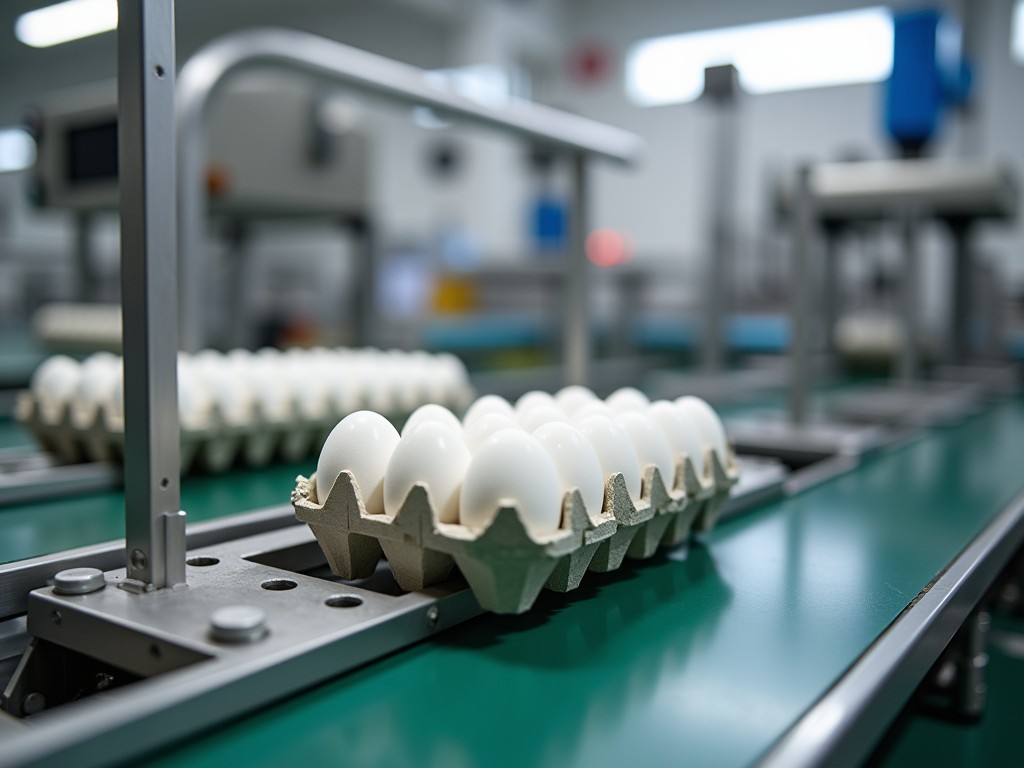
Egg End‑of‑Line Robotic Packaging System
Designed for high‑speed egg processing lines, this robotic cell receives trays or cartons from upstream equipment, orients each egg with vision guidance, and places them into final retail‑ready packaging at rates up to 120 cycles per minute. The system replaces manual handling, reduces product breakage, and maintains strict hygiene standards required for food‑grade operations.
System Architecture and Core Components
A six‑axis articulated robot with a payload capacity of 5 kg provides the primary motion axis. The robot is mounted on a rigid steel base that isolates vibration from surrounding conveyors. An integrated 3‑D vision system inspects egg position, orientation, and shell integrity before each pick operation.
End‑of‑arm tooling consists of a soft‑silicone vacuum gripper designed to handle eggs without exerting compressive force greater than 0.2 N. A stainless‑steel belt conveyor feeds empty cartons to the robot placement zone and removes filled units toward downstream case packing or palletizing.
All electrical and pneumatic components are housed in an IP65‑rated enclosure, allowing wash‑down cleaning with approved food‑safe detergents. The control cabinet runs a real‑time PLC platform coordinated with the robot controller via EtherCAT for sub‑millisecond synchronization.
Key Technical Specifications
| Parameter | Typical Value | Notes |
|---|---|---|
| Robot reach | 1 200 mm | Sufficient for carton loading/unloading zones |
| Maximum cycle rate | 120 cpm | Dependent on carton size and gripper design |
| Vision system resolution | 5 MP | Provides sub‑millimeter positioning accuracy |
| Gripper suction force | 0.2 N max | Ensures zero shell damage |
| Power supply | 380 V 3‑phase, 50/60 Hz | Standard industrial feed |
| Footprint (L × W) | 2 400 mm × 1 200 mm | Includes safety guarding |
Operational Advantages for Egg Processing
The soft‑gripper eliminates micro‑cracks that can occur with mechanical fingers, directly improving yield loss metrics by up to 0.8 % in typical layer‑farm operations. Vision‑based orientation reduces mis‑placements, which in turn lowers rework labor and downstream packaging jams.
Because the robot operates in a sealed cell, airborne contamination risk is minimized; the IP65 rating permits frequent CIP/SIP cycles without compromising electronics. Changeover between carton formats is handled via software recipe selection, requiring less than five minutes of mechanical adjustment.
Customization and Integration Options
- Robot models with payloads from 3 kg to 10 kg for heavier packaging formats
- Alternative end‑effectors: mechanical fingers, soft‑foam grippers, or hybrid vacuum‑mechanical designs
- Vision upgrades: hyperspectral imaging for internal quality detection
- Conveyor lengths adjustable from 800 mm to 3 000 mm to match line layout
- Software interfaces: Modbus TCP, OPC UA, or proprietary API for MES integration
- Optional sterilization UV module integrated into the robot base for additional microbial control
Quality Assurance and Testing
Prior to shipment each system undergoes a factory acceptance test (FAT) that includes 500 continuous cycles with monitored grip force, vision latency, and conveyor synchronization. Cleaning validation follows ISO 14644‑1 Class 6 standards using a defined detergent protocol, with post‑wipe swab analysis confirming absence of residual contaminants.
Spare parts are stocked for critical wear items such as gripper seals and vacuum pumps, with a mean time to repair (MTTR) under two hours for on‑site technicians. Documentation provides detailed preventive maintenance schedules based on operating hours, enabling predictive service planning.
Frequently Asked Questions
-
Can the system handle different egg sizes?
Yes, the vision system detects egg diameter and adjusts gripper approach height within a range of 40 mm to 55 mm, accommodating small, medium, and large grades.
-
What information is required before quotation?
Line speed, carton dimensions, desired cycle rate, available floor space, and any specific hygiene certifications needed for your facility.
-
Are materials of construction food‑grade?
All contact surfaces use 316L stainless steel or FDA‑approved silicone; structural components are painted with a food‑safe, powder‑coat finish.
-
How is quality inspected during operation?
Inline vision checks each egg for cracks, debris, and orientation; results are logged and can trigger automatic reject divert if thresholds are exceeded.
-
What is the typical production lead time?
Standard configurations ship within 10–12 weeks after receipt of purchase order; custom vision or gripper options may extend this window.
Request a Quote or Technical Consultation
Our engineering team is ready to review your line layout, discuss performance targets, and provide a detailed proposal tailored to your egg processing requirements.
Contact Our Engineering Team


