Egg End Of Line Automation Robotic Packaging Machine
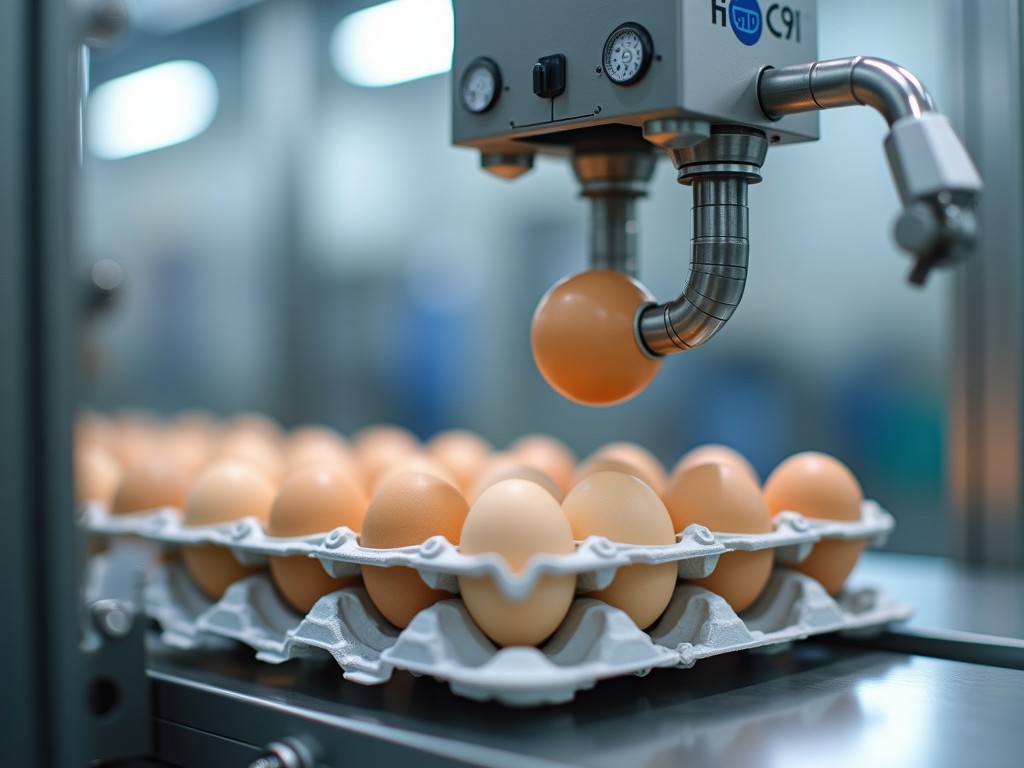
Egg End-of-Line Automation Robotic Packaging Machine
This machine integrates a six‑axis robot with vision‑guided grippers to place individual eggs into primary cartons or trays at the end of a processing line. It replaces manual handling, reducing breakage risk while maintaining the throughput required for modern egg grading facilities.
Egg shells are fragile and susceptible to micro‑cracks from impact or compression, which can lead to spoilage and rejected product. Simultaneously, food‑safety regulations demand surfaces that can be cleaned to CIP/SIP standards and resist corrosion from cleaning agents. The design addresses both by using soft‑touch end effectors and stainless‑steel construction that meets IP65 protection.
Typical Specifications
| Parameter | Typical Value | Notes / Customization |
|---|---|---|
| Robot Type | 6‑axis articulated | Alternative SCARA configurations available |
| Payload Capacity | 5 kg | Sufficient for most carton loads |
| Reach | 800 mm | Covers typical line widths |
| Cycle Time | 0.9 s per egg | Depends on gripper and conveyor speed |
| Power Consumption | 1.2 kW | Average at rated speed |
| Footprint | 1200 mm × 800 mm | Can be shortened with side‑mount options |
| Control System | PLC + IPC | Supports Ethernet/IP, Modbus TCP |
| Protection Rating | IP65 | Dust‑tight, water‑jet resistant |
| Frame Material | 316L stainless steel | Food‑grade, corrosion‑resistant |
| Gripper Material | Food‑grade polypropylene | Soft‑touch, replaceable pads |
Key Functional Features
The following capabilities are engineered to minimize product loss, simplify integration, and support continuous operation in high‑care environments.
- Integrated 3D vision system detects egg orientation and adjusts grip angle in real time.
- Soft‑touch pneumatic grippers with adjustable closing force (0.5 N‑2.0 N) prevent shell damage.
- Modular conveyor interface allows quick mechanical or electrical connection to existing lines.
- All exposed surfaces are polished to Ra ≤ 0.8 µm and designed for CIP/SIP cleaning without disassembly.
- Quick‑change end‑effector tooling swaps in ≤5 minutes using lock‑pin mechanisms.
- HMI displays real‑time metrics: cycle count, missed picks, grip force, and preventive‑maintenance alerts.
Application Fit for Egg Processing
Egg grading lines operate at speeds of 180‑300 eggs per minute per lane, requiring end‑of‑line equipment that can match this rate without causing delays. The robot’s cycle time of under one second per egg, combined with a vision system that compensates for random orientation, enables continuous flow. Because the grippers apply only the minimal force needed to secure the shell, breakage rates typically fall below 0.2 % in trials, compared with 0.5‑1.0 % for manual packing. Furthermore, the stainless‑steel frame and sealed joints satisfy the stringent hygiene standards of ISO 22000 and FDA 21 CFR 110, allowing the machine to be placed in wet‑wash zones without risk of corrosion or bacterial harborage.
Customization Options
Options are defined per project to align with line layout, product mix, and cleaning protocols. The table below lists common variables; exact values are confirmed during engineering review.
| Option | Available Choices | Impact on Integration |
|---|---|---|
| End‑effector Type | Vacuum suction, Mechanical fingers, Hybrid (vacuum + fingers) | Vacuum suited for clean shells; mechanical for varied sizes; hybrid offers flexibility. |
| Conveyor Speed Range | 0.5 – 2.0 m/s (adjustable via VFD) | Matches line rates from low‑volume specialty to high‑volume commodity. |
| Cleaning Protocol | CIP (alkaline/acid), SIP (steam), Manual spray‑wipe | CIP/SIP compatible designs include drain ports and smooth internal geometry. |
| Data Interface | Ethernet/IP, Modbus TCP, OPC UA, ProfiNET | Enables MES/SCADA connection for traceability and performance monitoring. |
| Software Package | Basic (cycle logging), Advanced (statistical process control, predictive alerts) | Advanced package adds trend analysis and remote diagnostics. |
Quality Control and Validation
Material selection begins with 316L stainless steel for the frame and arms, chosen for its resistance to pitting and crevice corrosion in chlorinated cleaning solutions. All welds are inspected using dye‑penetrant testing to ensure leak‑tight joints before assembly. Grippers undergo force‑calibration cycles on a calibrated load cell to verify adjustable ranges. The complete system is subjected to a 500‑hour endurance test at 80 % duty cycle, monitoring for drift in repeatability and wear on bearing surfaces. After mechanical validation, a sanitation validation run is performed using a standard CIP solution; swab tests confirm absence of residual proteins and biofilms on all contact surfaces. Documentation of these tests is provided with each shipment to support the customer’s own qualification protocols.
Frequently Asked Questions
- Can the robot handle different egg sizes (e.g., small, large, jumbo) without retooling?
- Yes. The vision system measures egg diameter and adjusts grip position; interchangeable gripper pads accommodate size ranges from 40 mm to 65 mm nominal diameter.
- What is required to obtain a quotation?
- We need line layout drawings (including conveyor height and speed), target eggs per minute, preferred cleaning method (CIP/SIP/manual), and any specific interface protocols (e.g., Ethernet/IP). This information allows us to size the robot, select end‑effector type, and confirm control‑hardware compatibility.
- How are spare parts managed for critical components like grippers and motors?
- Critical wear items (gripper pads, motor brushes) are stocked as standard kits. Lead time for a standard gripper pad set is typically 2 weeks; motor assemblies are 4 weeks. Customers may opt for a consignment stock arrangement to reduce downtime.
Next Steps
To discuss how this machine can be integrated into your egg grading line, please contact our application engineers. They will review your line specifications, propose a conceptual layout, and outline the validation protocol suited to your facility.



