China Egg Packing Robot Top Manufacturer
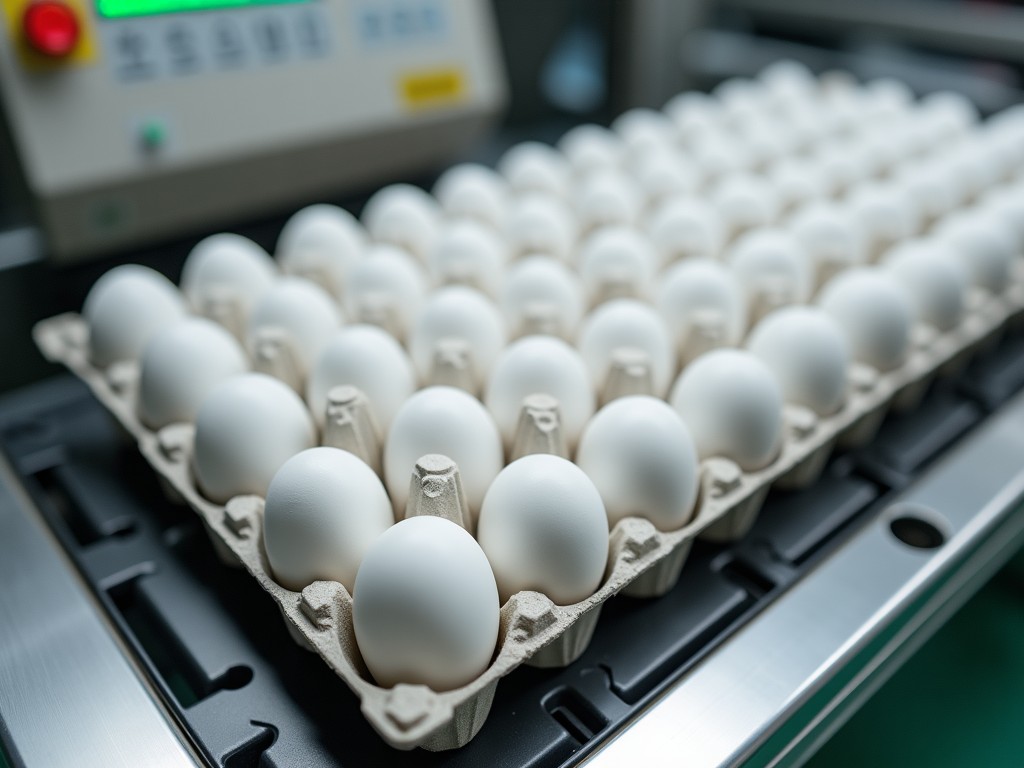
China Egg Packing Robot: Technical Overview from a Leading Manufacturer
Egg packing robots automate the transfer of graded eggs from conveyor lines into cartons or trays while maintaining shell integrity. The system replaces manual handling, reducing breakage rates typically below 0.5% and increasing line throughput to match upstream grading capacities of up to 30,000 eggs per hour.
Core equipment consists of a six‑axis articulated robot arm, a custom end‑effector designed for oval payloads, a vision system for position verification, and a safety‑rated control cabinet. The arm delivers a repeatability of ±0.02 mm at the tool center point, enabling precise placement into carton cavities spaced as close as 22 mm center‑to‑center.
Operation follows a synchronized pick‑and‑place cycle: the vision system locates each egg on the infeed belt, the robot computes approach trajectory, the end‑effector engages via low‑pressure vacuum or compliant mechanical fingers, and the egg is released into the carton after a controlled descent. Cycle times range from 0.8 s to 1.2 s per egg depending on carton configuration and line speed.
| Parameter | Typical Value / Customizable |
|---|---|
| Robot Reach | 800 mm – 1200 mm (based on model) |
| Maximum Payload | 5 kg (includes end‑effector and egg) |
| Repeatability (TCP) | ±0.02 mm |
| Egg Throughput | Up to 3,600 eggs/hour per robot (adjustable) |
| Power Consumption | 1.5 kW – 2.5 kW (depending on speed) |
| Footprint (W × D) | 900 mm × 700 mm (compact mounting) |
| Ingress Protection | IP54 (standard), IP65 available for wash‑down zones |
| Control Interface | PLC‑compatible (Ethernet/IP, Modbus TCP, PROFINET) |
Customization focuses on the end‑effector and integration layer. Options include interchangeable vacuum cups with adjustable suction levels, soft‑polymer mechanical fingers for gentle handling, and quick‑change tooling plates for switching between carton sizes ranging from 6‑egg to 30‑egg formats. The vision system can be upgraded to 3‑D stereo or line‑scan cameras for handling eggs with varying orientation or minor shell defects.
Software packages provide line synchronization modules that accept encoder feedback from grading conveyors, enabling dynamic speed matching. Users can program multiple carton patterns via a teach‑pendant or offline simulation, and the controller logs cycle statistics for OEE analysis. Safety features encompass area scanners, torque limiting, and emergency stop interfaces compliant with ISO 10218‑1.
Applications in Egg Processing Lines
Egg packing robots are positioned after washing, drying, and candling stations where eggs are conveyed in a single layer. The automation addresses three primary challenges: fragility of the shell, variability in egg weight and size, and stringent hygiene requirements that limit human contact. By maintaining a non‑contact, low‑force grip, the robot reduces micro‑cracks that could lead to microbial ingress during storage.
Typical installations integrate with inline carton erectors and sealing units, creating a continuous flow from grading to palletizing. Facilities processing free‑range, organic, or specialty eggs benefit from quick changeover capabilities, allowing shift changes between different carton graphics without mechanical re‑tooling. The robot’s compact footprint enables retrofitting into existing lines where floor space is limited.
Frequently Asked Questions
- Can the robot handle eggs with minor shell defects? Yes, the vision system can be configured to detect and reject eggs with cracks or deformities before the pick stage, preventing damage to the end‑effector.
- What information is required for a quotation? We need line speed (eggs per hour), carton dimensions and layout, available ceiling height for robot mounting, and any specific hygiene classification (e.g., FDA, EU).
- Which gripper materials are available for food‑contact applications? Options include FDA‑compliant silicone vacuum cups, stainless‑steel finger cores with PTFE coating, and disposable polymer inserts for high‑turnover environments.
- How is quality inspected during production? Each robot undergoes load‑repeatability testing, trajectory verification with a laser tracker, and functional cycle runs using real eggs under simulated line conditions.
- What are the typical lead times for a standard model? Standard configurations ship within 8‑10 weeks after order confirmation; customized units depend on gripper and software complexity, usually 12‑16 weeks.
For detailed technical data, layout drawings, or to discuss a custom solution for your egg packing line, please contact our engineering team.
Submit Inquiry


