China Automatic Palletizing Robot Supplier
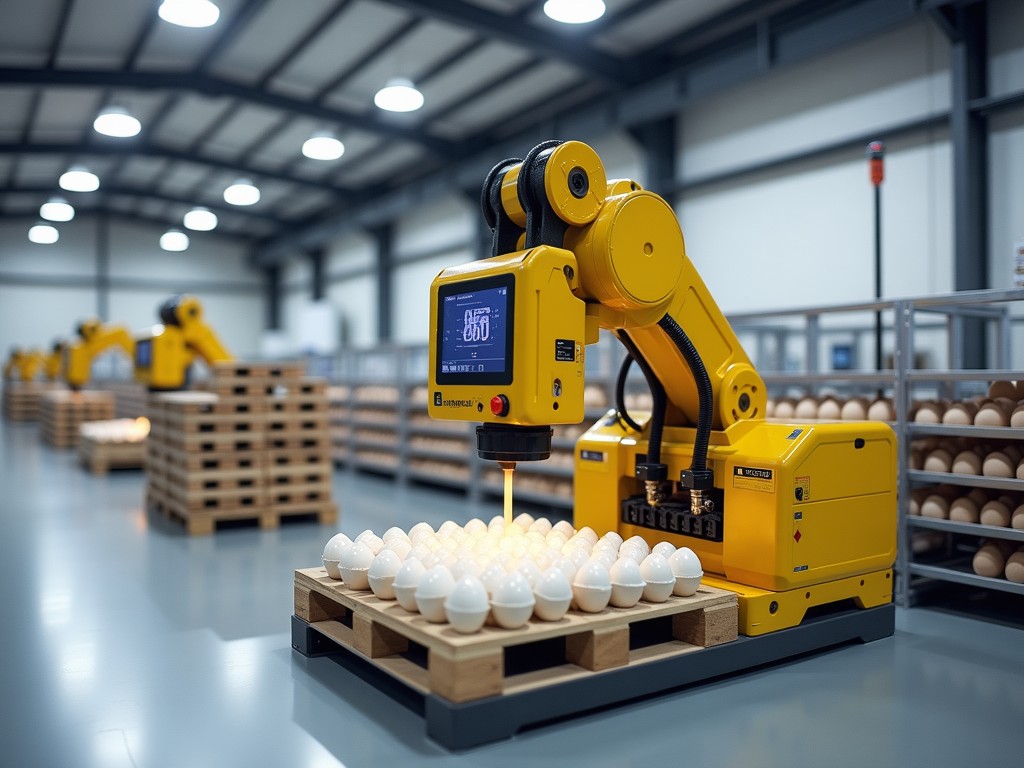
China Automatic Palletizing Robot Supplier
Automatic palletizing robots are articulated systems designed to stack cases, bags, or containers onto pallets with minimal human intervention. Typical models handle payloads from 5 kg to 150 kg, achieve cycle rates of 8–30 pallets per hour depending on product geometry, and provide repeatability within ±0.5 mm. These performance figures are derived from servo‑driven axes and rigid structural design, which together reduce product damage and labor variability.
Technical Specifications
| Parameter | Typical Value | Customizable Range |
|---|---|---|
| Payload Capacity | 50 kg | 5 kg – 150 kg |
| Horizontal Reach | 1800 mm | 1200 mm – 2500 mm |
| Vertical Stroke | 2200 mm | 1500 mm – 3000 mm |
| Cycle Rate (max) | 25 pallets/hour | 8 – 40 pallets/hour |
| Repeatability | ±0.3 mm | ±0.1 mm – ±0.8 mm |
| Power Consumption | 3.5 kW | 2 kW – 6 kW |
| Control Platform | PLC‑based with IEC 61131‑3 | PC‑based, ROS‑compatible |
Design and Construction
The robot frame is fabricated from extruded aluminum profiles with welded gussets, providing a stiffness-to-weight ratio that limits deflection under dynamic loads to less than 0.2 mm per meter of span. All moving axes employ brushless AC servo motors paired with harmonic drive gearboxes, delivering backlash below 3 arc‑minutes. Enclosures meet IP65 standards for dust and water jet protection, enabling operation in wash‑down environments common to food processing lines.
Safety systems include dual-channel emergency stop circuits, safety-rated light curtains, and collaborative speed limiting when operators enter a defined safety zone. These features comply with ISO 10218‑1 and ISO/TS 15066, reducing risk assessment complexity for integrators.
Applications
In beverage bottling plants, the robot handles 2‑liter PET bottles weighing approximately 25 kg each, stacking them in interlocking patterns that improve pallet stability during transit. The high repeatability ensures consistent layer alignment, which reduces stretch‑film usage by up to 15 %.
Pharmaceutical manufacturers use the same platform to palletize sterile trays containing vials; the cleanroom‑compatible stainless‑steel end‑effector option minimizes particle generation, meeting ISO Class 5 requirements.
Consumer goods distributors benefit from quick changeover tooling that switches between case palletizing and bag palletizing in under eight minutes, supporting mixed‑SKU fulfillment centers with fluctuating demand profiles.
Customization Options
- Payload upgrades via reinforced arm segments and higher torque servos.
- End‑effector varieties: vacuum grippers, mechanical clamps, magnetic heads, and custom tooling plates.
- Conveyor integration kits with variable speed drives and sensor interfaces for upstream/downstream synchronization.
- Software modules: pattern editor, pallet vision alignment, and remote diagnostics via OPC UA.
- Safety enclosures: fixed guarding, laser scanners, or collaborative speed‑and‑separation monitoring.
Quality Control and Testing
Each unit undergoes a three‑stage verification process. First, dimensional inspection of critical joints using a coordinate measuring machine ensures positional accuracy within ±0.1 mm. Second, a 100‑hour endurance cycle runs the robot through its full motion profile at 80 % duty cycle, logging motor temperature, vibration, and encoder drift. Third, functional validation checks the pick‑place accuracy with test payloads, confirming that stack height variation remains below 2 mm over 500 cycles.
All welds are inspected via ultrasonic testing, and electrical assemblies receive hip‑pot and insulation resistance tests per IEC 60204‑1. Documentation includes a factory test report, calibration certificate, and CE conformity declaration, which support traceability for auditors and end‑users.
Frequently Asked Questions
- Can the robot’s reach and payload be adjusted for a specific line layout?
- Yes, both reach and payload are scalable; the structural modules and servo sizes are selected based on the required envelope and load profile provided during quotation.
- What information is needed to generate a formal quote?
- Product dimensions, weight, desired pallet pattern, line speed, and any environmental constraints (e.g., wash‑down, explosive atmosphere) are essential for accurate sizing.
- Which end‑effector materials are available for hygienic applications?
- Stainless steel (AISI 304/316), FDA‑approved polymers, and coated aluminum options are offered; surface roughness can be specified to ≤0.8 µm Ra.
- How is the robot protected during overseas shipment?
- Units are secured in custom‑fit wooden crates with foam blocking, desiccant packs, and humidity indicators; the crate meets ISPM‑15 standards for phytosanitary compliance.
- What is the typical lead time from order to delivery?
- Lead time ranges from 8 to 12 weeks for standard configurations; customized designs may extend to 16 weeks, depending on part availability and engineering review.
Get in Touch
To discuss how an automatic palletizing robot can improve throughput and reduce labor costs on your production line, provide your project specifications and we will respond with a detailed feasibility assessment.
Submit an inquiry to start the conversation.



