China Automatic Palletizer Machine Manufacturer
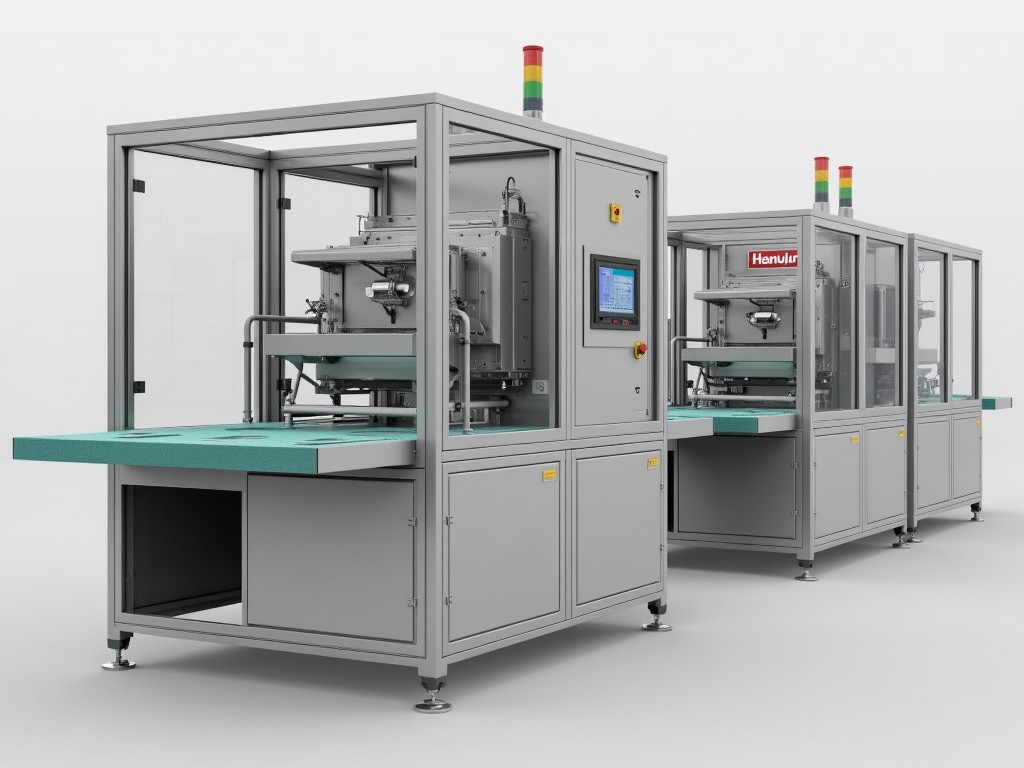
Automatic Palletizer Machine – China Manufacturer
An automatic palletizer stacks goods onto pallets without manual intervention, reducing labor intensity and improving throughput in warehouses and production lines. The machine receives items from a conveyor, orients them according to a predefined pattern, and places them layer by layer onto a pallet until the target load is reached.
Key performance parameters are dictated by the product’s dimensions, weight, and required stack height. For typical secondary packaging (cartons, bags, or trays) the machine handles payloads from 5 kg to 1500 kg per cycle, with cycle times ranging from 6 to 12 seconds depending on layer complexity and pallet size.
Technical Specifications
| Parameter | Typical Value | Notes |
|---|---|---|
| Maximum payload per cycle | 1500 kg | Depends on pallet and load distribution |
| Cycle time (single layer) | 6–12 s | Varies with product orientation complexity |
| Pallet size range | 800 × 1200 mm to 1200 × 1200 mm | Adjustable via mechanical stops |
| Stack height | Up to 2000 mm | Limited by mast reach and stability |
| Power consumption | 3.5 kW (average) | Three‑phase 380 V, 50/60 Hz |
| Control system | PLC (IEC 61131‑3) with HMI touchscreen | Supports recipe storage for multiple SKUs |
| Safety features | Light curtains, emergency stop, overload detection | Complies with ISO 13849‑1 PLd |
All values are typical; exact figures are confirmed during project engineering based on customer‑provided product data and layout constraints.
Typical Applications
In beverage bottling lines, the palletizer receives filled cases from a case sealer and builds stable 1.2 m high stacks onto Euro pallets, enabling direct fork‑lift pickup without intermediate handling.
For bagged agricultural products (fertilizer, seed), the machine handles variable bag weights (10–50 kg) and adjusts layer patterns to prevent shifting during transport, reducing product damage claims.
In e‑commerce fulfillment centers, the palletizer consolidates mixed‑size cartons onto pallets destined for regional distribution centers, improving trailer utilization by up to 18 % compared to manual stacking.
Design Considerations for Integration
Footprint: The machine’s base frame measures 2.2 m × 1.8 m, requiring a minimum clearance of 0.5 m on all sides for maintenance access and safety gate operation.
Infeed height: Standard infeed conveyor height is 900 mm; optional lift modules can raise or lower this to match upstream equipment ranging from 750 mm to 1050 mm.
Electrical interface: The PLC accepts 24 V discrete signals for start/stop and fault acknowledgment; analog speed references can be supplied via 0–10 V or 4–20 mA for synchronization with line speed.
Environmental rating: IP54 enclosure protects against dust and splashing water; for humid or wash‑down environments, an optional IP65 upgrade is available.
Customization Options
- End‑effector tooling: vacuum grippers for cartons, mechanical clamps for bags, or fork‑type heads for trays.
- Pallet magazine: automatic pallet dispenser holding up to 10 pallets, reducing changeover time.
- Load‑cell feedback: real‑time weight monitoring to detect missing items and trigger reject.
- Software: MES‑compatible API for production order dispatch and traceability reporting.
Each option is evaluated against cycle‑time impact, structural load, and cost; the manufacturer provides a feasibility study before finalizing specifications.
Quality Assurance & Testing
Before shipment, each palletizer undergoes a 48‑hour endurance run at 80 % of maximum rated cycle rate, logging motor temperature, vibration amplitude, and positional accuracy.
Positional repeatability is verified using a laser tracker; the standard tolerance is ±2 mm in X/Y axes and ±3 mm in Z axis over 1000 cycles.
Safety circuits are tested per ISO 13849‑1, confirming that the safety‑related control system achieves a PLd rating with a diagnostic coverage of ≥ 95 %.
Documentation includes a factory acceptance test (FAT) report, electrical schematics, and a spare‑parts list with part numbers and recommended stock levels.
Frequently Asked Questions
- Can the machine handle different product sizes without retooling?
Yes, the gripper can be adjusted pneumatically or via servo‑driven jaws to accommodate a range of carton dimensions; changeover typically takes under 15 minutes. - What information is needed for a quotation?
Product dimensions, weight, required stack height, infeed/conveyor speed, and facility layout (available floor space and power supply). - Is on‑site installation and commissioning provided?
The manufacturer supplies a field service team for mechanical installation, electrical hook‑up, and performance validation; the customer provides utilities and access. - How are spare parts managed?
Critical wear items (gripper seals, drive belts, sensor cables) are stocked locally; lead time for standard parts is 7‑10 business days. - What is the typical production lead time?
From order confirmation to factory ready‑to‑ship, the lead time is 10‑12 weeks, depending on selected customizations.
Next Steps
To discuss how an automatic palletizer can be integrated into your specific production line, provide your product specifications and layout details.



