China Automatic Egg Tray Crate Loader
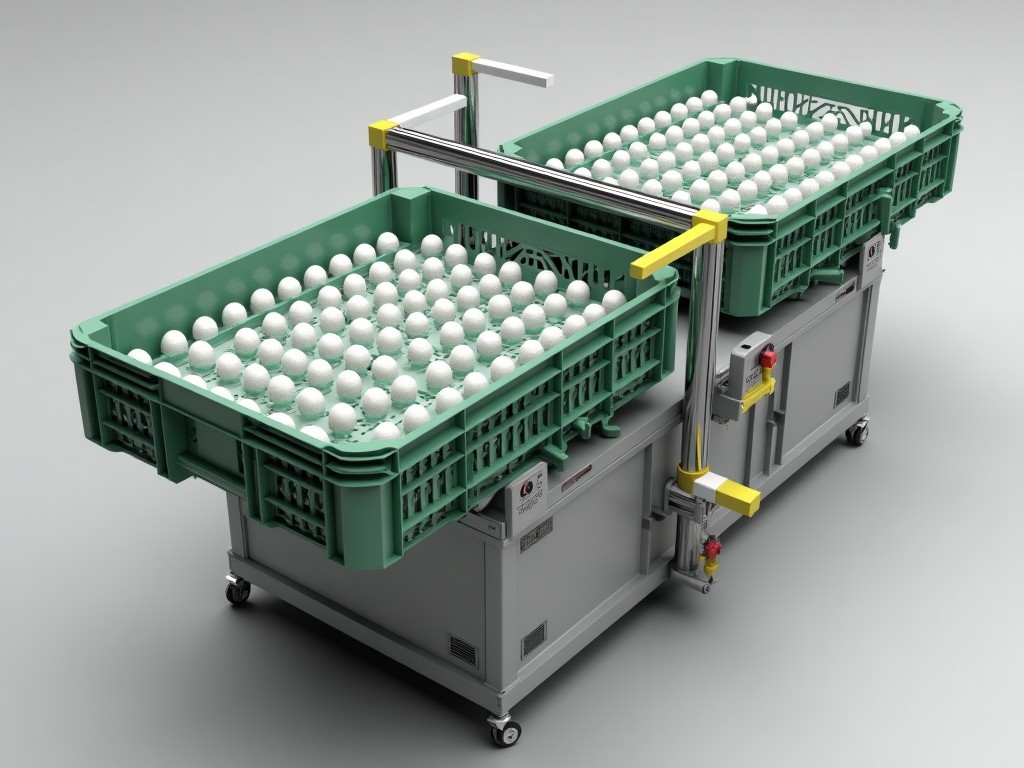
China Automatic Egg Tray Crate Loader
This equipment automates the transfer of formed egg trays into standardized crates for further processing or shipping. It is designed to integrate with egg washing, drying, and grading lines commonly found in large‑scale poultry farms and egg product plants.
Working Principle
Trays exit the forming station onto a synchronized conveyor belt. A vision system detects tray orientation and triggers a pneumatic gripper that lifts each tray and places it into the awaiting crate layer. The crate indexer advances after each layer is filled, ensuring consistent stacking without manual intervention.
All motions are coordinated by a programmable logic controller (PLC) with adjustable timing parameters to accommodate different tray dimensions and crate heights. Safety light curtains and emergency stops protect operators during operation.
Technical Specifications
| Parameter | Typical Value / Customizable |
|---|---|
| Maximum tray throughput | Up to 120 trays per minute (adjustable) |
| Power supply | 380 V ± 10 %, 3‑phase, 50/60 Hz |
| Control system | PLC with HMI touchscreen (optional remote monitoring) |
| Conveyor speed | 0.1 – 0.5 m/s (variable frequency drive) |
| Overall dimensions (L×W×H) | 2500 mm × 1200 mm × 1800 mm (customizable) |
| Frame material | Powder‑coated carbon steel (stainless steel option) |
| Motor type | Servo‑driven axes for gripper and indexer |
| Net weight | Approx. 850 kg (varies with options) |
Key Features
- Modular frame allows quick relocation or line reconfiguration
- Adjustable gripper jaws accommodate tray widths from 300 mm to 450 mm
- PLC logic includes recipe storage for multiple product sizes
- Energy‑efficient servo drives reduce power consumption by up to 20 % compared with pneumatic‑only systems
- Low‑maintenance design with sealed bearings and easily accessible wear parts
Applications
In egg processing facilities, manual crate filling creates bottlenecks and introduces variability in stack height, which can cause instability during transport. By automating this step, the loader ensures uniform layer alignment, reduces labor dependency, and maintains line speed upstream of packing or palletizing stations.
The equipment is also suitable for hatcheries that transfer trays to incubation crates, where consistent positioning affects airflow and temperature distribution. Integration with upstream washing or drying modules helps maintain hygiene standards by minimizing human contact with the product.
Customization Options
- Tray size adapters for non‑standard dimensions
- Crate type converters (e.g., vented vs. solid walls)
- Integration kits for existing conveyor heights and speeds
- Software interfaces for MES or ERP data exchange
- Additional safety guarding or light curtain configurations
Quality Control and Testing
Before shipment, each unit undergoes a factory acceptance test that includes a 24‑hour continuous run at rated throughput, verification of placement accuracy within ±5 mm, and validation of all safety interlocks. Frame components are inspected for weld integrity and coating thickness according to ISO 12944‑5 standards.
Material certificates for steel and electrical parts are provided upon request. Critical moving parts are lubricated with food‑grade grease where applicable, and the final assembly is cleaned and dried to meet the cleanliness requirements of food‑processing environments.
Frequently Asked Questions
Can the machine dimensions be modified to fit an existing line layout?
Yes. The frame length, width, and height can be adjusted within standard structural limits. Detailed layout drawings are required to confirm feasibility and any needed foundation modifications.
What information is needed to prepare a quotation?
Required data include tray dimensions (length, width, height), crate specifications, desired throughput (trays per hour), line elevation, power supply details, and any integration constraints such as existing conveyor speed or height.
How is after‑sales support handled?
Support includes remote diagnostics via the HMI, spare‑part catalogs with lead times, and optional on‑site service contracts. Training for operators and maintenance personnel is provided during commissioning.
Next Steps
To discuss your specific requirements or request a detailed proposal, please contact our technical sales team.



